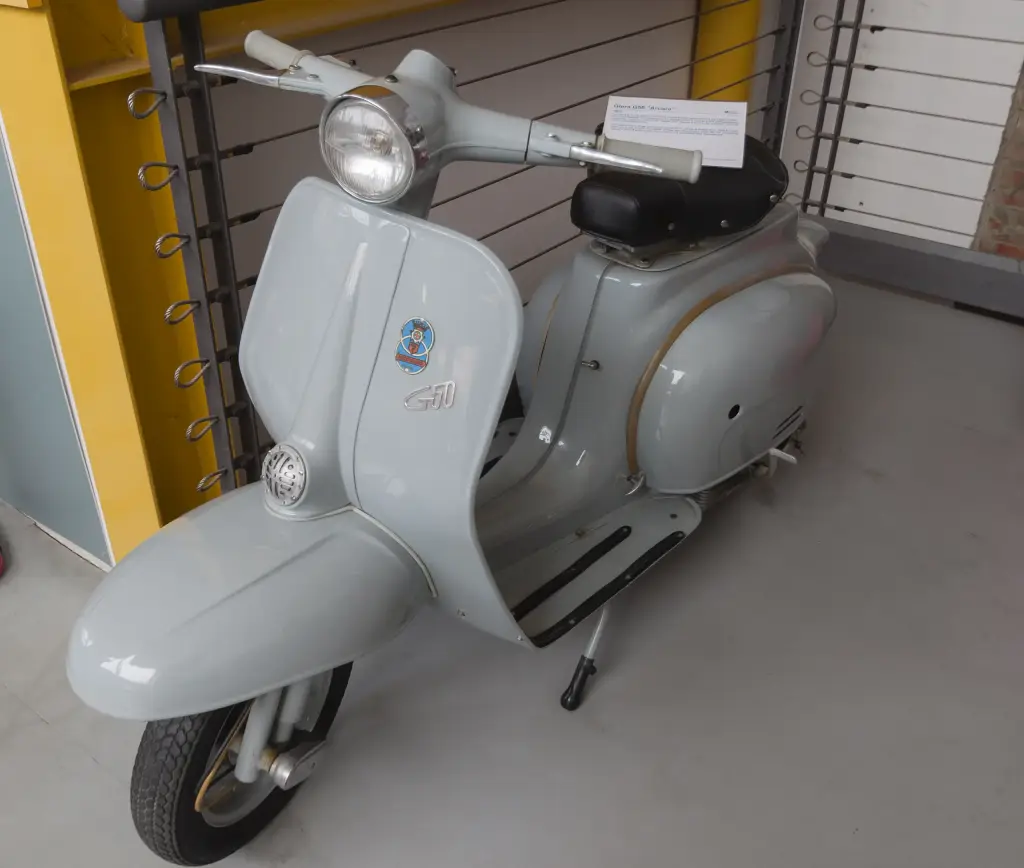
The Gilera G was a family of small scooters produced from 1962 to 1968 in three forms: the G50, the export G50 T and the G80. It was Gilera’s attempt to build a moped around a four-stroke engine and very low running costs, at a time when buyers were turning to cheap and fast two-strokes.
Gilera G at a glance
| Maker | Gilera, Arcore (Milan) |
|---|---|
| Production | 1962–1968 |
| Models | G50, G50 T, G80 |
| Engine | four-stroke Otto cycle |
| Gearbox | three speeds |
| Final drive | without chain |
| Frame | load-bearing body, in the manner of the Vespa |
| Claimed consumption | 1.1 litres per 100 km |
| G50 T | 2.3 hp, 60 km/h, registered as a motorcycle |
| G80 | 76.4 cm³, with room for a passenger, almost 3,000 built |
based on one source (Italian Wikipedia).
History of the Gilera G
A new kind of moped
In 1959 the new Italian highway code created the moped as a motor vehicle without a plate that could be ridden without a driving licence, and at the same time abolished the pedals required on the earlier “cycles with auxiliary motor”. The law set limits on capacity, power, speed and weight, in theory pushing manufacturers to compete on running costs and comfort rather than speed.
Those ideas were the basis for Gilera’s decision to build a scooter with a four-stroke engine, within the legal power limit and with very low consumption. Giuseppe Gilera’s expectations turned out to be wrong: even in this utilitarian class buyers compared performance, and preferred two-stroke mopeds that could be tuned to much higher power at little cost.
The G50
Gilera put its originality into the engine and its economy. The small four-stroke had a final drive without a chain and a three-speed gearbox. The chassis was a load-bearing body of the kind used by the Vespa, although Piaggio would present the Vespa 50 only the following year.
Despite a claimed consumption of 1.1 litres of petrol per 100 km, the Arcore scooter was received coolly by the market and never reached significant production volumes. The first series of 1962 is recognised by its original cantilever wheels of the split type, a single seat and a curved front suspension mounted from above.
G50 T and G80
For foreign markets Gilera built the G50 T with 2.3 hp and a top speed of 60 km/h. That version was approved in Italy as a motorcycle and had a stop light, because its performance was above the 40 km/h limit the highway code of the time set for mopeds.
In 1963 the G50 was joined by the G80, with capacity increased to 76.4 cm³ and room to carry a passenger. Almost 3,000 were built up to 1968. The engine of the G50 was also used in the Cadet moped, and Gilera returned to scooters only in 1982 with the GSA.
Design and features
- Four-stroke engine in a moped: the technical bet that defined the range.
- Chainless final drive: one of the novelties of the G50.
- Load-bearing body: a Vespa-style chassis, a year before the Vespa 50.
- Claimed 1.1 l/100 km: economy was the selling point, not speed.
- Cantilever split wheels: a distinctive feature of the 1962 first series.
Gilera G versions
- G50 (1962): the original moped, with a single seat and curved front suspension.
- G50 T: the export version, 2.3 hp, 60 km/h, registered as a motorcycle in Italy.
- G80 (1963–1968): 76.4 cm³, able to carry a passenger, almost 3,000 built.
The later small Gilera mopeds are the CBA and the Città, and the four-stroke tradition behind this scooter is described with the 125-150-175. More models are in the Gilera collection.
Video: Gilera g50
Video by andreaabarth1 on YouTube.
Sources
- Gilera G, Italian Wikipedia: production years, models, engine, chassis, consumption, G50 T and G80