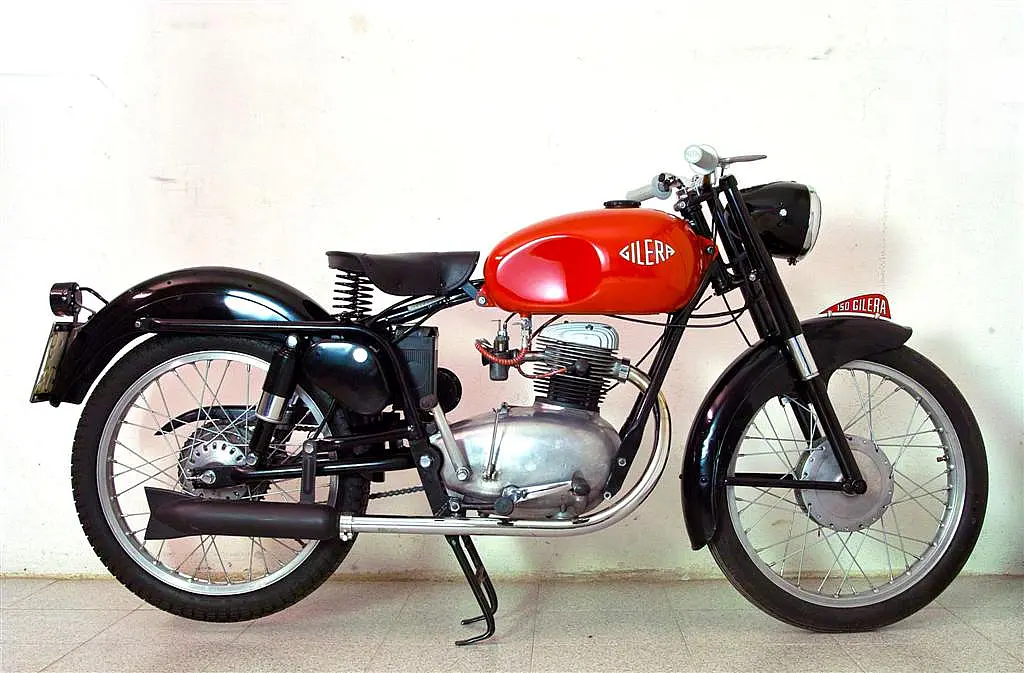
The Gilera 125-150-175 was a family of four-stroke lightweights built at Arcore between 1949 and 1960. The 125 was the company’s first attempt at a cheap mass-market motorcycle, and its engine was born out of a long argument between the owner and his technical director.
Gilera 125-150-175 at a glance
| Maker | Gilera, Arcore (Milan) |
|---|---|
| Production | 1949–1960 |
| Types | 125, 150 and 175 cm³ four-stroke singles |
| First prototype | Milan show, 1948: 3.5 hp, 70 km/h |
| 125 launched | 22 March 1949: 4.7 hp, 80 km/h |
| Series | six of the 125, ending in July 1952 |
| Sport (1951) | 13-litre tank, 7 hp, 90 km/h |
| 125 built | about 25,000 |
| Engine designer | Piero Remor, with Giuseppe Gilera |
| Reason for the 150 | new Italian law taxing 125s and reserving motorways for 150s |
based on one source (Italian Wikipedia); the article source is cut off in the section on the 1955 Export, so nothing beyond that point is used.
History of the Gilera 125-150-175
After the war
Motorised two-wheelers spread quickly after the Second World War, and Italian manufacturers rushed to offer cheap transport. Gilera had chosen to return with the Nettuno and the Saturno, larger machines presented in 1946, and Giuseppe Gilera soon realised they did not suit the market. He asked the engineer Piero Remor to study an economical model, but with a four-stroke engine rather than the two-strokes that dominated the class.
Two men, one engine
Remor and Gilera agreed only on the idea of a cheap 125 with a four-stroke engine. Remor, the father of the four-cylinder engine that would dominate racing for decades, wanted overhead valves; Gilera, loyal to the traditions of the factory, preferred proven and cheap side valves. After long discussions Remor gave way and designed a side-valve engine.
The prototype shown at the Milan show in 1948 had a clean, simple line but was received coolly by the public, the dealers and the press: its old-fashioned engine produced 3.5 hp and gave 70 km/h. Moving to overhead valves caused another clash, this time over whether to redesign the engine completely, as Remor wanted, or modify the existing one, as the owner insisted. Gilera won again, which is why the new engine has its pushrods and camshaft in the unusual position in front of the cylinder: they could not be placed behind it without rebuilding the crankcase. The atmosphere between owner and technical director became so tense that at the end of 1949 Remor left Arcore for MV Agusta, taking his assistants Andrea and Arturo Magni with him.
The 125
The new Gilera 125 was presented to the press and dealers on 22 March 1949 and, despite its difficult birth, was immediately well received. For a price close to that of two-stroke rivals, buyers got a machine from a great marque with 4.7 hp and 80 km/h, a four-stroke engine that used very little fuel and stood up to long use, even if the finish was slightly below that of the two-stroke competition.
The first series went into production in September 1949, and the main problem was that too few were being built: many orders were still open when the second series arrived in December 1949 with small improvements and trailing-link shock absorbers. Working flat out, the factory could not build more than 500 machines a month. The third series began in June 1950 with 5 hp, improved valve gear and new valve seats; in January and February 1951 production stopped while Giuseppe Gilera’s new assembly carousels were installed. Work resumed in March with the fourth series, the “Turismo”, which had a larger oil sump and finally bronze big-end bearings instead of rollers. The carousels, at full speed, turned out a thousand engines a month.
In April 1951 the fifth series, the “Sport”, joined it with a 13-litre tank, 7 hp and 90 km/h at unchanged consumption. A sixth series with small changes ran from February to July 1952.
Why the 150 replaced it
A new Italian law required 125s to be registered and reserved motorway access to motorcycles of at least 150 cm³. That ended the 125 after about 25,000 examples in all series and versions, and the model was replaced by the 150. In 1955 Gilera put a 125 back on the market, derived from the 150 and called the “Export” because it was intended for foreign markets.
The bigger brothers
The 150 of 1952 became the base of the range and its cylinder was later doubled to create the twin of the B300. The 175 appeared in the mid-1950s and was also offered in off-road form, as the 175 5V RC of the 124 Regolarità family.
Design and features
- Four-stroke engine in a cheap class: the whole point of the project, against the two-stroke orthodoxy of 1949.
- Unusual valve gear: pushrods and camshaft in front of the cylinder, the result of Gilera’s refusal to redesign the crankcase.
- Thrifty and durable: minimal fuel consumption and good resistance to prolonged use.
- Continuous development: six series of the 125 in three years, from 4.7 to 7 hp.
- Modern production: Gilera’s assembly carousels raised output to a thousand engines a month.
Gilera 125-150-175 versions
- 125 (1949–1952): six series, 4.7 to 7 hp.
- 125 Turismo (1951): fourth series with a larger oil sump and bronze big-end bearings.
- 125 Sport (1951): 13-litre tank, 7 hp, 90 km/h.
- 150 (from 1952): the replacement model, built to clear the new 150 cm³ threshold.
- 125 Export (1955): a 125 derived from the 150 for export markets.
- 175: the largest of the family, also sold in off-road trim.
The off-road derivative is described in the article on the 124 5V Regolarità Casa, and the twin built from two 150 cylinders is the B300. More models are in the Gilera collection.
Video: GOPRO GILERA 150 SPORT 1961
Video by leonardo gonzalez on YouTube.
Sources
- Gilera 125-150-175, Italian Wikipedia: design history, series, production figures, the 150 and Export