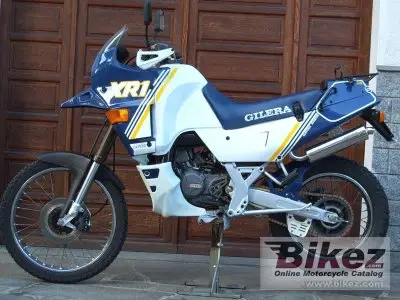
The Gilera XR1 was a 125 cm³ enduro of the “African” kind built in 1988 and 1989 and drawn by the Italian designer Luciano Marabese. Its extended bodywork, with a beak under twin round headlights, was shaped for aerodynamic downforce at high speed.
Gilera XR1 at a glance
| Maker | Gilera, Arcore (Milan) |
|---|---|
| Production | 1988–1989 |
| Designer | Luciano Marabese |
| Engine | 125 cm³ two-stroke, liquid-cooled |
| Engine code | tipo 149 |
| Frame | double cradle, code 150 |
| Valve system | APTS 2, opening from about 6,000 rpm |
| Fuel tank | about 23 litres, 2.5 reserve |
| Oil tank | 1.9 litres in the tail |
| Front suspension | Paioli upside-down fork, 38 mm |
| Type approval | 23 March 1988 |
| Replaced by | XR2 in 1990 |
based on one source (Italian Wikipedia). The Commons search found no free photograph of the XR1, so the article keeps the photo already attached to the record.
History of the Gilera XR1
An “African” 125
The XR1 was a motorcycle of the enduro-africana school produced in 1988 and 1989 and designed by Luciano Marabese. It was also available with electric starting and had an oil mixer, was built only as a 125 cm³ and was replaced in 1990 by the XR2.
Bodywork
The bike was very distinctive in line, with extended bodywork whose front carried a “beak” below the twin headlights to give effective aerodynamic downforce at high speed. The double cradle frame stayed hidden, protected at the sides by plastic covers with mouldings styled to imitate an aluminium frame. The engine was left on view, and the bodywork was strongly shaped around the rider’s legs to make the riding position as protected and comfortable as possible.
The screen had a clean, flowing line and housed the twin round headlights typical of the 1980s. The mirrors were simple square Vitaloni units. The side panels had a large opening to let out the hot air from the single radiator, mounted under the steering head. The indicators were clearly visible and set flush into the side panels. The seat was a long one-piece shared by rider and passenger and fastened by two quick-release hooks. The tail light was a single unit but split visually by a bodywork bar extending beyond the seat, and the tail also held the 1.9-litre oil tank of the mixer and carried a useful luggage rack with a helmet holder. The fuel tap sat on the right of the bike, and the lower front of the machine had a “toe” acting as a fairing for the frame cradle, carrying the small coolant expansion tank on its right side. With the seat removed, the tail left space for a small storage compartment.
Chassis and engine
A 28 mm Dell’Orto carburettor was fed by gravity from the large tank of about 23 litres, of which 2.5 were reserve. The forks were Paioli upside-down telescopic units with 38 mm stanchions, the swingarm was a twin-arm type with a monoshock adjustable only in spring preload and progressive linkage, and the exhaust ended under the tail on the left in a single stainless steel silencer. The wheels were in chromed steel.
The liquid-cooled engine was an evolution of the unit fitted to the Gilera KK 125, with reed induction in the cylinder, and used a developed version of the APTS (Automatic Power Tuning System) called APTS 2. The system combined a cylindrical exhaust valve in the cylinder casting, moved centrifugally, with a resonance chamber at the top of the cylinder head. A centrifugal device with a contrast spring drove a geared pin in the left crankcase and then a linkage; the valve began to open at about 6,000 rpm, gradually opening the exhaust port, and at the same time closed the duct to the resonance chamber, finishing around 7,500 rpm. That raised power considerably and made the engine smoother.
The XR1 was type-approved by the Italian Ministry of Transport on 23 March 1988 under certificate 52488 OM. The engine was called “tipo 149” and the frame “n°150”; the engine was identical in every detail, including carburation settings, to the one fitted to the 1989 XR2.
Design and features
- Beak under the headlights: aerodynamic downforce in the fashion of the African enduros.
- APTS 2 exhaust valve: a cylindrical valve and resonance chamber working from 6,000 to 7,500 rpm.
- 23-litre tank: long range, with a separate 1.9-litre oil tank in the tail.
- Paioli upside-down fork: 38 mm stanchions, with a progressive monoshock at the rear.
- Plastic-covered frame: side panels moulded to imitate an aluminium chassis.
Gilera XR1 versions
- XR1 (1988–1989): the standard model, also available with electric starting.
- XR2 (1989–1990): the successor, with the same engine in every detail.
The small Gilera off-road bikes of the same period are described with the RC family, and the road moped of those years is the CBA. More models are in the Gilera collection.
Video: gilera xr1 125
Video by MrRobber2000 on YouTube.
Sources
- Gilera XR1, Italian Wikipedia: production years, design, bodywork, chassis, APTS 2, type approval