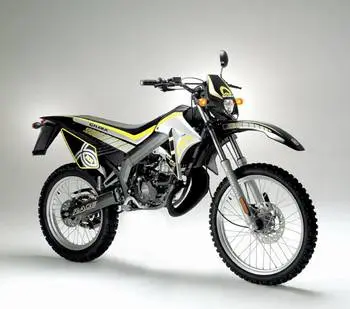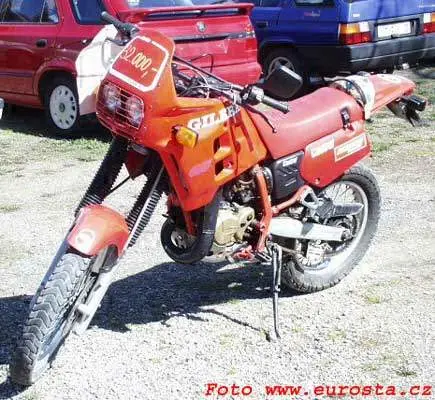
The Gilera RC took its name from regolarità casa, a term the company had used before, and was produced from 1989 to 1994 in several capacities and versions. The original prototype was a 600, and the range later included 125 and 50 cm³ versions, both called “top rally”.
Gilera RC at a glance
| Maker | Gilera, Arcore (Milan) |
|---|---|
| Production | 1989–1994 |
| Presented | 1988 |
| Design | Luciano Marabese |
| Engine | four-stroke single, four valves, toothed belt |
| Capacity | 600 cm³ (558 cm³ in the XRT 600) |
| Power | 48 hp at 7,250 rpm |
| Carburettors | two 28 mm Teikei |
| Frame | split rectangular single beam enclosing the engine |
| Front suspension | Marzocchi 40 mm, 240 mm travel |
| Rear suspension | Power-drive monoshock, 260 mm travel |
| Wheels | 21-inch front, 17-inch rear |
| Price in 1990 | 7,985,000 lire |
based on one source (Italian Wikipedia).
History of the Gilera RC
The design
The line of the RC was drawn by Luciano Marabese and his studio, who were also working for Arcore at the time. The engine had a complex history: it was an evolution of the car-derived twin-four already fitted to the earlier Dakota 350 of 1986 and Dakota 500, a four-stroke single with four valves per cylinder designed years before by Cesare Bossaglia and finished, after his death, by the company’s technical staff under Lucio Masut with Bruno Grana and Alessandro Colombo.
It was a four-valve engine with toothed belt drive, liquid cooling and three-way thermostat-controlled mixing, with a double radiator and electric fans. In 1988 it was fitted to the XRT 350 and, enlarged to 558 cm³, to the XRT 600; the RC 600 engine was modified further. When the bike was presented, power was 48 hp at 7,250 rpm, produced through two Japanese Teikei carburettors with 28 mm chokes sharing a single float chamber.
The completely new frame was a split rectangular single beam that enclosed the engine, with a rear subframe of round tubes bolted to the main structure. Front suspension was a Marzocchi fork with 40 mm stanchions and 240 mm of travel; at the rear Gilera chose a Power-drive monoshock with 260 mm of travel. Brakes were a 260 mm front disc with a Brembo caliper and a single 220 mm rear disc, and the aluminium wheels measured 1.85×21 in front and 2.50×17 at the rear. The gearbox had five speeds with straight-cut gears.
1989–1990
The first machines left the assembly lines at the beginning of 1989 and were all red. During 1990 the bike was slightly improved to correct some early faults: the colour range, until then red with a red frame, was widened to blue and black with grey frames, a rev counter was added to the instruments, the original carburettors were replaced by a new generation of Teikei units, and the generator, the exhaust camshaft timing and the con-rod materials were revised. The road price was 7,985,000 lire, and a “pronto gara” version without electric starting was also offered.
1991–1993: Cobra and RC-R
The 1990 version was built in few examples, because during the year Gilera announced a restyling and buyers waited for the 1991 range. In 1991 the company ended production of both the first and the second type of RC 600 and split the model in two: the RC 600-C, or Cobra, intended for more amateur use, and the RC 600-R, aimed more at off-road riding.
The Cobra’s frame was largely redesigned for touring, with new 43 mm Kayaba forks and 30 mm carburettors, and the whole structure was more enveloping and slimmer than the RC of 1989 and 1990. The R had forks with 46 mm stanchions and a rear wheel of 18 inches instead of the 17 of the RC and the Cobra, with a reinforced frame for the harder use it was meant for.
Smaller capacities and the end
Besides the 600, the range included 125 and 50 cm³ versions, both called “top rally”, and a 750 cm³ development was raced in the Paris–Dakar rallies of the early 1990s. Production was at the via Cesare Battisti works in Arcore; when that closed in 1993, machines already assembled were finished at Piaggio’s Pontedera plant, which carried the model to the end of its commercial life.
Design and features
- Car-derived four-valve single: developed from the engine of the earlier Dakota.
- Marabese styling: a distinctive trail bike line by Luciano Marabese’s studio.
- Serious chassis: split rectangular beam frame, 40 mm Marzocchi fork, 21-inch front wheel.
- Power-drive monoshock: 260 mm of rear wheel travel.
- Two characters from 1991: the touring Cobra and the off-road RC-R.
Gilera RC versions
- RC 600 (1989–1990): the original red bike, then red, blue and black.
- Pronto gara: a version without electric starting.
- RC 600-C Cobra (1991): touring version with 43 mm Kayaba forks.
- RC 600-R (1991): off-road version with 46 mm forks and an 18-inch rear wheel.
- RC 125 and RC 50 top rally: the smaller-capacity versions.
The engine came from the Dakota, the supermotard derivative is the Nordwest, and the road single that followed is the Saturno. More models are in the Gilera collection.
Video: Gilera Rc 125 Top Rally
Video by Raptor1000v on YouTube.
Sources
- Gilera RC, Italian Wikipedia: engine, chassis, model years, versions, the Dakar development