The Gilera GFR 250, Gilera Formula Racing, was the machine with which the company returned to the 250 cm³ class of the motorcycle world championship in 1992. It was built by a new racing department at Velate, near Arcore, with an ambitious budget and a list of exotic materials.
Gilera GFR 250 at a glance
| Builder | Gilera, racing department at Velate |
|---|---|
| Debut | 1992, 250 cc world championship |
| Engine | 75-degree V-twin, two-stroke |
| Induction | six-petal reed valve |
| Power 1992 | over 86.5 hp at 12,750 rpm |
| Power 1993 | over 94 hp at 12,800 rpm |
| Carburettors | Dell’Orto 40 mm flat slide |
| Engine weight | 23 kg |
| Frame | aluminium alloy, 10 kg |
| Dry weight | 95 kg |
| Gearbox | six speeds, extractable |
| Brakes | 290 mm steel and 272 mm carbon front discs |
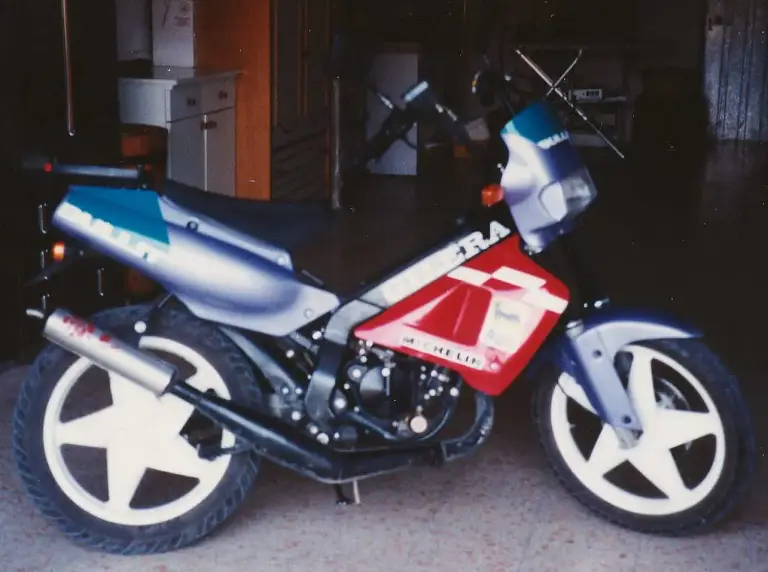
The Commons search found no free photograph of the GFR 250, so the article keeps the photo already attached to the record. The video attached to the record shows other Gilera racing machines, so no video is embedded.
History of the Gilera GFR 250
The announcement
The return had been discussed for some time, and on 21 February 1991 came the announcement: Gilera’s return to the world championship was to be the flagship of the Piaggio group, confirming the brand’s role among the world leaders and giving production bikes the benefit of racing. The 250 class was chosen because it was the most competitive, with the aim of private testing in 1991, a few Grands Prix in 1992 and victories in 1993, on a budget of seven billion lire for 1991.
At the top of the programme was the engineer Masut, head of project planning and a former Gilera technical director, with the engineer Federico Martini, formerly of Bimota and Ducati. The base was a new racing department at Velate, a few kilometres from Arcore, equipped with computer design tools such as CAD.
The engine
The 250’s engine was a 75-degree V-twin with a balance shaft, a six-petal reed valve and exhaust power valves controlled by the digital CDI ignition unit. The 75-degree V allowed a very light crankshaft, carried on three main bearings, four from 1993, in ceramic ball bearings. Maximum power was the highest in the class: over 86.5 hp at 12,750 rpm in 1992 and over 94 hp at 12,800 rpm in 1993.
The carburettors were 40 mm flat-slide Dell’Ortos, the cylinders had seven transfer ports and three exhaust ports, and the engine weighed 23 kg. The balance shaft was titanium, the dry multi-plate clutch was titanium and aluminium, and the con-rods, crankshaft and six-speed extractable gearbox were in steel re-melted under vacuum.
Chassis
The aluminium alloy frame weighed 10 kg and allowed the position of the swingarm pivot to be adjusted. The brakes used two front discs, a 290 mm steel one and a 272 mm carbon fibre one, with a 190 mm cast iron disc at the rear. Suspension was a Kayaba fork adjustable in compression, rebound and spring preload, with titanium springs, and at the rear a progressive Power-drive system with a Kayaba shock adjustable in compression and rebound, again with a titanium spring. The Marchesini magnesium wheels were 3.50×17 in front and 5.25×17 at the rear, the bodywork was kevlar and carbon fibre, and dry weight was 95 kg.
The 1993 season
For 1993 the engine was refined by the Austrian engineer Harald Bartol, who designed an engine with vertical opposed cylinders, called a boxer in the source, of 95 hp with electronic injection to cure the fuelling problems that had troubled the team all through the previous championship and contributed to many retirements.
Gilera had signed Alessandro Gramigni, the outgoing 125 world champion with Aprilia, but although performance matched the opposition, and was often better in power, acceleration and top speed, the 1993 season became an ordeal because of insufficient reliability, especially in fuelling, probably caused by development and testing that were too quick. Casoli and Gramigni retired in Malaysia after the sighting lap, and an injury to Casoli made the season worse, although the arrival of Bartol brought technical improvement and first points at mid-season. Logistical and technical problems continued, and a road accident involving a group of mechanics travelling to Brno for the Czech Grand Prix killed two of them; the team withdrew from the event in mourning and a few weeks later announced it was leaving the championship, a sad prelude to the closure of the historic Arcore factory.
A road-going replica of the racer was later produced as the Gilera GFR 125.
Design and features
- 75-degree V-twin: a very light crankshaft on ceramic ball bearings.
- Class-leading power: over 86.5 hp in 1992 and over 94 hp in 1993.
- Exotic materials: titanium balance shaft and clutch, vacuum re-melted steel internals.
- Carbon front disc: a 272 mm carbon fibre disc alongside a 290 mm steel one.
- 95 kg dry: with kevlar and carbon fibre bodywork.
Gilera GFR 250 versions
- GFR 250 (1992): the original 86.5 hp engine.
- 1993 engine: refined by Harald Bartol, 95 hp with electronic injection.
- GFR 125: the road-going replica produced afterwards.
The single-cylinder Gilera racers of the same period are described with the RC 600, and the road-going replica is the GFR 125. More models are in the Gilera collection.
Sources
- Gilera GFR 250, Italian Wikipedia: programme, engine and chassis specification, 1993 season
- Gilera GFR 250, English Wikipedia: debut in the 1992 250 cc world championship