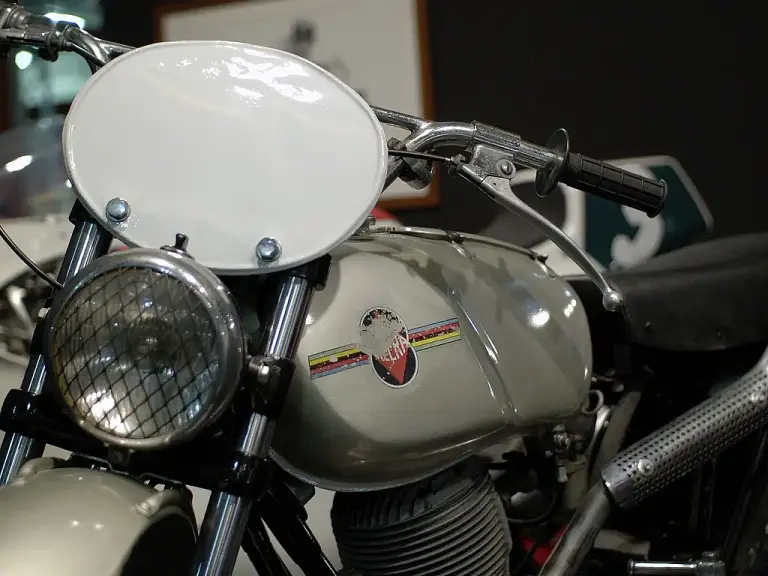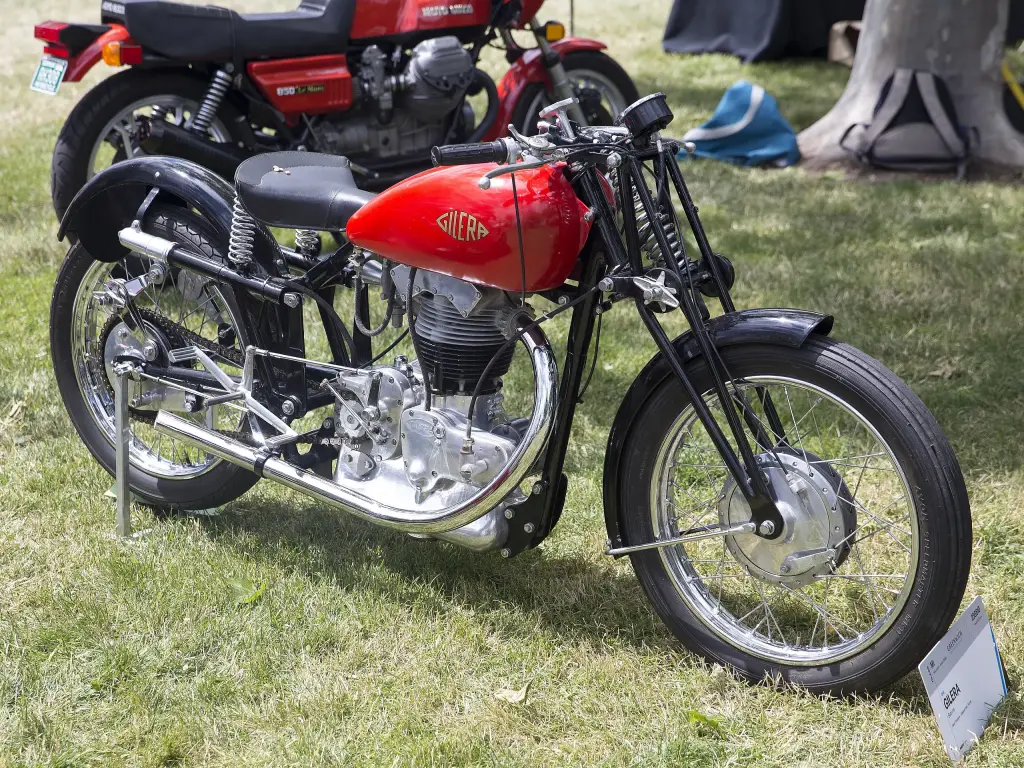
The Gilera Saturno was a 500 cm³ four-stroke single built from 1946 to 1958 and designed by Luigi Salmaggi at the end of the 1930s. It was presented at the Milan show of 1940 as the heir of the Otto Bulloni, and after the war it carried the Arcore factory as its flagship model.
Gilera Saturno at a glance
| Maker | Gilera, Arcore (Milan) |
|---|---|
| Designer | Luigi Salmaggi |
| Presented | Milan show, 1940 |
| Production | 1946–1958 |
| Engine | four-stroke single, pushrods, 500 cm³ |
| Bore and stroke | 84 x 90 mm |
| Gearbox | four speeds, pedal change |
| Frame | open single cradle in steel tubes |
| Front suspension | parallelogram fork, telescopic from 1951 |
| Rear suspension | plunger springs with friction dampers; swinging arm from 1952 |
| Versions | Turismo, Sport, Competizione, Corsa, Cross, Regolarità |
| Built | about 6,000, of which 1,250 in the final chassis |
based on one source (Italian Wikipedia).
History of the Gilera Saturno
Designed before the war
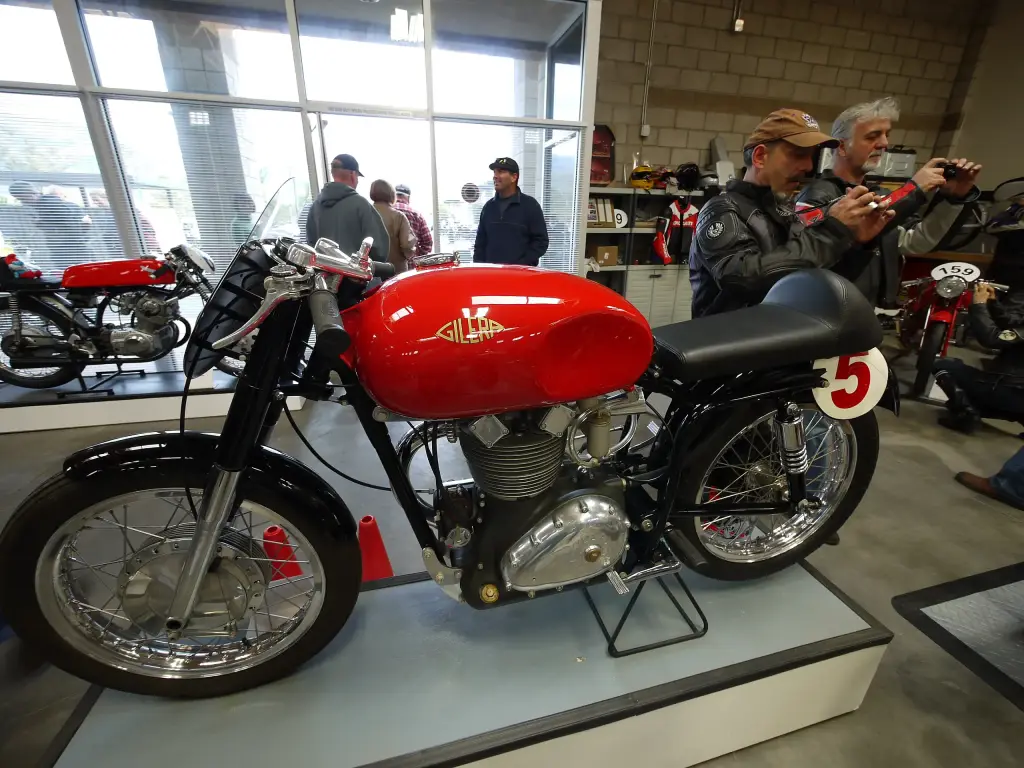
The Saturno was designed by Luigi Salmaggi at the end of the 1930s and presented at the Milan show of 1940 as the successor of the Otto Bulloni. It was a four-stroke 500 single, but the Second World War postponed series production until 1946; only six “Tipo Competizione” machines were built before the war broke out.
The technique
The engine was the classic Gilera pushrod single of 500 cm³, with the company’s usual half-litre bore and stroke of 84 by 90 mm. The frame was an open single cradle in steel tubes, the fork a parallelogram type, and at the rear there were springs inside ferrules on each side of the wheel assisted by friction dampers, a system Gilera had used since the mid-1930s. The gearbox had four speeds with a pedal change.
Four versions were offered: Turismo, Sport, Competizione and Corsa. In 1953 the Cross and Regolarità versions were added, for disciplines that were spreading in Italy at the time. The main difference between Sport and Turismo was the cylinder head, aluminium on the former and cast iron on the latter. For the reborn Italian Army, the police and the Guardia di Finanza, Gilera built dedicated military versions, which differed from the civilian bikes in their grey-green paint instead of black with a red tank and in various mechanical changes such as a lower compression ratio and different gearbox ratios.
Chassis development
The Saturno stayed almost unchanged until 1951, when a telescopic fork was adopted at the front. The following year the rear suspension was also redesigned, with a more modern swinging arm, two telescopic shock absorbers and a cush drive in the hub. In this final configuration the Saturno was built until 1958 in 1,250 examples out of about 6,000 made in total, most of them Turismo and Sport, including 300 Competizione, 60 Corsa, 18 Cross and only 2 Regolarità. An unspecified number of Turismo machines intended for registration as sidecar outfits received an engine enlarged to 600 cm³ by lengthening the stroke to 105 mm.
Piuma and the end
In 1952 Gilera presented a racing version for private riders, with a twin-cam engine and much lightened, which became famous as the “Piuma”; 110 were built.
Production of the Saturno ended for two reasons: the 500s on sale in Italy, the Gilera and the Moto Guzzi Falcone, were by then out of date in technique and performance, and the economic boom let almost anyone buy a far more comfortable car. The flagship role of the Arcore factory passed to the smaller 300 twin, already in the catalogue since 1953. A Gilera single of about half a litre returned only in 1985 with the enduro Dakota, followed in 1988 by a “new Saturno” that had very little in common with its namesake of forty years before.
Design and features
- Pushrod 500 single: 84 by 90 mm, the classic Gilera half-litre dimensions.
- Six versions: Turismo, Sport, Competizione, Corsa, Cross and Regolarità.
- Military models: built for the Italian Army, police and Guardia di Finanza in grey-green.
- Modernised chassis: telescopic fork in 1951 and swinging arm in 1952.
- Piuma racer: a twin-cam, lightened machine for private riders, 110 built.
Gilera Saturno versions
- Turismo: cast iron cylinder head, the touring model.
- Sport: aluminium cylinder head.
- Competizione and Corsa: the racing versions, 300 and 60 built.
- Cross and Regolarità (1953): off-road versions, 18 and 2 built.
- Military: versions for the Army, police and Guardia di Finanza.
- 600 for sidecars: Turismo machines with a longer stroke for outfit use.
- Piuma (1952): twin-cam racer for private riders, 110 built.
The Saturno’s successor as flagship was the twin-cylinder B300, and its half-litre single tradition returned with the Dakota and the 1988 RC family. More models are in the Gilera collection.
Video: Gilera SATURNO
Video by neroalfa155 on YouTube.
Sources
- Gilera Saturno, Italian Wikipedia: design, engine and chassis, versions, production figures, Piuma, end of production