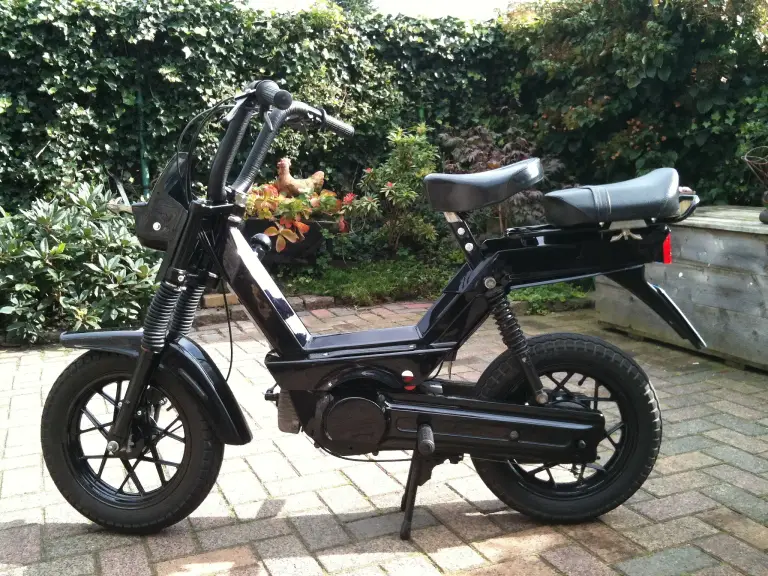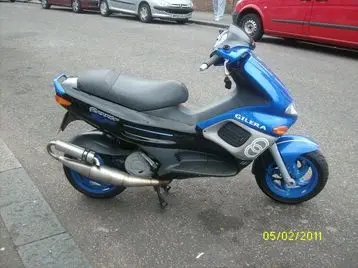
The Gilera CBA was a moped built from 1977 to 1989, its name standing for ciclomotore bitubo automatico, automatic twin-tube moped. It shared its engine and transmission with the Piaggio Ciao, Sì, Boxer and Bravo, and in North America it was sold as the Piaggio Vespa Grande.
Gilera CBA at a glance
| Maker | Gilera, in the Piaggio group |
|---|---|
| Production | 1977–1989 |
| Name | Ciclomotore bitubo automatico |
| Engine | 49 cm³ air-cooled two-stroke, horizontal cylinder |
| Drive | single speed or variator, pedal start |
| Frame | twin-tube, fuel tank inside |
| Design | Paolo Martin |
| Suspension | telescopic fork and twin rear shock absorbers |
| Brakes | two drum brakes, both lever-operated |
| Sister model | CB1 with four-speed gearbox and chain drive |
| Sold in North America | as the Piaggio Vespa Grande |
based on one source (Italian Wikipedia). The Commons candidates for this model showed other machines, so the article keeps the photo already attached to the record.
History of the Gilera CBA
What the name means
The CBA was produced by Gilera from 1977 to 1989. Its name is the acronym of ciclomotore bitubo automatico, the automatic twin-tube moped. On the North American market it was sold by Piaggio’s American division, the Vespa of America Corporation, as the Piaggio Vespa Grande.
Mechanics shared with the Ciao
Like the Sì, the Ciao and many mopeds of the period, the CBA had pedals and a 49 cm³ air-cooled two-stroke engine with lateral induction on the crankcase, attached below the frame with the cylinder lying horizontally. All versions were available with a single speed or with a variator.
Gilera also offered the CB1, which had a four-speed gearbox, a vertical chromed aluminium cylinder, kick starting and the classic chain drive; its very robust engine came from the company’s motocross and trials models. The CBA, by contrast, shared all its mechanical parts — engine and transmission, wheel size and brake mechanism — with the other mopeds of the same family, the Ciao, Sì, Boxer and Bravo.
Design by Paolo Martin
The CBA was laid out to save space: the fuel tank was formed inside the twin-tube frame itself, which also gave strength and a slim, innovative shape by the designer Paolo Martin. The same design made room for a front storage compartment with a flap, fixed to the frame under the steering head and reached through the space between the frame and the front wheel. Besides the pedals the bike had two folding footrests at the bottom of that compartment.
The suspension was a telescopic fork in front and a pair of shock absorbers at the rear. Braking was by two drum brakes, both operated by levers on the handlebar. The electrical system, with position and dipped lights, was controlled from the handlebar, and the headlamp shell had a small indicator, lit not by its own bulb but by refracted light, to show that the lights were actually on.
Three series
The first series, from 1977 to 1982, is easily recognised by the fuel filler under the handlebar; spoked wheels were standard and alloy wheels an option, and the seat could be fixed for one person or long and hinged.
The second series, from 1982 to 1987, had a longer, more modern seat with a storage compartment and the filler cap underneath it, different plastics and alloy wheels as standard, plus a small compartment under the horn; a chromed headlamp shell and silencer were optional.
The Super Sport, from 1987 to 1989, added a small screen around the headlamp, side panels with a number plate holder under the seat and various painted details.
Design and features
- Tank inside the frame: a space-saving solution that also stiffened the twin-tube chassis.
- Paolo Martin design: slim bodywork with a flap-covered front compartment.
- Shared mechanics: the engine and transmission of the Ciao, Sì, Boxer and Bravo.
- Single speed or variator: both transmissions offered on every version.
- CB1 sister model: a four-speed, chain-driven alternative with a motocross-derived engine.
Gilera CBA versions
- First series (1977–1982): filler under the handlebar, spoked wheels, single or long seat.
- Second series (1982–1987): long seat with compartment, alloy wheels, new plastics.
- Super Sport (1987–1989): small screen, number-plate panels and painted details.
- Piaggio Vespa Grande: the North American version.
The other small Gilera of the same years is the Città, and the later moped range includes the Bullit. More models are in the Gilera collection.
Sources
- Gilera CBA, Italian Wikipedia: production years, name, mechanics, design, three series