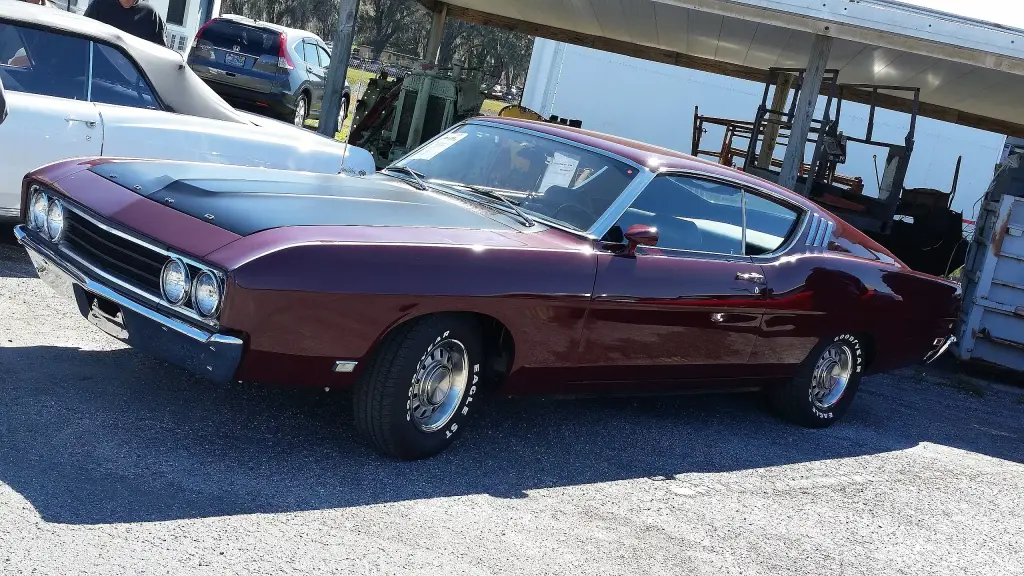
The Ford Torino Talladega is a muscle car that Ford produced only during the first few weeks of 1969. It was named for the Talladega Superspeedway, which opened the same year, and was a special, more aerodynamic version of the Torino built to make Ford even more competitive in NASCAR racing.
Ford Torino Talladega at a glance
| Built | January and February 1969, at Ford’s Atlanta Assembly plant |
|---|---|
| Homologation need | 500 cars in 1969 |
| Production | about 754, though the registry can account for 750 |
| Base car | Torino/Fairlane SportsRoof fastback |
| Road engine | 428 Cobra Jet V8 |
| Race engines | 427 side-oiler, later the Boss 429 |
| Nose | about six inches longer, with a flush grille |
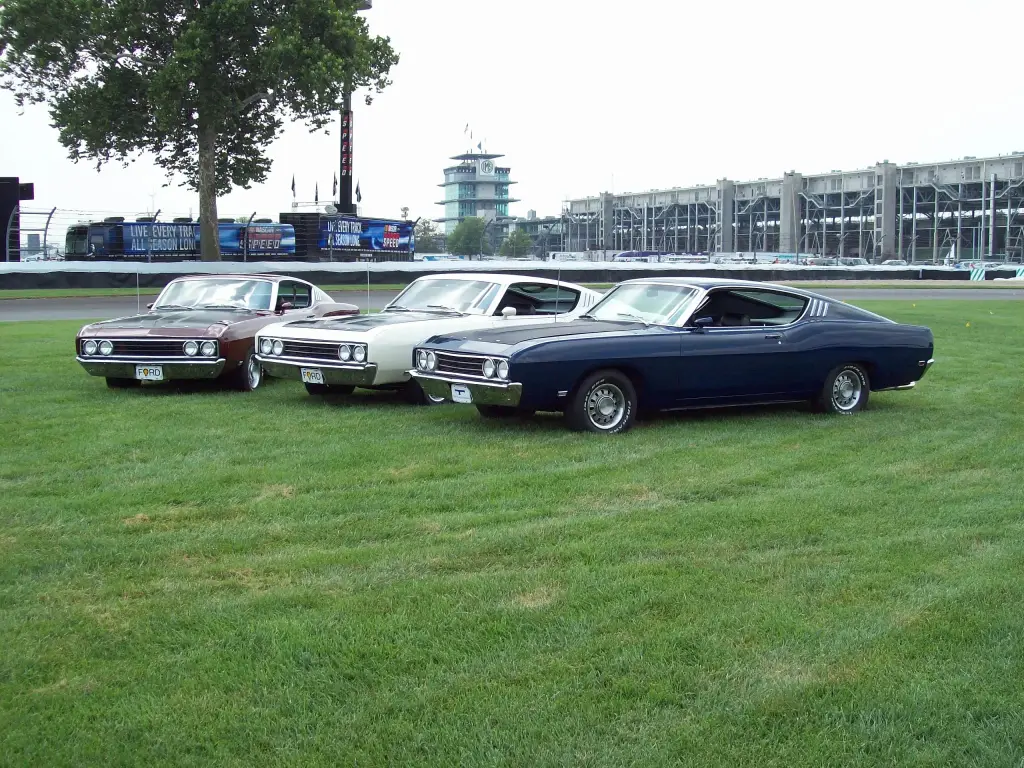
| Colours | Wimbledon White (286), Royal Maroon (258), Presidential Blue (199) |
| Race wins | 29 Grand National races in 1969 and 1970 |
| Sister car | Mercury Cyclone Spoiler II |
This page is based on English Wikipedia only (a trusted source), because no German or other-language article was available; the facts were not cross-checked against a second source.
History of the Ford Torino Talladega
The Talladega was sold to the public only because homologation rules required a minimum number of cars, 500 in 1969, to be produced and made available. All production Talladegas were equipped with the new 428 Cobra Jet, which was powerful and reliable but intended as a street engine with high torque at low revs rather than a high-revving race engine. A largely equivalent car was also sold under the Mercury name as the Cyclone Spoiler II.
Design
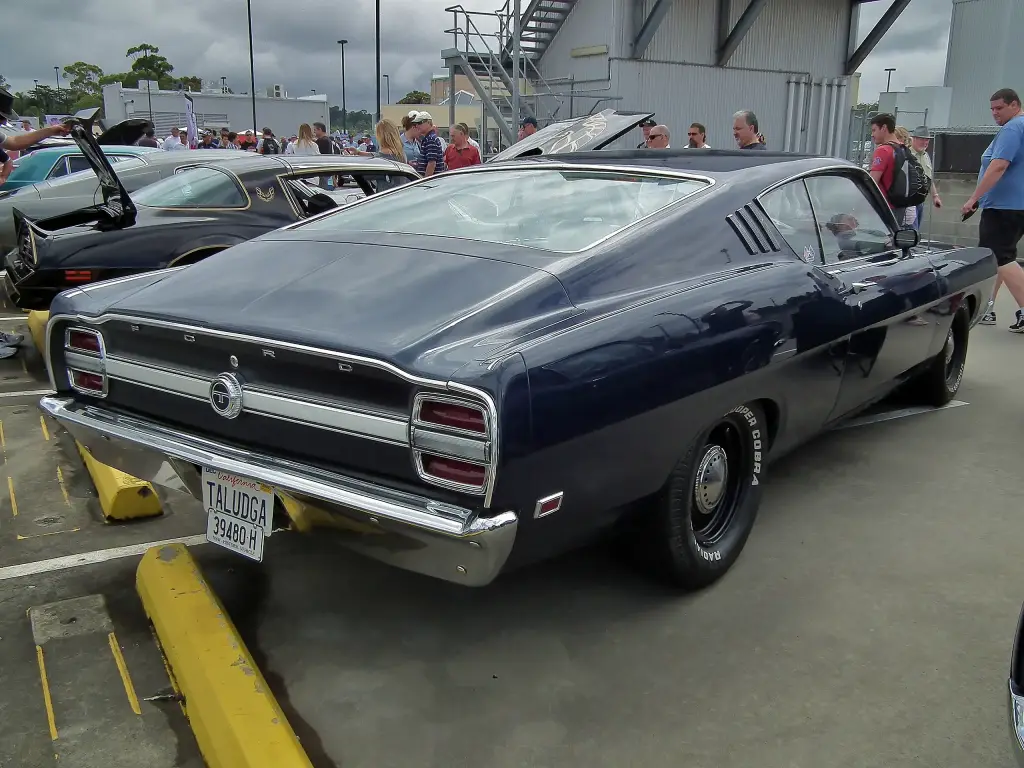
The 1969 Talladega was based on the Fairlane SportsRoof, Ford’s name for a fastback two-door hardtop. Ordinary Fairlanes and Torinos had a fashionable inset grille and headlights, which did badly in the wind tunnel. The Talladega replaced this with a nose that made the car about six inches longer, with a flush-mounted grille; the design and construction of the nose is often attributed to the Holman-Moody race team’s shop. The close-fitting bumper was really a rear bumper that had been cut, narrowed and V’ed in the centre to form a crude air dam. The rocker panels were reshaped and rolled so that Ford teams could run their racers about an inch closer to the ground within NASCAR rules, which lowered the centre of gravity and reduced wind resistance.
The cars also had an engine oil cooler and a power-steering oil cooler, staggered shocks, a 3.25:1 nine-inch rear axle, and a heavy-duty C-6 automatic transmission with column shift. Every production car had a competition black bonnet and rear tail panel and the only interior offered, black vinyl and cloth with a front bench seat. The only options, besides the three colours, were power steering, power brakes, colour-keyed racing mirrors, an AM radio and argent styled steel wheels with F70 x 14 tyres.
Racing and the Aero Wars
Racing versions were first fitted with the 427 side-oiler engine that had been Ford’s main racing engine since 1963, and later in the season with the Boss 429 once NASCAR president Bill France Sr. declared it homologated. Ford homologated that engine separately from the car, in the 1969 Mustang Boss 429, which many experts think was done so that the Talladega’s bodywork could be homologated at the start of the 1969 season. The car won 29 Grand National races in the 1969 and 1970 seasons, far more than any other model. It won the 1969 NASCAR Manufacturers’ Championship, with David Pearson taking the Drivers’ title, and the 1969 ARCA Manufacturers’ Championship, with Benny Parsons the champion. Richard Petty finished second in the 1969 points race driving a Talladega.
Chrysler’s first competitor was the Dodge Charger 500, which proved aerodynamically inferior, so Dodge went back to the drawing board to create the Charger Daytona, which won six races in 1969 and 1970. Ford then pulled out: after Congressional hearings that questioned the cost of racing against improving economy and safety, it abandoned all its racing programmes from the 1970 season. Teams kept running their 1969 Talladegas without factory support because they were aerodynamically superior to the 1970 Torinos, until NASCAR effectively banned the “aero cars” by limiting them to engines of no more than 305 cubic inches.
Production and rarity
It is believed that 754 Talladegas may have been built, including prototypes, pilot cars and a special post-production car for Ford’s president Semon “Bunkie” Knudsen, which was built in Lorain, Ohio. All homologation cars were built between 21 January and 28 February 1969. The last 247 were built after the homologation requirement had been met, and it is unknown why, as Ford is thought to have lost several thousand dollars on every car. Today the Talladega is collectible, though its values for a long time trailed those of the Mopar aero cars.
Design and features
- Nose: a flush-grille front end that added about six inches to the car.
- Hardware: oil coolers, staggered shocks and a heavy-duty C-6 automatic.
- Paint: three colours, with a black bonnet and tail panel on every car.
Ford Torino Talladega versions
- Talladega road car (1969): about 754 built with the 428 Cobra Jet.
- Talladega race car: first with the 427, later the Boss 429.
- Mercury Cyclone Spoiler II: the sister car sold by Mercury.
Its rivals were the winged Dodge Charger Daytona and the Plymouth Superbird; its engine appeared in the Ford Mustang Boss 302 family. See also the Ford Torino, the Mercury Cyclone and our Ford collection.
Sources
- Ford Torino Talladega, English Wikipedia: design, racing record, production numbers