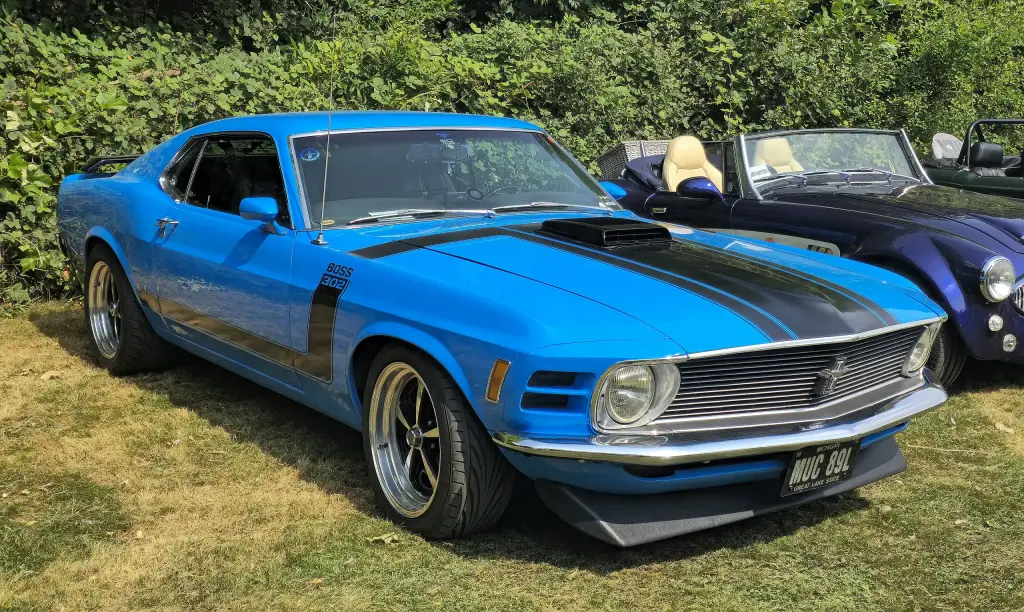
The Mustang Boss 302 is a high-performance Mustang with a 302 cu in (4.9 L) H.O. V8, originally produced by Ford in 1969 and 1970. It was developed to meet homologation requirements for the Trans-Am racing series and was Ford’s response to the success of the Chevrolet Camaro Z/28, though many thousands were sold to the public in street-legal form.
Ford Mustang Boss 302 at a glance
| Produced | 1969 and 1970 |
|---|---|
| Engine | 302 cu in (4.9 L) H.O. V8, “G code”, rated at 290 hp (216 kW) |
| Reason | SCCA Trans-Am homologation, with a 5 L (305 cu in) limit |
| Rival | Chevrolet Camaro Z/28 |
| Styling | Larry Shinoda |
| Transmission | four-speed manual only |
| 1970 price | $3,720 suggested; 7,013 sold |
| 1970 performance | 0–60 mph in 6.9 seconds; quarter mile in 14.6 seconds |
| Revival | 2012 and 2013 |
This page is based on English Wikipedia only (a trusted source), so the facts were not cross-checked against a second source.
History of the Ford Mustang Boss 302
The Camaro and Mustang rivalry began in 1967 with the arrival of the Chevrolet Camaro, the largest threat to the lead Ford held in the pony-car segment, which Ford had largely created in 1964. The Mustang with Ford’s stock 289 small-block and 390 big-block was not up to the Camaro with equivalent Chevy engines. To improve the Mustang’s image Ford developed the Boss 302 engine and offered it in a complete performance package, together with the 429 cu in Boss 429 as a big-block alternative.
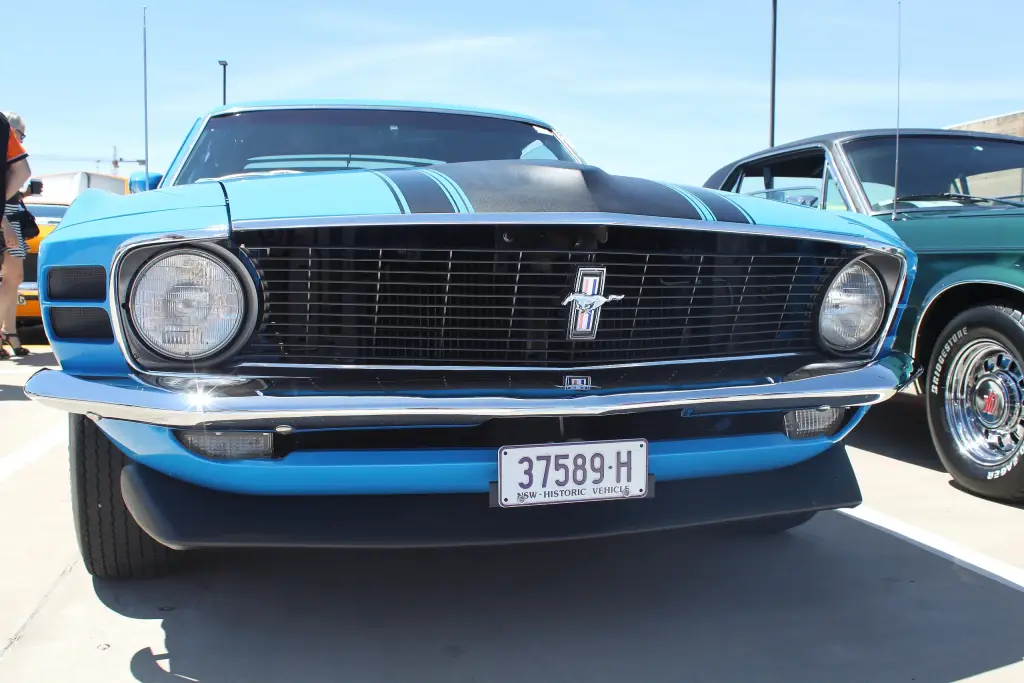
The specific reason for the 302 engine was to meet the SCCA’s homologation requirements for the 1969 Trans-Am road racing series, which limited displacement to 5 litres (305 cu in); the 7-litre Boss 429 was developed for NASCAR in the same way. The Boss 302’s engine differed substantially from stock 302s, being based on a unique thin-wall, high-nickel small-block casting, with solid lifters, strong four-bolt main bearings and heads with canted valves allowing larger valves, developed for the 351 Cleveland that followed. It was available only in a complete Boss 302 package with a four-speed manual, a lower ride height, front disc brakes, larger sway bars, heavier spindles and reinforced shock towers.
Styling and the name
The Boss 302 was styled by Larry Shinoda, a former GM employee, who deleted the fake scoops in the rear quarter panels of the 1969 Mustang and added a front spoiler and a rear deck wing, making it one of the first production cars to have both. The name “Boss”, 1960s slang for “excellent”, stuck when Shinoda was asked what he was working on and answered “the boss’s car”, meaning the new Ford president, Semon “Bunkie” Knudson, who had brought him over from Chevrolet.
For 1970 there were side “hockey stick” stripes, a front end with the outer pair of headlights replaced by vents and moved inside the grille opening, a revised exhaust and suspension, and a Hurst shifter as standard. At a suggested $3,720, 7,013 were sold. The 1970 car did 0–60 mph in 6.9 seconds and the quarter mile in 14.6 seconds.
Trans-Am
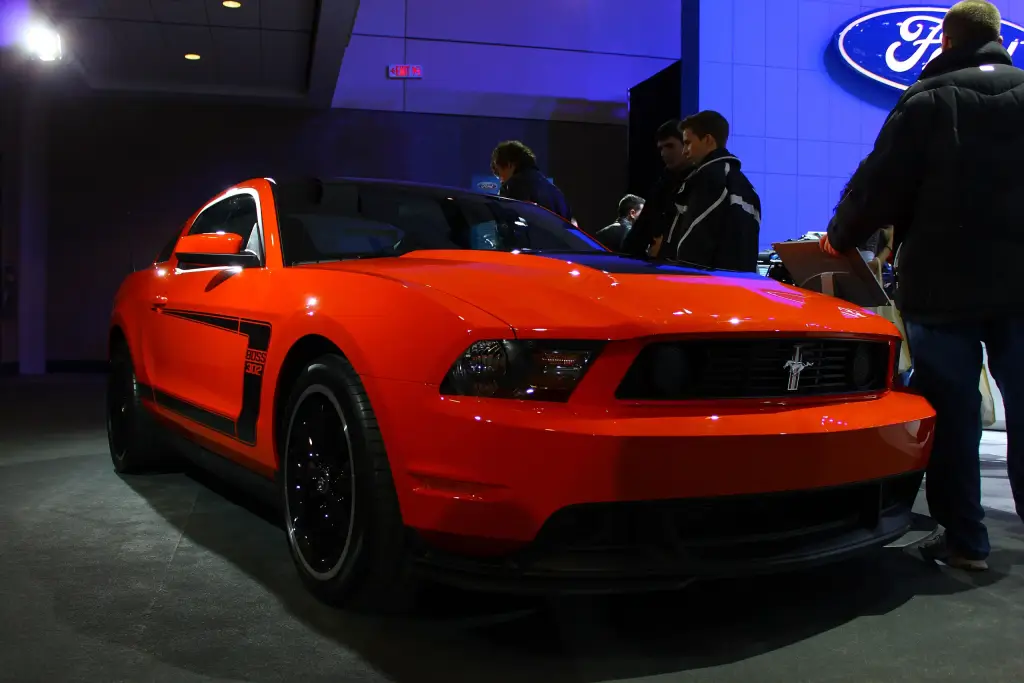
The Boss 302 program was part of Ford’s effort to win the SCCA Trans-Am Championship in 1969 and 1970. The Penske Camaros had triumphed in 1968 and 1969, but Penske switched to the American Motors Javelin for 1970, so the Boss 302’s direct competition that year was the AAR Cudas, the Pontiac Firebird, the Team Chaparral Camaros and the Penske Javelins. In 1969 tyre trouble and slow pit stops limited Ford’s success. In 1970 the factory effort was headed by Bud Moore, whose cars on Goodyears edged out Penske’s Javelins, with Moore’s driver Parnelli Jones beating Penske’s Mark Donohue. Ford dropped the Boss 302 after 1970, and revived the name for a two-year run in 2012 and 2013.
Design and features
- Engine: a unique thin-wall, high-nickel 302 with canted-valve heads.
- Chassis: a lower ride height, front discs, bigger sway bars and reinforced shock towers.
- Aero: a front spoiler and rear wing, early for a production car.
Ford Mustang Boss 302 versions
- 1969 Boss 302: the first year; 290 hp.
- 1970 Boss 302: new stripes, a revised front end and a Hurst shifter.
- Boss 429: the big-block sister car, for NASCAR homologation.
- 2012–2013 Boss 302: the revival.
The Boss sat inside the Ford Mustang family and raced Plymouth’s pony car; for another Detroit homologation special see the Plymouth Superbird. More Fords are in our Ford collection.
Sources
- Boss 302 Mustang, English Wikipedia: development, engine, styling, Trans-Am racing