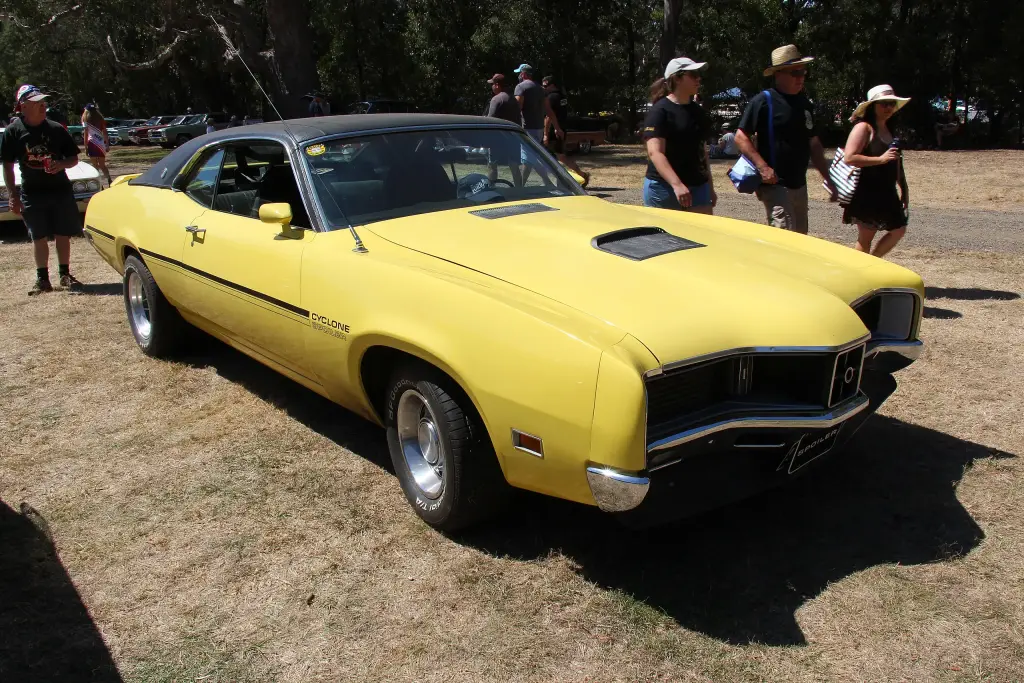
The Mercury Cyclone was marketed from 1964 to 1971. It began as the Mercury Comet Cyclone, the performance version of the Comet, and became a separate nameplate for 1968 as the Montego replaced the Comet. Four generations were built before production ended after 1971, with a short-lived option-package return in 1972.
Mercury Cyclone at a glance
| Production | 1964–1971, four generations |
|---|---|
| Introduced as | Mercury Comet Cyclone, replacing the S-22 |
| Own nameplate | from 1968 |
| Position | between the Cougar and the Marquis/Marauder |
| 1964 engine | 289 cu in V8, 210 hp |
| 1965 engine | four-barrel 289 cu in V8, 200 hp |
| 1966 engines | 390 cu in V8 with 265 or 275 hp; GT with 335 hp |
| 1968 engines | 302, 390 and the mid-year 428CJ rated at 335 hp |
| 1968 speed record | 189.22 mph at Daytona |
| 1972 return | option package on the Montego, 30 built |
The article is based on one source, the English Wikipedia page on the Cyclone; the material stops during the 1969 model year, so the last two years are covered only briefly.
History of the Mercury Cyclone
From Comet option to muscle car
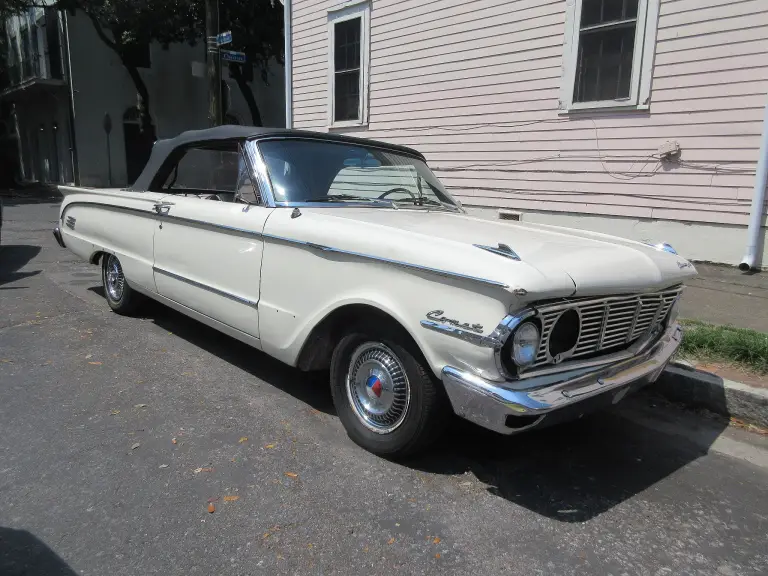
The Cyclone started life in 1964 as an option on the Mercury Comet, replacing the S-22 as the performance-oriented version of the line. It carried a 289 cu in V8 with 210 hp, a sporty look, a spoked steering wheel and bucket seats, and some of its engine parts were chromed. For 1965 the engine became the four-barrel version of the same 289, rated at 200 hp; the car gained a handling package, a special fan, a “power transfer” rear axle, a blacked-out stand-up grille, bucket seats with sewn-through pleats, a centre console, chrome wheel covers with exposed lug nuts, an engine dress-up kit, unique insignias, a vinyl roof in black or white and a padded instrument panel with a Power-Pac gauge cluster.
Second generation
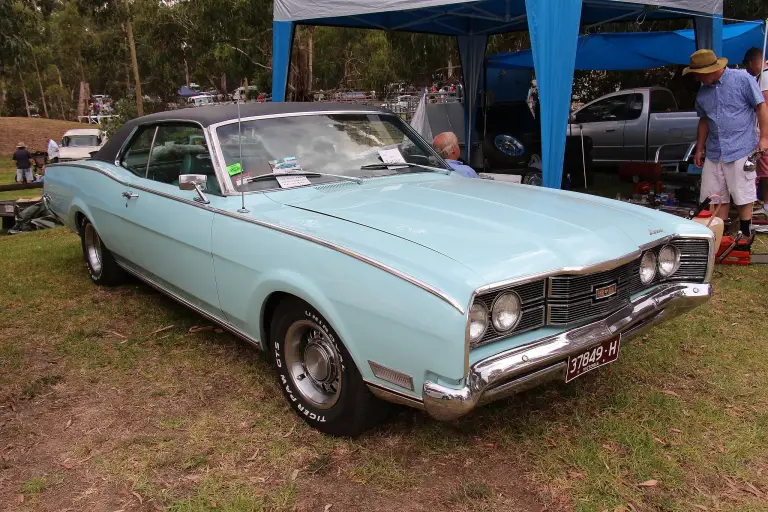
The 1966 cars were restyled with sculpturing that ran the length of the body and were based on the Ford Fairlane. New engines arrived: a 390 cu in unit with a two-barrel carburettor and 265 hp, and a four-barrel version with 275 hp. The GT option used a 390 with a four-barrel carburettor and 335 hp, adding stripes, a fibreglass bonnet with two air scoops and other performance equipment. For 1967 the standard engine was again the 289 V8 with 200 hp and the GT used a 390 quoted at 320 hp, fifteen fewer than before. Neither the 1966 nor the 1967 Cyclone used the 427 cu in Ford FE engine officially, although Comet Cyclones modified by Andy Hotton of Dearborn Steel Tubing could be ordered with the 427 rated at 410 hp; only a small chrome “427” badge on each front wing gave the game away.
A name of its own
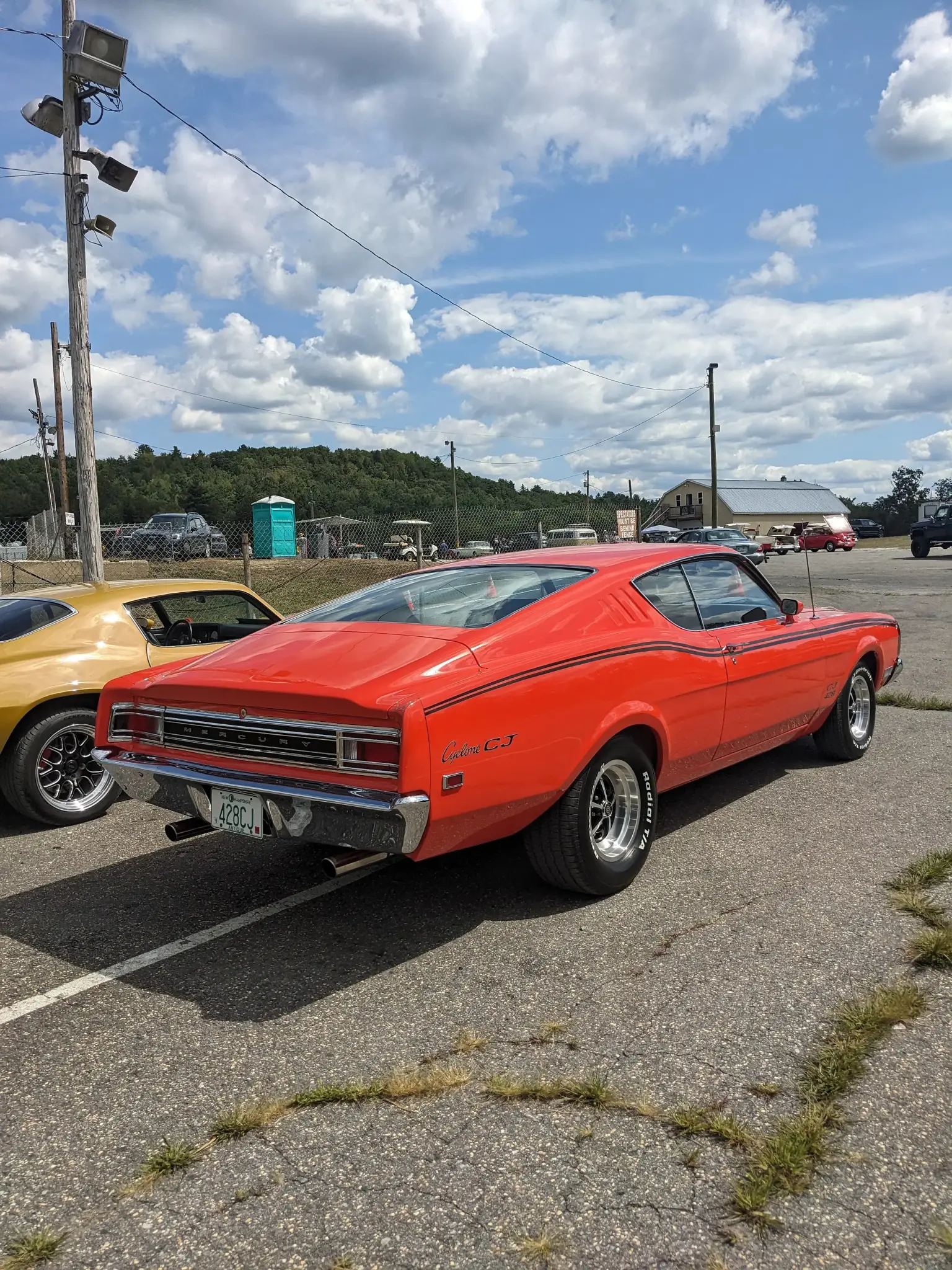
The 1968 models dropped “Comet” from the name and the Cyclone became a distinct Mercury nameplate, slotted between the Cougar pony car and the full-size Marquis and Marauder two-doors. The Cyclones carried a mid-level body tape stripe, while the Cyclone GT had an upper-level stripe, bucket seats, wide whitewall tyres, special wheel covers, an all-vinyl interior and the special handling package. It was named the fastest car of that year after setting a world record of 189.22 mph at Daytona. Engines ranged from a 302 cu in V8 with 210 or 230 hp, through a 390 with 265 or 325 hp, to the limited-production 428CJ that arrived mid-year with 335 hp.
The end
Production ended after the 1971 model year. For 1972 the Cyclone returned only as an option package on the Montego, and just 30 examples were produced. Within the Mercury range it was not directly replaced: the Cougar XR-7 was repackaged as a personal-luxury version of the Montego for 1974.
Design and features
- Muscle-car ladder: a 289 in 1964 rising to the 428CJ in 1968.
- GT package: stripes, a fibreglass bonnet with air scoops and a handling package.
- Daytona record: 189.22 mph in 1968 made it the fastest car of the year.
- Dealer specials: Dearborn Steel Tubing built a handful of 427-powered Comet Cyclones.
- Short life: four generations in eight years, then a 30-car option package in 1972.
Mercury Cyclone versions
- Comet Cyclone (1964–1965): the original 289-powered Comet option.
- Cyclone and Cyclone GT (1966–1967): Fairlane-based cars with 390 engines.
- Cyclone (1968–1969): the first stand-alone nameplate, with 302, 390 and 428CJ power.
- 1972 Montego option package: the final 30 cars.
The Cyclone grew out of the Comet and shared the showroom with the Cougar and the Montego. More cars are in the Mercury collection.
Video: 1969 Mercury Cyclone CJ 428 … car has been sold
Video by Dirk Wallace on YouTube.
Sources
- Mercury Cyclone, English Wikipedia: generations, engines, equipment, the Daytona record and the 1972 package