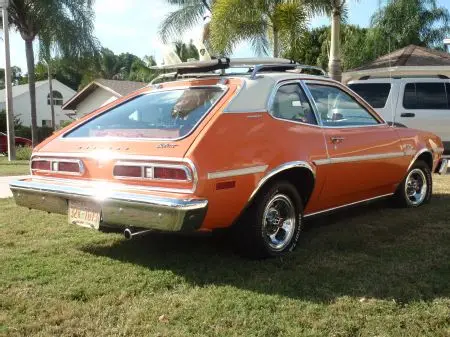
The Mercury Bobcat was the Mercury division’s version of the Ford Pinto subcompact. It arrived for 1975, a year after Canada, and stayed in production until 1980. About 224,000 Bobcats were built, alongside more than three million Pintos.
Mercury Bobcat at a glance
| Maker | Mercury division of Ford Motor Company |
|---|---|
| Production | 1975–1980 (Canada from 1974) |
| Based on | Ford Pinto |
| Body styles | two-door sedan, three-door hatchback, two-door station wagon |
| Layout | front-mounted inline-four, rear-wheel drive |
| Construction | unibody, unequal-length control arms at the front, live axle on leaf springs |
| Built | about 224,000 |
| Plants | Edison, New Jersey; St Thomas, Ontario; San Jose, California |
| Related | Ford Pinto |
| Market position | more expensive Mercury alternative to the Pinto |
The Bobcat is described in a short section of the English Wikipedia article on the Ford Pinto, which is the only source used here; the article is therefore based on one source.
History of the Mercury Bobcat
Why Mercury needed it
By the late 1960s the American makers had answered imported small cars such as the Volkswagen Beetle with compacts like the Ford Falcon, Ford Maverick, Chevrolet Corvair and Plymouth Valiant, but those cars still used six-cylinder engines and belonged to a larger class. As the Toyota Corolla and Datsun 510 gained ground, Ford of North America brought in the Cortina from Ford of Europe as a captive import and then developed a true subcompact of its own. The Pinto, named after the horse, went on sale on 11 September 1970. It used a new platform and a powertrain taken from the European-specification Escort.
The Bobcat arrives
Mercury had no subcompact of its own, so the division took the Pinto and rebadged it as the Bobcat. The car was offered from 1975 in the United States and from 1974 in Canada. Like the Pinto it came as a two-door fastback sedan with a separate boot, a three-door hatchback and a two-door station wagon; the hatchback was the model Ford marketed as the Runabout, with a fold-down rear seat and 38.1 cubic feet of load space. The Bobcat was the better-equipped, more expensive version, sold through Mercury dealers alongside the larger Comet, Monarch and Cougar.
The Bobcat shared the Pinto’s mechanical layout. The engine was a longitudinally mounted inline-four driving the rear wheels through a manual or an automatic gearbox, and the suspension used unequal-length control arms with coil springs in front and a live axle on leaf springs behind. Rack-and-pinion steering was available with power assistance, as were the brakes.
The Pinto shadow
The Bobcat inherited the Pinto’s reputation. In the 1970s the design of the Pinto’s fuel tank came under intense media and government scrutiny after several deadly fires following rear-end collisions. Later analysis of the design’s overall safety suggested that it was comparable to other subcompact cars of the period, but the case became a widely cited study in business ethics and tort reform. For Mercury the association was unavoidable, because the two cars were the same underneath.
The end
Bobcat production ended in 1980 together with the Pinto, after roughly 224,000 cars. The cars were assembled at Edison Assembly in Edison, New Jersey, St Thomas Assembly in Southwold, Ontario, and San Jose Assembly in Milpitas, California. Mercury replaced the Bobcat in the compact class with the front-wheel-drive Lynx, a version of the new Ford Escort.
Design and features
- Mercury badge on a Pinto: the same body, chassis and engines, with Mercury trim and a higher price.
- Three body styles: two-door sedan, three-door hatchback and two-door station wagon.
- Runabout hatchback: a fold-down rear seat and 38.1 cubic feet of cargo space with the seat folded.
- Conventional engineering: front-mounted four-cylinder engine, rear-wheel drive and a live rear axle.
- Pinto safety controversy: the fuel tank layout that made the Pinto famous for the wrong reasons.
Mercury Bobcat versions
- Bobcat two-door sedan: the fastback with a separate boot, the cheapest body style.
- Bobcat hatchback: the three-door Runabout with a folding rear seat.
- Bobcat station wagon: the two-door wagon, the rarest of the three bodies.
- Canadian Bobcat (1974–1980): sold a year earlier than the American version.
The Bobcat was the smallest Mercury of its day; the Comet and Capri sat above it in the range, and the Cougar was the division’s best seller. More cars are in the Mercury collection.
Video: 1976 Mercury Bobcat Commercial ‘Love That Bobcat’
Video by NYCYankInTexas on YouTube.
Sources
- Ford Pinto, English Wikipedia: Bobcat production years, output, plants, body styles and Pinto background