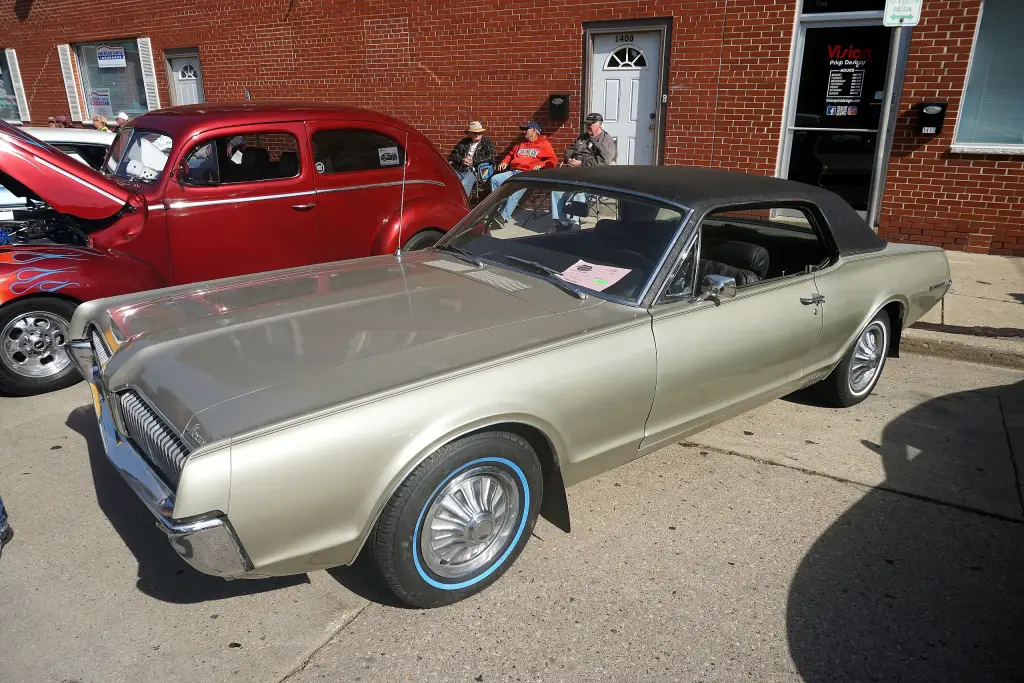
The Mercury Cougar was sold from 1967 to 2002 across eight generations, skipping the 1998 model year. With 2,972,784 cars built it was the best-selling Mercury, and at 34 years it was second only to the Grand Marquis for production longevity.
Mercury Cougar at a glance
| Production | 1967–2002, eight generations |
|---|---|
| Built | 2,972,784 |
| Launch price | US$2,854 for 1967 |
| XR-7 price | up to US$4,500 fully optioned |
| Wheelbase | 111 in, three inches longer than the Mustang |
| Award | 1967 Motor Trend Car of the Year |
| Chassis | Ford Mustang, then intermediate Ford, then Fox, then MN12 |
| Plants | Dearborn, San Jose, Lorain and Flat Rock |
| Body styles | coupé, convertible, hatchback, sedan and wagon over the years |
| Longevity | 34 years, second only to the Grand Marquis |
The article is based on one source, the English Wikipedia page on the Cougar; the description of the later generations is a summary of its overview section.
History of the Mercury Cougar
A Mercury of its own
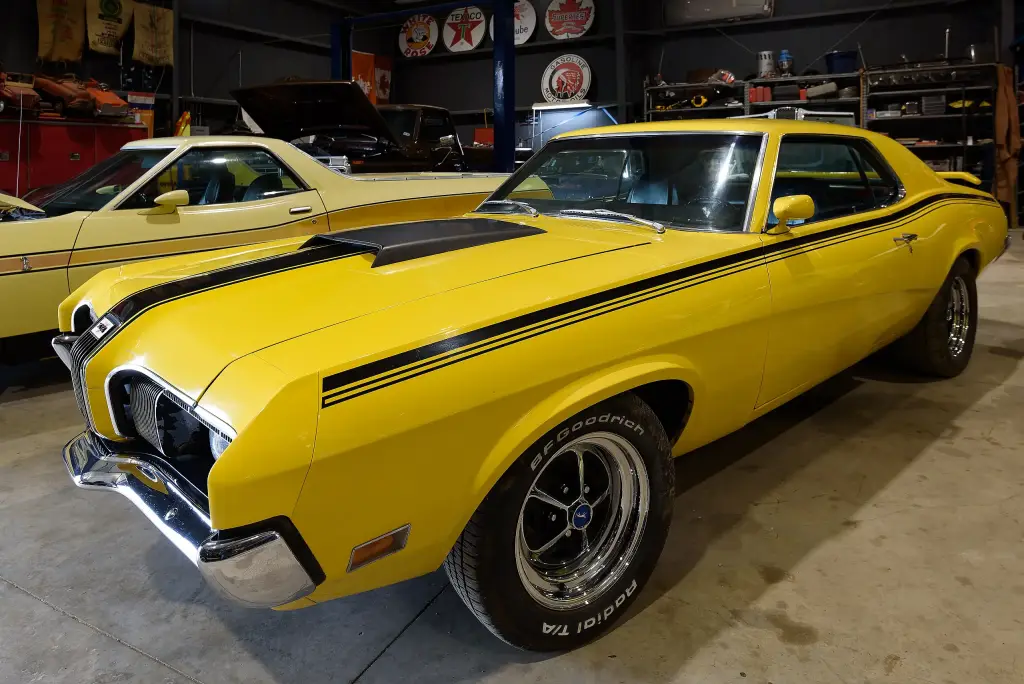
The Cougar began in the summer of 1962, when Ford and Lincoln-Mercury stylists both submitted proposals for the T-5 project that became the 1965 Ford Mustang. Ford’s design was chosen, but Lincoln-Mercury kept its interest and wanted a car from the same mould to compete with the Ford Thunderbird, which at the time outsold Lincoln by a wide margin. Once the Mustang proved a success, Ford approved the T-7 project and let Lincoln-Mercury develop a model from the planned 1967 Mustang update.
The T-7 took the Cougar name. Rather than a direct Mustang counterpart, like the Pontiac Firebird to the Chevrolet Camaro, the Cougar was meant to create its own segment between the Mustang and the Thunderbird: more comfort and equipment than the Mustang, better road manners than the Thunderbird. The name itself revived a nameplate from an earlier Ford proposal.
1967: the first generation
Lincoln-Mercury released the Cougar on 30 September 1966. It far exceeded sales projections, accounting for nearly 40 per cent of the division’s 1967 sales. Unlike the Mustang, it was initially offered only as a two-door hardtop. The base price was US$2,854, US$284 more than an equivalent Mustang, and a fully optioned Cougar XR-7 cost US$4,500, essentially the base price of a Ford Thunderbird. The Cougar won the 1967 Motor Trend Car of the Year award, the only Mercury ever to do so.
Underneath, the first-generation Cougar used the chassis of the 1967 Mustang, itself derived from the rear-wheel-drive Ford Falcon unibody. The Cougar’s wheelbase was three inches longer than the Mustang’s, at 111 inches. The car was assembled at Dearborn Assembly in Michigan from 1967 to 1973, at San Jose Assembly in California from 1968 into early 1969, at Lorain Assembly in Ohio from 1974 to 1997 and at Flat Rock in Michigan from 1999 to 2002.
Eight generations
For most of its life the Cougar was the Mercury counterpart of a Ford model, distinguished by its own grille, badges, lights and often by almost every body panel. The first two generations were derived from the Mustang; the second moved the car towards the personal-luxury segment. The third and fourth generations used the Ford intermediate chassis, with the Cougar XR-7 becoming the counterpart of the Ford Thunderbird for two decades. The fifth and sixth generations moved to the Ford Fox platform, the standard Cougar replacing the Monarch and the XR-7 pairing with the Thunderbird. The seventh generation introduced the MN12 platform, and the eighth, from 1999, returned the nameplate as a sports compact hatchback based on the Ford Contour, originally intended as the third-generation Ford Probe. Over the years the Cougar was offered as a coupé, convertible, hatchback, and even as a four-door sedan and five-door station wagon during its mid-size period. Mercury’s advertising of the 1970s and 1980s, “The Sign of the Cat”, put big cats on Lincoln-Mercury dealer signs, and cat names spread to the Bobcat and Lynx.
Design and features
- Mustang bones, Mercury manners: the 1967 car shared the Mustang chassis but rode on a longer wheelbase.
- XR-7: the luxury version that eventually became a line of its own alongside the Thunderbird.
- Motor Trend Car of the Year 1967: the only Mercury to win the award.
- Eight generations: pony car, personal luxury coupé, mid-size family car and finally a compact hatchback.
- The Sign of the Cat: the advertising theme that linked the Cougar to the Bobcat and Lynx.
Mercury Cougar versions
- Cougar (1967–1970): the original Mustang-based two-door hardtop and convertible.
- Cougar XR-7: the luxury trim that grew into a separate model and later the Thunderbird’s twin.
- Mid-size Cougar (1974–1979): the sedan and wagon years on the Ford intermediate chassis.
- Fox-platform Cougar (1980–1988): the downsized coupé replacing the Monarch.
- 1999–2002 Cougar: the Contour-based sports compact hatchback, the final generation.
The Cougar replaced the Cyclone as Mercury’s performance car and was followed in the range by the Monarch. More cars are in the Mercury collection.
Video: FORD MERCURY COUGAR 1968 BLACK
Video by DONOLI77 on YouTube.
Sources
- Mercury Cougar, English Wikipedia: development, generations, prices, production figures and plants