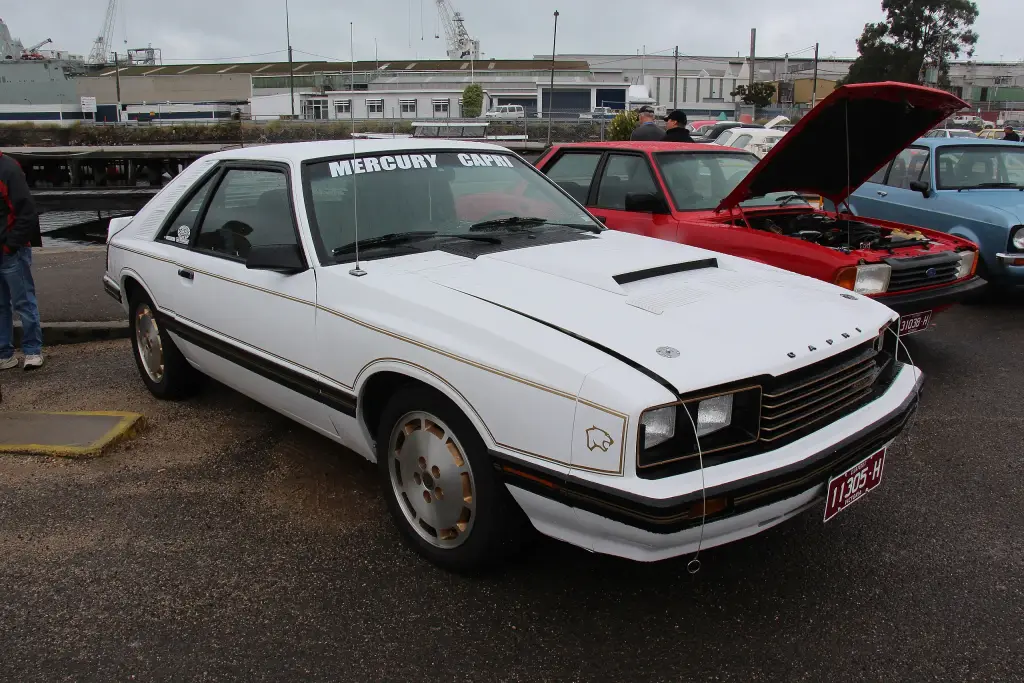
Capri was a nameplate used by Lincoln-Mercury over three generations between 1970 and 1994. The first was a German-built sports coupé sold with no divisional badge at all, the second a Mustang-based pony car, and the third an Australian-built roadster.
Mercury Capri at a glance
| Nameplate used | 1970–1994, three generations |
|---|---|
| First generation | 1970–1978, built by Ford of Europe in Cologne |
| Launch price | US$2,300 in 1970 |
| First engines | 1.6 L Kent four, 2.0 L OHC four |
| First V6 | 2.6 L Cologne V6 from 1972, enlarged to 2.8 L for 1974 |
| Capri II | 1976–1978, hatchback roofline |
| Sales 1970–1978 | 513,500 Capri and Capri II |
| Second generation | 1979–1986, Mercury-badged Ford Mustang |
| Third generation | 1991–1994, roadster built by Ford Australia |
| Name origin | the Italian island of Capri |
The whole article is based on the single English Wikipedia page on the Capri, so it is based on one source.
History of the Mercury Capri
A German coupé for American dealers
Ford of Europe developed the Ford Capri as its answer to the Mustang: a two-door coupé with a long bonnet and a short boot, designed by Ford of Britain using components from the Cortina MkII and Escort. Lincoln-Mercury began selling it in North America in April 1970, simply as the Capri, without Ford or Mercury divisional branding. It was a captive import built in Cologne, Germany, and priced at US$2,300 at launch, far below the Mercury Cougar and Montego.
For the American market the Capri received four circular headlamps in place of the European rectangular units, grille-mounted turn signals, side marker lights and Rostyle wheels as standard. Power came at first from a 1.6 L Kent crossflow four, with a 2.0 L OHC four added for 1971. For 1972 Mercury offered a 2.6 L Cologne V6, the first American-market vehicle from Ford with a V6; it grew to 2.8 L for 1974 when Ford revised the block and cylinder heads. The Capri II arrived as an early 1976 model, skipping the 1975 model year, with a hatchback roofline and the same quad headlamps. After 1977 the imports ended, and unsold cars were sold during 1978. In total 513,500 Capri and Capri II models were sold by Lincoln-Mercury from 1970 to 1978; at its peak the Capri was the best-selling imported car in America apart from the Volkswagen Beetle.
The Mustang connection
From 1979 to 1986 the Capri became part of the Mercury range as a US-built pony car, a badge-engineered version of the contemporary Ford Mustang. It kept the name but lost the European character: the same body, the same engines and the same platform as the Mustang, sold through Mercury dealers. A Mercury version of the Mustang II had been considered earlier, with a rounded rear quarter window and the Mustang’s bodyside sculpting, but strong sales of the imported Capri shelved the plan.
The Australian roadster
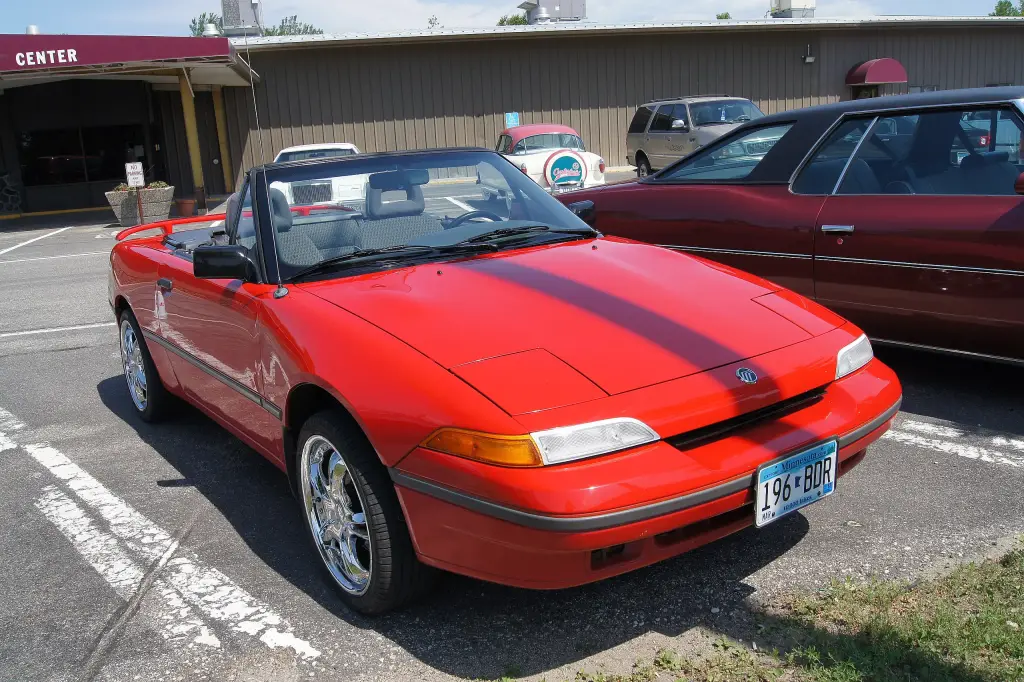
The third generation was a two-seat convertible built by Ford Australia and sold as the Mercury Capri in North America from 1991 to 1994; elsewhere the same car was marketed as the Ford Capri. It was the only front-wheel-drive Capri and the only one offered as a soft-top, and it shared nothing with the earlier generations beyond the name.
Reception
Road & Track was enthusiastic about the first car. Of the 1970 Capri 1600 the magazine wrote that styling and image sell cars, and that Lincoln-Mercury had “a real winner”. In February 1971 it called the Capri 2000 a solidly built, sporty compact car that was fun to drive, especially with the two-litre engine. That reputation for good handling at a modest price was what carried the nameplate through three very different cars.
Design and features
- Captive import: the first Capri was built in Cologne and sold without divisional badges.
- American lighting: four round headlamps, grille-mounted indicators and side markers for the US market.
- First Ford V6 in America: the 2.6 L Cologne unit of 1972, enlarged to 2.8 L in 1974.
- Capri II hatchback: a new roofline for 1976 that turned the coupé into a hatchback.
- Mustang twin: from 1979 the Capri was a US-built version of the Ford Mustang.
Mercury Capri versions
- Capri (1970–1975): the original German coupé with 1.6, 2.0 and 2.6/2.8 engines.
- Capri II (1976–1978): hatchback version with the 2.3 L four or 2.8 L V6.
- Second-generation Capri (1979–1986): Mercury-badged Mustang pony car built in the USA.
- Third-generation Capri (1991–1994): Australian-built two-seat roadster.
The Capri sat below the Cougar in the Mercury range and shared its engines with the Bobcat and the Comet. More cars are in the Mercury collection.
Sources
- Mercury Capri, English Wikipedia: all three generations, engines, prices, sales total, press quotes