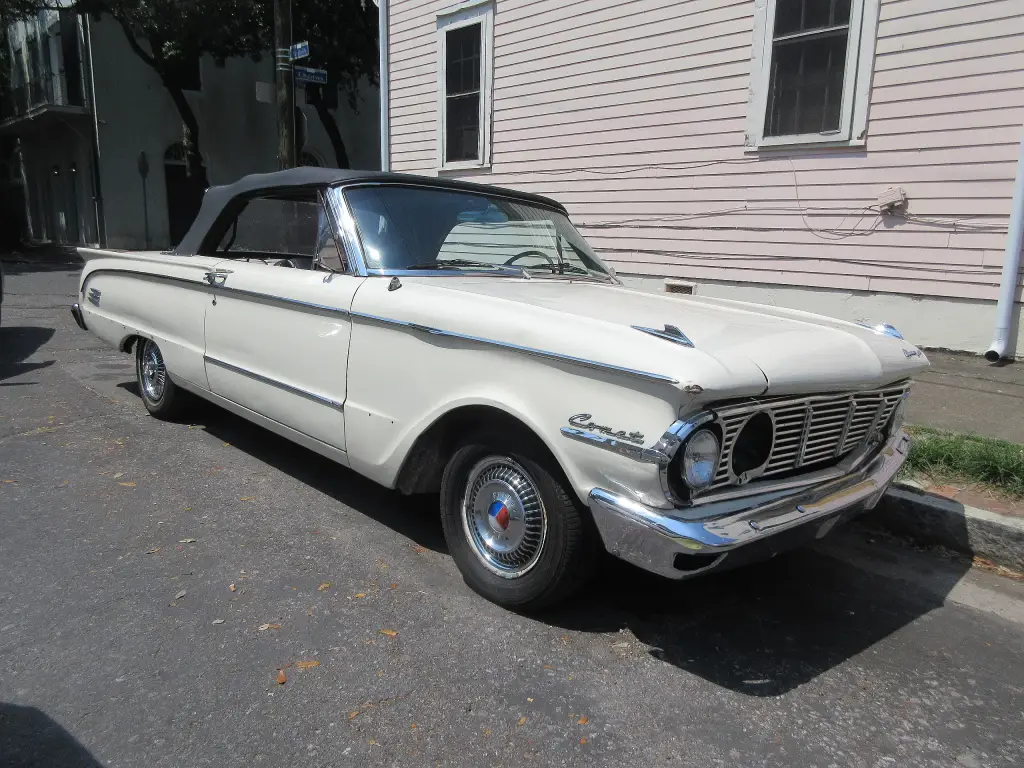
The Mercury Comet was produced from 1962 to 1969 and again from 1971 to 1977, but for 1960 and 1961 it was a brand of its own, sold by Lincoln-Mercury as the “Comet” without a Mercury badge. The car started as a Falcon-based compact and finished on the Ford Maverick.
Mercury Comet at a glance
| Production | 1960–1969 and 1971–1977 |
|---|---|
| Brand | Comet (1960–1961), then Mercury |
| Origin | originally planned as the 1960 Edsel Comet |
| Platforms | Ford Falcon, then Ford Fairlane, then Ford Maverick |
| First engine | 144 cu in straight-six, 90 hp |
| 1961 engine | 170 cu in straight-six, 101 hp |
| 1963 option | 260 cu in V8, 164 hp |
| Bodies | two- and four-door sedans, hardtop, convertible, station wagons |
| Trim levels | standard, Custom, S-22, Villager wagon |
| Name bought from | Comet Coach Company, a hearse and ambulance builder |
The article is based on a single source, the English Wikipedia page on the Comet.
History of the Mercury Comet
An Edsel that never was
The Comet was originally meant to be the 1960 Edsel Comet. When Edsel was shut down in November 1959, the model moved to Lincoln-Mercury and was released on 17 March 1960 in the United States, sold through Lincoln-Mercury-Comet and Mercury-Comet dealerships. Early cars carried only “Comet” badges, in the same way that the Plymouth Valiant began without Plymouth badging; the door VIN tags read “Made in U.S.A. by Comet”. The split grille of the Edsel was replaced by one closer to Mercury’s design themes, but the canted elliptical tail lights survived and even carried Edsel part numbers. Some 1959 Edsel parts, including parking lights and dashboard knobs, were used on the first-year car, and the keys were shaped like Edsel keys with the centre bar of the “E” removed to form a “C”.
The name itself came from Comet Coach Company, a professional-car builder that made funeral coaches, mostly on Oldsmobile chassis. Ford bought the “Comet” name in 1959 and the coachbuilder was renamed Cotner-Bevington.
The Falcon-based Comet
From 1960 to 1965 the Comet used the Ford Falcon platform, stretched by five inches for the sedans but not for the wagons. Initial body styles were two- and four-door sedans and two- and four-door station wagons, in standard and Custom trim, the latter adding badges, chrome and all-vinyl interiors. The only engine in 1960 was the 144 cu in Thriftpower straight-six with a single-barrel Holley carburettor, rated at 90 hp at 4200 rpm, although some sources quote 85 hp. Transmission choices were a column-shifted three-speed manual and a two-speed Comet-Drive automatic.
For 1961 the 170 cu in straight-six arrived with 101 hp at 4400 rpm, answering complaints about the small engine, and a four-speed manual became optional. The optional S-22 package, offered only on the two-door sedan, added bucket seats, a centre console and S-22 badges, though the mechanicals were unchanged. For 1962 the Comet was folded under the Mercury brand, with Mercury and Comet emblems together. The S-22 gained six bullet-shaped tail lights while regular cars had four oval lamps, and a Comet Villager station wagon with simulated woodgrain panels joined the range. The Comet-Drive automatic was renamed Merc-O-Matic.
V8 power and the Cyclone
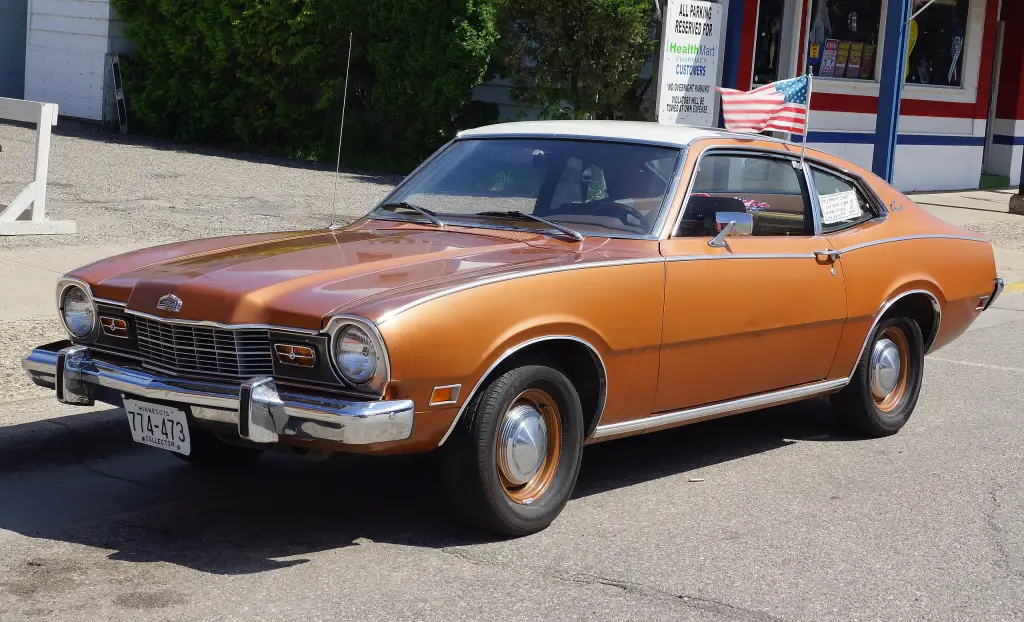
The 1963 model looked almost identical to the earlier cars, but the chassis and suspension were redesigned to take an optional 260 cu in V8 from the Fairlane, with a two-barrel carburettor and 164 hp. Two new body styles, a convertible and a pillarless hardtop, were added. The 1964 Comet Cyclone, with a 289 cu in V8 and 210 hp, replaced the S-22 as the performance model and later became a nameplate of its own. From 1966 the Comet moved to the intermediate Ford Fairlane platform, and for 1971 it returned on the compact Ford Maverick, staying in production until 1977.
Design and features
- Mercury styling on a Falcon: a longer wheelbase and better interior trim than the Ford Falcon.
- Edsel leftovers: elliptical tail lights and dashboard parts carried Edsel part numbers.
- Six or V8: from a 90 hp straight-six in 1960 to a 164 hp 260 V8 in 1963.
- Sporty S-22: bucket seats and a console on the two-door sedan.
- Three platforms: Falcon, Fairlane and finally Maverick underpinnings.
Mercury Comet versions
- Comet (1960–1963): the “round body” Falcon-based compact, sedans and wagons.
- Comet S-22 (1961–1963): the sporty two-door with bucket seats and console.
- Comet Cyclone (1964–1965): the V8 performance version that became a separate model.
- Comet Villager: a station wagon with simulated woodgrain side panels.
- Maverick-based Comet (1971–1977): the final generation, a compact two-door and four-door.
The Comet grew into the Cyclone and shared the showroom with the Meteor and the Capri. More cars are in the Mercury collection.
Sources
- Mercury Comet, English Wikipedia: history, engines, trim levels and body styles