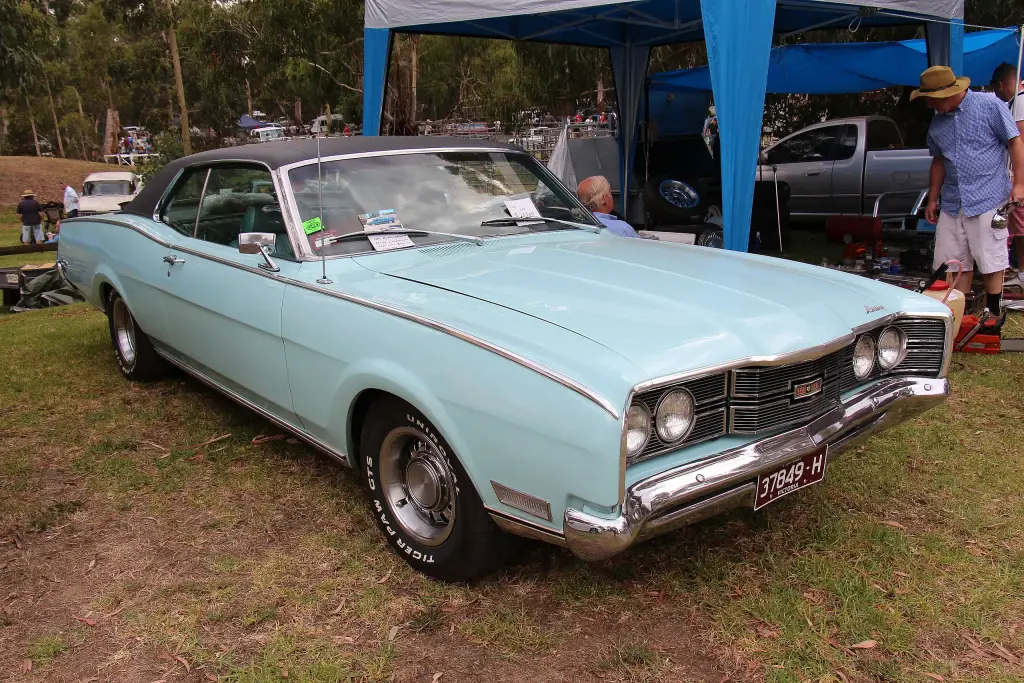
The Mercury Montego name was used on three separate vehicles. It appeared in Canada for 1967, became Mercury’s intermediate from 1968 to 1976 as the counterpart of the Ford Torino, and returned for 2005 on a full-size sedan based on the Ford Five Hundred.
Mercury Montego at a glance
| Nameplate used | 1967 (Canada), 1968–1976, 2005–2007 |
|---|---|
| Name origin | Montego Bay, Jamaica |
| First car | intermediate, counterpart of the Ford Torino |
| Body styles | two-door hardtop, convertible, four-door sedan, station wagon |
| Trims 1968 | Montego, Montego MX, Montego MX Brougham |
| Engines 1968 | 200 cu in six; 302, 351 and 390 V8s |
| 1969 addition | 428 Cobra Jet V8 and a 250 cu in six |
| Second generation | 1972–1976, body-on-frame, split wheelbase |
| Revival | 2005 full-size sedan, code D333, Ford Five Hundred counterpart |
| Renamed | became the Mercury Sable for 2008 |
The article is based on one source, the English Wikipedia page on the Montego; the 2005 car is covered briefly because the material deals mainly with the 1968–1976 generations.
History of the Mercury Montego
From Canada to North America
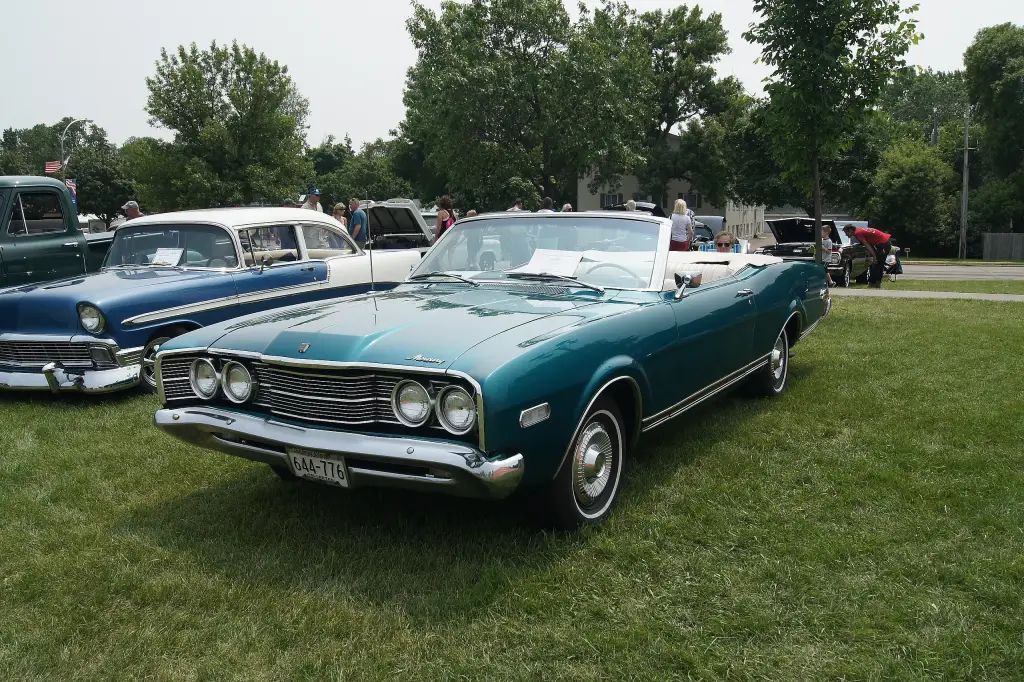
The Montego name first appeared for 1967 in Canada as part of the Meteor model line, which was derived from Mercury. For 1968 the Montego arrived across North America as the Mercury counterpart of the Ford Torino intermediate. It replaced the Comet Capri and Comet Caliente under a single nameplate, while the high-performance Comet Cyclone became a model line of its own. The first-generation car came as a two-door hardtop, a two-door convertible, a four-door sedan and a five-door station wagon, in Montego, Montego MX and Montego MX Brougham trim.
For 1969 the 200 cu in inline-six was replaced as standard by a 250 cu in six, a 351 V8 joined the 302 and 390 V8s as an option, and the 428 Cobra Jet V8 became available on cars other than the MX Brougham. For 1970 the range was facelifted and the Comet name was dropped from the Mercury intermediates. The chassis gained an inch of wheelbase for the sedans and wagons, the front was restyled with a forward-thrusting grille and bonnet, and the MX Brougham received concealed headlamps. The convertible was dropped, the two-door hardtop took a sleeker roofline, and the Montego MX Villager wagon was added as the wagon equivalent of the MX Brougham. The 390 and 428 V8s gave way to a 429, while the 351 was replaced by an all-new engine of the same size.
1971 and the second generation
For 1971 the grille became an egg-crate design, the concealed headlamps were dropped and the Cyclone was folded into the Montego line; the rest of the range lost the 429, leaving the 351 Cleveland as the most powerful V8. For 1972 a second-generation Montego arrived alongside the redesigned Ford Torino. In a major shift, the intermediates moved from unibody to body-on-frame construction with a split wheelbase: 114 inches for two-doors and 118 inches for four-doors and wagons. Four-door hardtops were replaced by pillared hardtops with frameless door glass, while the two-door kept a hardtop roof with much wider C-pillars. The Cyclone was reduced to an option package with only 30 cars built, and Mercury introduced the Montego GT, its counterpart of the Ford Gran Torino SportsRoof, for 1972 and 1973.
The 250 cu in six was standard in the second generation, with five V8s available as options; from 1974 a 460 V8 could be ordered, shared with the Marquis and Colony Park. The redesign was a success at first: 1972 Montego sales rose 136 per cent over 1971, with the MX Brougham two-door up 897 per cent and the four-door up 1,021 per cent. The 1973 fuel crisis then pushed sales down across the industry. For 1974 the Cougar XR-7 took over the Montego two-door hardtop body as Mercury’s intermediate personal-luxury car, and the fastback Montego GT was dropped. For 1977 Mercury discontinued the Montego and expanded the Cougar line to include sedans and wagons.
The 2005 revival
After a 28-year absence the Montego name came back for 2005 on a full-size sedan, internally coded D333, the Mercury counterpart of the Ford Five Hundred. It was marketed between the Milan and the Grand Marquis. For 2008 the Montego adopted the nameplate of the car it had replaced, becoming the final generation of the Mercury Sable.
Design and features
- Torino twin: the 1968–1976 Montego was Mercury’s version of the Ford Torino.
- Cyclone link: the high-performance Cyclone became its own model, then an option package.
- Montego GT: Mercury’s answer to the Ford Gran Torino SportsRoof, 1972–1973.
- Body-on-frame: the 1972 redesign moved the intermediate to a separate frame.
- Name revived: the 2005 Montego was a full-size Ford Five Hundred twin.
Mercury Montego versions
- Montego and Montego MX (1968–1971): the first generation in hardtop, convertible, sedan and wagon form.
- Montego MX Brougham: the top trim, with concealed headlamps from 1970.
- Montego GT (1972–1973): the fastback performance version of the second generation.
- Montego (2005–2007): the full-size D333 sedan, later renamed Sable.
The Montego replaced the Comet as the intermediate and was related to the Cyclone; the Sable later took its place. More cars are in the Mercury collection.
Video: 2007 Mercury Montego Premier
Video by MikesCarInfo on YouTube.
Sources
- Mercury Montego, English Wikipedia: all three uses of the name, engines, trims and sales