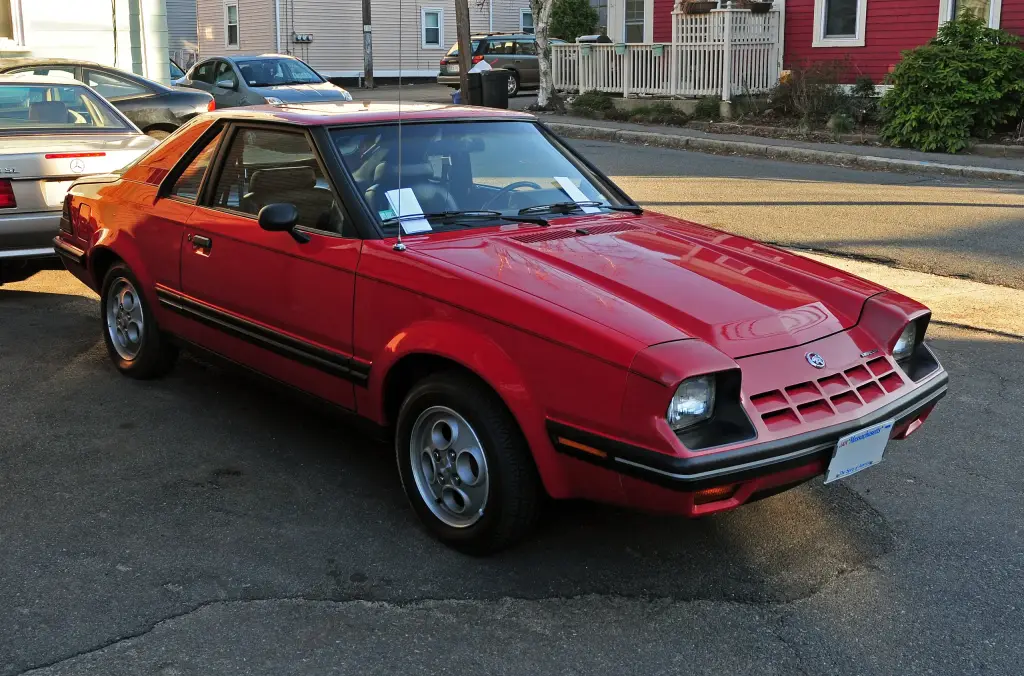
The Mercury LN7 was the Mercury-badged version of the Ford EXP, a two-seat sport compact coupé based on the North American Ford Escort. It was sold for 1982 and 1983 only, and every LN7 was built at Ford’s St Thomas plant in Ontario.
Mercury LN7 at a glance
| Production | 1982–1983 model years |
|---|---|
| Based on | Ford EXP, derived from the North American Ford Escort |
| Body | two-seat coupé with a low fastback roofline |
| Layout | front-wheel drive, transverse engine |
| Wheelbase | 94.2 inches |
| Engine | 1.6 L CVH four, 70 hp |
| Gearbox | four-speed manual transaxle standard |
| Suspension | four-wheel independent, shared with the Escort |
| Built at | St Thomas Assembly, Ontario |
| Production dates | 16 February 1981 to 30 June 1983 |
The LN7 is described in the English Wikipedia article on the Ford EXP, which is the only source used here; the article is based on one source.
History of the Mercury LN7
Ford’s two-seater
The Ford EXP was a sport compact coupé built from 1982 to 1988 over two generations. It was the first two-seat Ford since the original Thunderbird and was sold only in North America. The car was derived from the American Ford Escort and shared its powertrain and chassis, but received model-specific front and rear styling and a new, lower coupé roofline that turned the Escort’s rear seat area into cargo space. Ford marketed a badge-engineered version through Mercury for 1982 and 1983 under the name LN7.
The idea behind the EXP came from Ford’s market research. A growing number of one- and two-person households and younger buyers’ appetite for small sporty cars led the company to conclude that Americans wanted a “lively little car that is dependable, efficient, and good-looking”. Ford Division general manager Louis E. Latalf compared it to the 1955–1957 Thunderbird: another two-seater with the same flair, but affordable and economical. A series of sporty concepts built by Ford’s Ghia studio, including the 1981 EXP-II on an Escort platform, foreshadowed the production car’s shape.
Built in Ontario
Development took place at Ford’s St Thomas Assembly plant in Ontario, where the majority of EXPs and LN7s were produced, including all of both models for 1982 and 1983. The plant built EXPs from 16 February 1981 to 5 August 1983 and LN7s from 16 February 1981 to 30 June 1983, ending the LN7 with the 1983 model year while American plants continued the EXP until 1988. Ford had expected to build and sell 200,000 EXPs and 70,000 LN7s in the 1982 model year, but only about half of those numbers reached production.
The engineering
The LN7 shared the Escort’s unibody construction, 94.2-inch wheelbase, front-wheel drive and four-wheel independent suspension. At 50 inches tall and 14 feet long, the EXP was longer and lower than the North American Escort. Performance was unremarkable: the car weighed about 200 lb more than the contemporary Escort but used the same 1.6 L CVH engine rated at 70 hp, with a standard four-speed MTX-I manual transaxle. Ford had planned a 1.3 L CVH as well, but only the larger engine was offered, tuned for fuel economy rather than power. The March 1981 issue of Car and Driver reported 44 mpg on the highway for an EXP with a manual gearbox. The styling included a sharply sloped windscreen, prominent wheel-arch lips, wide body-side mouldings and a minimalist grille of two horizontal slots, with a dog-leg hatch at the back.
Why it is rare
Two model years
The LN7 lasted only 1982 and 1983, and Mercury never replaced it as a two-seater. Ford continued the EXP on its own until the model was discontinued after 1988.
Design and features
- Two seats only: the Escort’s rear seat area became cargo space.
- Mercury version of the EXP: the same body and mechanicals with Mercury trim.
- Escort underneath: 94.2-inch wheelbase, front-wheel drive and independent suspension.
- Economy engine: a 70 hp 1.6 L CVH four with a four-speed manual.
- Two-year life: 1982 and 1983 only, all built at St Thomas in Ontario.
Mercury LN7 versions
- LN7 (1982): the launch car, offered with the 1.6 L CVH engine.
- LN7 (1983): the final model year, built until 30 June 1983.
- Ford EXP: the sister car, sold through Ford dealers and built until 1988.
The LN7 shared its Escort base with the Lynx and was the smallest coupé in the range below the Capri. More cars are in the Mercury collection.
Video: Ford EXP Mercury LN7 Owners Club
Video by EsOne on YouTube.
Sources
- Ford EXP, English Wikipedia: development, LN7 production dates, engines and dimensions