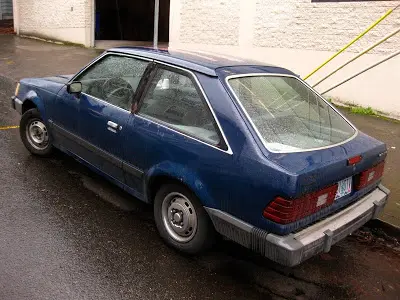
The Mercury Lynx was the Mercury-badged version of the first-generation North American Ford Escort. It went on sale for 1981, when the Escort replaced the Pinto as Ford’s small car, and stayed in production until 1990, when the Tracer took its place.
Mercury Lynx at a glance
| Production | 1981–1990 model years |
|---|---|
| Based on | first-generation North American Ford Escort |
| Replaced | Mercury Bobcat |
| Replaced by | Mercury Tracer |
| Driven wheels | front |
| Engine | CVH inline-four, shared with the European Escort |
| Wheelbase | 94.2 inches |
| Body styles | three-door hatchback, five-door hatchback, five-door station wagon |
| Trim levels | base, L, GL, GLX and SS |
| Launch date | 3 October 1980 for the 1981 model year |
The Lynx itself is mentioned only briefly in the English Wikipedia article on the North American Ford Escort, which is the only source used here; the article is based on one source.
History of the Mercury Lynx
A world car, American style
The North American Ford Escort was intended as a world car, developed by Ford in North America together with Ford of Europe, which had sold cars called Escort since 1968. The programme was meant to replace the North American Ford Pinto and the European Escort Mk II with a single architecture for a 1981 launch. During development the American and European teams diverged: the two cars share the same basic shape and the same 94.2-inch wheelbase, but no body parts are interchangeable, and the only common components are the CVH inline-four engine and the ATX automatic transmission. The American car is longer and wider, with more chrome trim, and was given its own heavier appearance. Lincoln-Mercury marketed the first-generation Escort as the Mercury Lynx.
The first-generation Escort was launched on 3 October 1980 for the 1981 model year, replacing the Pinto and largely taking over from the imported Fiesta as Ford’s smallest North American car. The Escort became the best-selling car in the United States after 1982 and held that position for much of the 1980s. For 1981 the Escort came as a three-door hatchback and a five-door station wagon, with a five-door hatchback added in May 1981. To show off its “world car” status, Ford designed an Escort badge with a globe on the front wings, used for 1981 only. The wagon could be ordered with an imitation woodgrain Squire package in GL and GLX trim. For 1982 the badges were revised to carry the Ford blue oval, and the SS package of 1981 added blacked-out trim, stripes and decals.
The Lynx in the Mercury range
The Lynx replaced the rear-wheel-drive Bobcat as Mercury’s small car and gave the division a modern front-wheel-drive hatchback to sell against imported compacts. Underneath it was pure Escort: a transverse CVH engine, front-wheel drive and a chassis shared, in its basic design, with the European car. The same first-generation Escort also served as the basis of the longer-wheelbase Ford Tempo and Mercury Topaz and of the two-seat Ford EXP and Mercury LN7, which shows how widely Ford spread the platform.
The Escort on which the Lynx was based was built at Ford’s American and Canadian plants, including Wayne Stamping & Assembly in Michigan, Edison Assembly in New Jersey, San Jose Assembly in California and Oakville Assembly in Ontario. For 1991 the Escort moved to a second generation that shared a platform with the Mazda 323 and a body with the Ford Laser, and the Lynx was replaced in the Mercury range by the Tracer. The Escort itself carried on in North America until the 2002 model year.
Design and features
- Front-wheel drive: the Lynx marked Mercury’s move away from rear-wheel-drive compacts.
- CVH engine: the inline-four shared with the European Escort.
- Three body styles: three-door hatchback, five-door hatchback and station wagon.
- Squire wagon: imitation woodgrain trim in GL and GLX form.
- Best-seller base: the Escort it was based on became America’s best-selling car after 1982.
Mercury Lynx versions
- Lynx three-door hatchback: the basic small Mercury of the 1980s.
- Lynx five-door hatchback: added in May 1981.
- Lynx station wagon: available with the Squire woodgrain package.
- Lynx SS (1981): blacked-out trim, stripes and decals.
The Lynx replaced the Bobcat and was itself replaced by the Tracer; it shared its platform with the LN7 and the Topaz. More cars are in the Mercury collection.
Video: Mercury Lynx Hatchback L Station Wagon Ford Escort 5 Door 85 1.9L Test Drive Walk Around Video
Video by Cereal Marshmallows on YouTube.
Sources
- Ford Escort (North America), English Wikipedia: development, launch, body styles, trim, plants and the Lynx’s place in the range