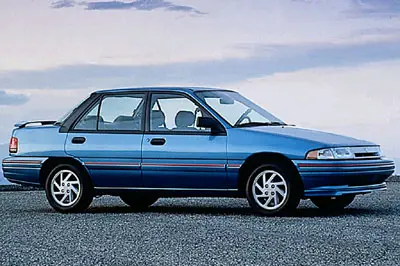
The Mercury Tracer was a compact car sold from 1987 to 1999 as the replacement for the Lynx. It came in three generations: the first was developed by Mazda and built outside North America, while the later two were counterparts of the Ford Escort.
Mercury Tracer at a glance
| Production | 1987–1999 model years |
|---|---|
| Replaced | Mercury Lynx |
| Generations | three |
| Bodies | three-door hatchback, five-door hatchback, five-door station wagon, four-door sedan |
| First generation | 1987–1989, derived from the Ford Laser and Mazda 323 |
| First engine | 1.6 L B6 inline-four |
| Power | 71 hp carburetted in Canada, 84 hp fuel-injected in the USA |
| Gearboxes | five-speed manual standard, three-speed automatic optional |
| Built first generation | Ford Lio Ho, Taiwan; Hermosillo, Mexico |
| Later generations | counterparts of the Ford Escort |
The article is based on one source, the English Wikipedia page on the Tracer; its material covers the first generation in most detail.
History of the Mercury Tracer
A Mercury without a Ford twin
For 1987 Mercury introduced the Tracer to replace the Lynx as its subcompact. It was the first Mercury since the 1960 full-size range to share no commonality with a Ford model in North America: the Tracer was derived from the Ford Laser, itself a variant of the Mazda 323. The Laser had been redesigned in 1985 and was sold in Asia-Pacific markets in place of the Ford Escort. The first Tracers went on sale in Canada in early October 1986; in the United States the car arrived in March 1987 and was sold alongside the Lynx until the end of that model year.
The Tracer was also the first Mercury assembled outside North America. Canadian cars, three-door and five-door hatchbacks, came from Ford Lio Ho in Taiwan, while cars for the United States, including the station wagon, were built at Hermosillo Stamping & Assembly in Mexico. The Tracer had almost no United States parts content and therefore did not count towards lowering Ford’s Corporate Average Fuel Economy.
The Mazda chassis
The Tracer was the American counterpart of the Australian-market Ford Laser KE, also sold in Japan, Asia and South Africa. Although the Laser had a slightly different body, it shared its chassis with the front-wheel-drive Mazda 323, designated the Mazda BF platform. A 1.6-litre B6 inline-four from the 323 was offered: Canadian cars had a 71 hp carburetted engine, while the United States got an 84 hp fuel-injected version. A five-speed manual was standard with a three-speed automatic as an option. Like its Lynx predecessor, the Tracer came as a three-door and a five-door hatchback; for the United States a five-door station wagon was added for 1988. It shared its exterior with the Ford Laser apart from a Mercury grille, badges, wheel covers, clear-lens front marker lights and small changes to the hatchback and wagon tailgates, the wagon sharing almost identical sheet metal with the 323 wagon.
The end of the first car
The first-generation Tracer was sold through the 1989 model year, matching the model cycle of its Laser counterpart. Mexican assembly ended in August 1989, with late examples sold as “89½” models into calendar year 1990, and Tracer sales in the United States actually picked up in model year 1989 despite the cancellation. In Canada imports ended during 1989: 5,489 Tracers were sold there in calendar year 1988 and 1,775 in 1989.
Later generations
The second and third generations of the Tracer served as counterparts of the Ford Escort, and the whole model line, including two generations of the Escort, was derived from the Mazda 323 and Protegé. A four-door sedan arrived with the second generation. Mercury discontinued the Tracer after the 1999 model year as Ford began phasing out the Escort in favour of the Focus for 2000. Without a Mercury counterpart to the Focus, the brand left the compact car segment. A fourth-generation Tracer was planned for a 2012 release but the project was abandoned after Mercury closed in 2010.
Design and features
- Mazda underneath: the first Tracer was derived from the Ford Laser and Mazda 323.
- No Ford twin: the first Mercury since 1960 without a direct Ford counterpart in North America.
- Built abroad: Taiwan for Canada, Mexico for the United States.
- Hatchbacks and wagon: three- and five-door hatchbacks plus a five-door wagon.
- Escort years: the later generations were Mercury versions of the Ford Escort.
Mercury Tracer versions
- Tracer (1987–1989): the Mazda-based first generation.
- Tracer (second generation): an Escort counterpart with a sedan body added.
- Tracer (third generation): the final Escort-based cars.
- Canadian and American sources: Taiwanese hatchbacks for Canada, Mexican cars including the wagon for the USA.
The Tracer replaced the Lynx and was itself replaced in spirit by the Mystique; it shared its Mazda base with later Escort-based Mercurys. More cars are in the Mercury collection.
Sources
- Mercury Tracer, English Wikipedia: generations, Mazda origins, engines, plants and the end of production