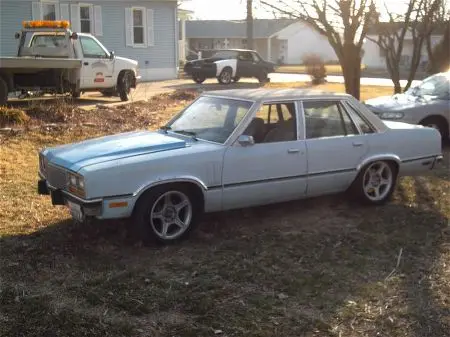
The Mercury Zephyr was the Mercury-badged version of the Ford Fairmont, sold from the 1978 to the 1983 model year. It replaced the Monarch as Mercury’s compact and was one of the first cars to use Ford’s rear-wheel-drive Fox platform.
Mercury Zephyr at a glance
| Production | 1978–1983 model years |
|---|---|
| Counterpart | Ford Fairmont |
| Replaced | Mercury Monarch |
| Replaced by | Mercury Topaz (front-wheel drive, 1984) |
| Platform | Ford Fox, rear-wheel drive |
| Bodies | two-door notchback sedan, two-door coupe, four-door sedan, five-door station wagon |
| Launch | August 1977 as a 1978 model |
| Fox longevity | the platform lasted, updated, until model year 2004 |
| Ford milestone | a 1978 Fairmont Futura coupe was Ford’s 100 millionth vehicle |
| Fox relatives | shared with twelve other Ford, Mercury and Lincoln lines |
The Zephyr is described in the English Wikipedia article on the Ford Fairmont, which is the only source used here; the article is based on one source, and no free photographs of the Mercury Zephyr were found.
History of the Mercury Zephyr
Planning a smaller compact
In April 1973 the American EPA published its first comprehensive fuel economy list, and in October the oil crisis began. Ford’s North American range then consisted of the subcompact Pinto and Mustang II and the compact Maverick, and replacements for all of them would soon be needed. At the same time Ford of England’s Cortina and Ford of Germany’s Taunus needed refreshing. William O. Bourke, a former chairman of Ford of Europe, became executive vice president of North American Operations, and Robert Alexander, who had been in charge of car development at Ford of Europe, took the same post in the United States.
Hal Sperlich, Ford’s vice-president of product planning and research and a supporter of downsizing, conceived a “world car” that could be sold in Europe and North America to meet the needs of the different divisions. Some sources say the Fox name was borrowed from the Audi 80, sold in the United States and Australia as the Audi Fox from May 1973, because Ford executives saw the 80 as their class-leading subcompact rival and used it as the benchmark; other reports show Ford using the Fox name in an internal report as early as February 1973. In December 1973 Ford president Lee Iacocca formally approved development of the Fox platform.
Two wheelbases, one platform
Although the Fairmont was the first Fox-based car to reach the market, development was guided by an anticipated sport coupe on the new platform. Work began in early 1973 on both a short-wheelbase version to replace the Pinto, Cortina and Taunus and a long-wheelbase version that became the Fairmont. By 1974 the difficulties of meeting conflicting regulations in different markets and the different production methods of the various divisions had killed the world-car idea, and in 1975 North American Automobile Operations took over development of the Fox platform. The first running Fox prototype was a modified Cortina with MacPherson strut and torsion bar front suspension.
The Fairmont and Zephyr
The Ford Fairmont was launched in August 1977 as a 1978 model, the successor of the Ford Maverick and the third generation of Ford’s North American compact sedans. It was initially positioned between the Pinto and the Granada and later between the Escort and the LTD. Unlike its predecessor, which came only as a two-door or four-door sedan, the line offered a two-door notchback sedan, a two-door coupe, a four-door sedan and a five-door station wagon. Mercury sold a rebadged version as the Mercury Zephyr. As the first models on Ford’s new rear-wheel-drive Fox platform, replacing cars based on the Falcon, the Fairmont and Zephyr ultimately shared that platform with twelve other Ford, Mercury and Lincoln lines; although the Fairmont was built for only six model years, the Fox platform continued in updated form through model year 2004. On 15 November 1977 a 1978 Fairmont Futura coupe became the 100 millionth vehicle assembled by Ford Motor Company.
The end
For 1984 the Fairmont, and with it the Zephyr, was replaced by the front-wheel-drive Ford Tempo and Mercury Topaz, which brought aerodynamic styling to the compact class. The Zephyr thus closed Mercury’s rear-wheel-drive compact chapter that had run from the Comet through the Maverick-based cars and the Monarch.
Design and features
- Fairmont twin: the Mercury version of the Ford Fairmont, with its own grille and trim.
- First Fox cars: the Fairmont and Zephyr introduced Ford’s long-lived rear-wheel-drive platform.
- Four body styles: two-door notchback, two-door coupe, four-door sedan and wagon.
- Compact replacement: the Zephyr succeeded the Monarch in Mercury showrooms.
- Replaced by front-wheel drive: the Topaz took over for 1984.
Mercury Zephyr versions
- Zephyr two-door notchback sedan: the basic two-door body.
- Zephyr two-door coupe: the sportier two-door with its own roofline.
- Zephyr four-door sedan: the family body.
- Zephyr Villager (1978–1981): the wood-trim station wagon version.
The Zephyr replaced the Monarch and was replaced by the Topaz; it was also the wagon that carried the Villager name in 1978–1981. More cars are in the Mercury collection.
Video: Mercury Zephyr vs GTO
Video by NXGonzoVideo on YouTube.
Sources
- Ford Fairmont, English Wikipedia: Fox platform development, launch, body styles, the 100 millionth car and replacement