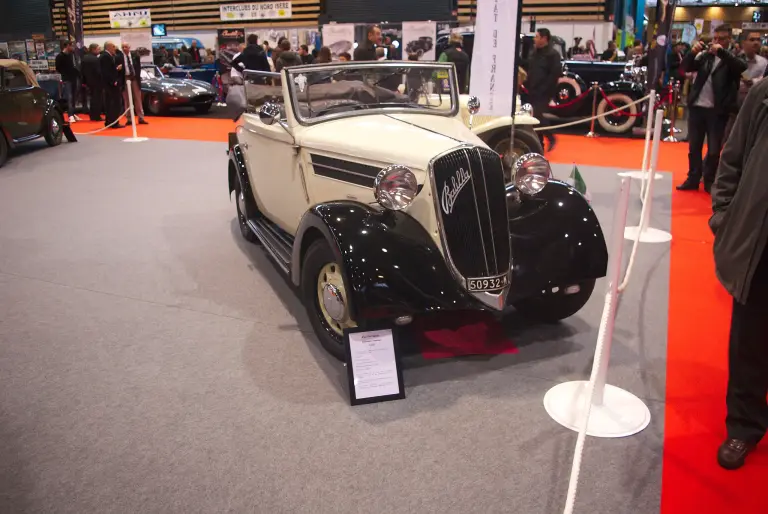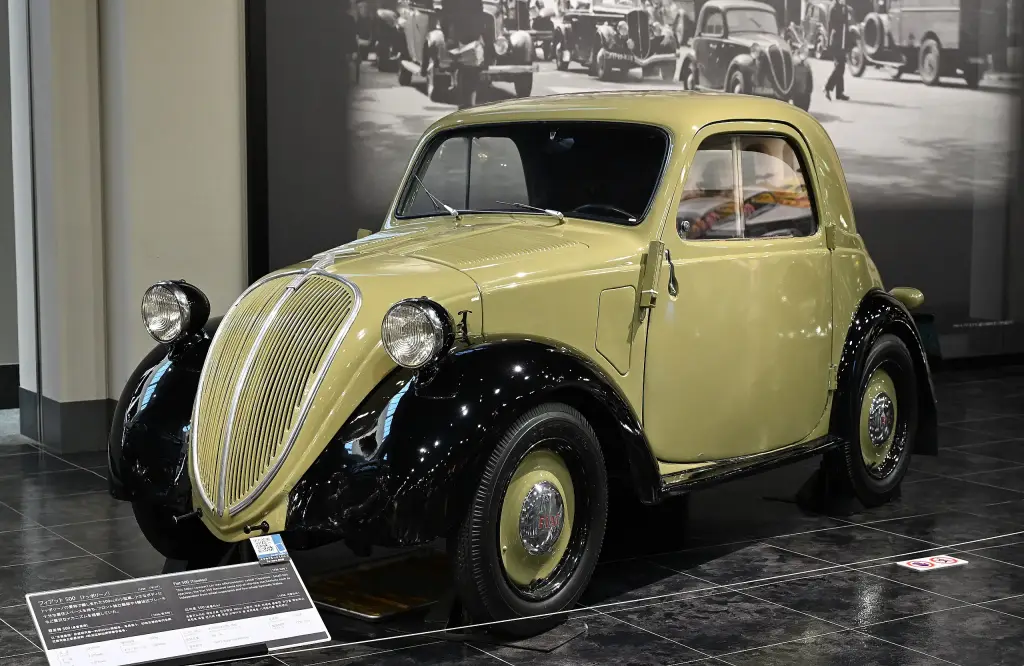
The Fiat 500, commonly known as the Topolino — Italian for “little mouse” and also the Italian name of Mickey Mouse — was a city car built by Fiat from 1936 to 1955. It was one of the smallest cars in the world at the time, and three models were produced with only minor mechanical and cosmetic changes.
Fiat 500 Topolino at a glance
| Production | 1936–1955 |
|---|---|
| Also called | Topolino, little mouse |
| Engine | 569 cc four-cylinder, side valve, water cooled |
| Engine position | in front of the front axle |
| Power | 13 bhp in the Model A, 16 hp in the B and C |
| Top speed | about 85 km/h |
| Fuel consumption | up to about 6 l/100 km |
| Price at launch | 9,750 lire |
| Total built | nearly 520,000 |
| Models | 500 A, 500 B, 500 C |
History of the Fiat 500 Topolino
Design
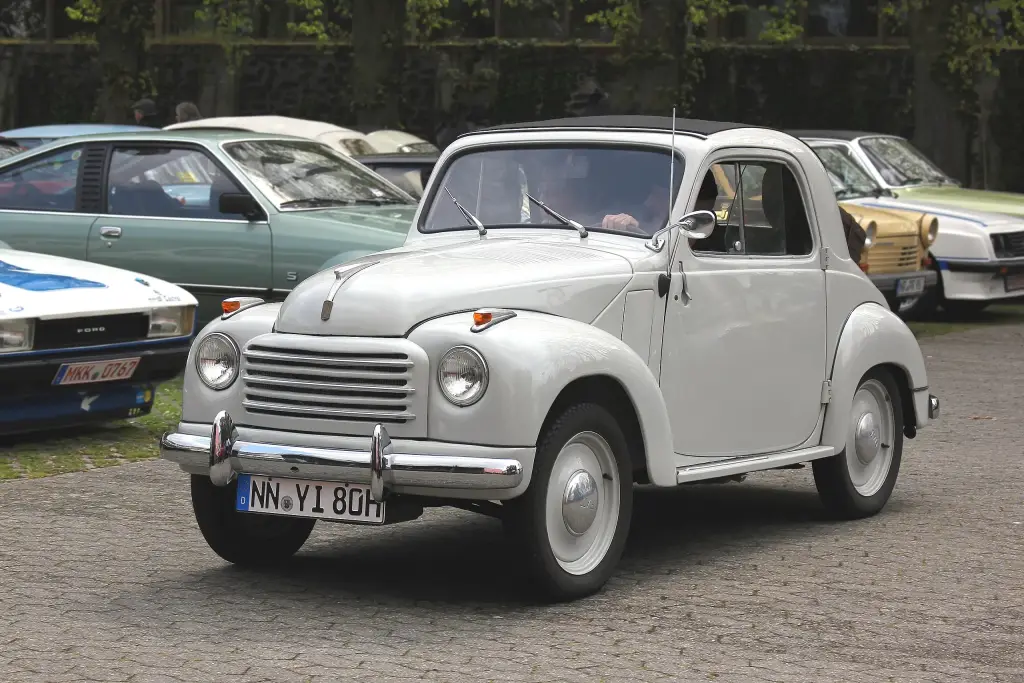
The Topolino was launched in June 1936. Its 569 cc four-cylinder side-valve water-cooled engine sat in front of the front axle, an arrangement that made it a full-scale car rather than a cyclecar, and later versions used an overhead-valve head. The radiator was placed behind the engine, which allowed a lowered aerodynamic nose at a time when rivals had flat, almost vertical grilles; the shape of the front also gave exceptional forward visibility.
Rear suspension initially used quarter-elliptic springs. Buyers frequently squeezed four or five people into the nominally two-seater car, so in later models the chassis was extended at the rear to take more robust semi-elliptic springs. With an output of around 10 kW (13 bhp) the car reached about 85 km/h and could return up to an estimated 6 litres per 100 km. The target price when the car was planned was 5,000 lire; it was launched at 9,750 lire, and later in the 1930s sold for about 8,900 lire. Despite being more expensive than planned it was competitively priced, and nearly 520,000 were sold.
Model A and Model B
The Model A and Model B shared the same body, but the Model B engine produced 16 hp against 13 hp for the Model A. The A was built from 1937 to 1948 and the B in 1948 and 1949. The Model A came as a two-door saloon, a two-door convertible saloon with a folding roof and a two-door van; the Model B added a three-door estate called the 500 B Giardiniera, or “gardener”. The Giardiniera was first offered as a woodie with an outside ash frame instead of steel, in seven metallic colours; when it was later renamed Belvedere the wood gave way to metal. This model and the regular two-seater convertible saloon were also built in France by Simca as the Simca 5 and in Germany by the German Fiat subsidiary NSU-Fiat.
Model C
The Model C appeared in 1949 with a restyled body and the same engine as the Model B. It was offered as a two-door saloon, a two-door convertible saloon, a three-door estate and a two-door van. In 1952 the Giardiniera was renamed Belvedere, a reference to its sunroof, and the Model C stayed in production until 1955. In that year Fiat launched the larger rear-wheel-drive Fiat 600, which became the design basis for the new Fiat 500, the Nuova 500; the two new models replaced the original 500.
In popular culture
La Topolino Amaranto is a 1975 song by Paolo Conte about the summer of 1946, so the car it mentions is probably a first-model 500 A in amaranth. From the 1950s the Topolino became a popular choice for hot rodders in North America, thanks to its light weight, rear-wheel drive and the room under the bonnet for a V8. In the 2011 animated film “Cars 2” the character Uncle Topolino is based on a first-generation car.
Design and features
- Ahead of the axle: the engine sat in front of the front axle, making a real car of it.
- Radiator behind the engine: this allowed a low, aerodynamic nose and fine forward visibility.
- Economy: up to about 6 l/100 km from 13–16 hp.
- Giardiniera estate: first a wood-framed woodie, later the metal-bodied Belvedere.
- Built abroad: as the Simca 5 in France and by NSU-Fiat in Germany.
Fiat 500 Topolino versions
- 500 A: 13 hp, built 1937–1948 as saloon, convertible saloon and van.
- 500 B: 16 hp, 1948–1949, and the first Giardiniera estate.
- 500 C: restyled body from 1949, built until 1955.
- Giardiniera and Belvedere: three-door estates, wood-framed at first and metal-bodied later.
- Simca 5 and NSU-Fiat: licence-built versions in France and Germany.
The Topolino was replaced by the Fiat 600 and by the new Fiat 500 of 1957. The pre-war saloon range above it included the Fiat 508 Balilla, and more cars are in the Fiat collection.
Sources
- Fiat 500 “Topolino”, English Wikipedia: design, models A to C, prices, production and popular culture