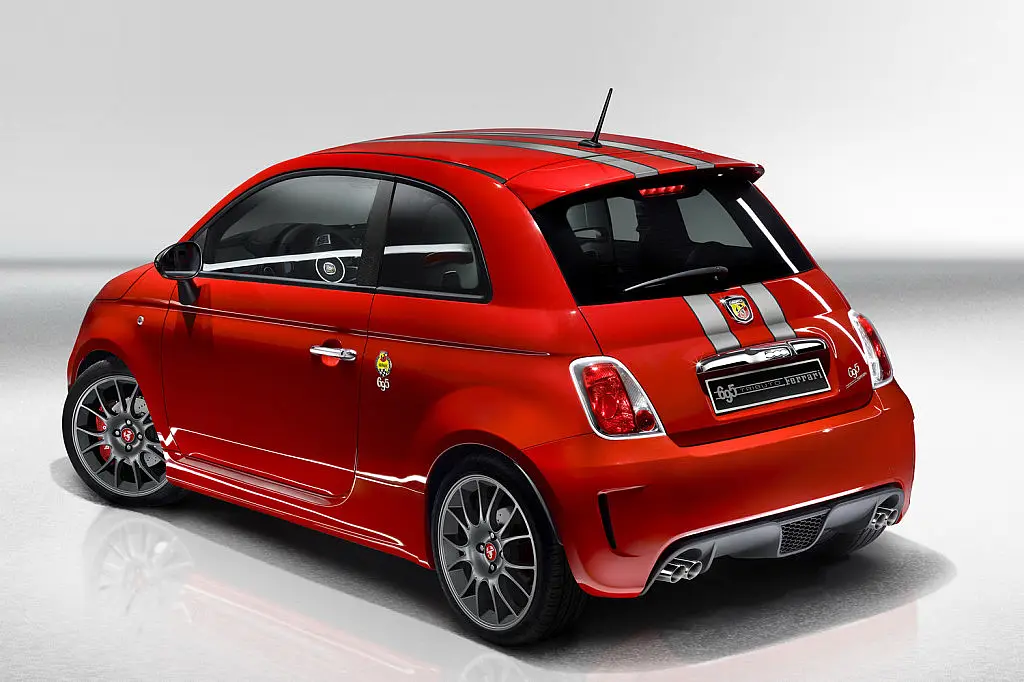
The Fiat 500, known in Italy as the Cinquecento, was an economy city car built and sold by Fiat from 1957 until 1975. Launched as the Nuova 500, it replaced the 500 Topolino, measured 2,970 mm in length and was powered by a rear-mounted 479 cc two-cylinder air-cooled engine.
Fiat 500 at a glance
| Production | 1957–1975 |
|---|---|
| Also called | Nuova 500, Cinquecento |
| Body | two-door saloon, semi-convertible, estate, panel van |
| Engine | rear-mounted 479 cc air-cooled two-cylinder |
| Power | 13 hp in the Nuova 500, 21.5 PS in the 500 Sport |
| Length | 2,970 mm |
| Drag coefficient | 0.38 |
| Replaced | Fiat 500 Topolino |
| Replaced by | Fiat 126 |
| Licence production | Neckar in Germany, Steyr-Puch in Austria |
History of the Fiat 500
From Topolino to Nuova 500
Fiat had released the front-engined 500 economy car, better known as the Topolino, in 1936. Production resumed in 1949 with revised front and rear bodywork on the 500C, at first only as a two-door coupé with a sunroof and later also as an estate with a rear seat. Both continued until 1955, when they were replaced by the lighter, all-new Fiat 600, which put its engine at the rear on the pattern of the Volkswagen Beetle. Two years later Fiat introduced an even smaller rear-engined model, the Nuova 500. Several makers followed the then unusual rear-engine layout with some success: from October 1961 a Neckar version of the 500 was built in Heilbronn under an arrangement involving NSU, and Steyr-Puch built the car under licence in Graz.
The first models
The Nuova 500 had a 479 cc twin, hence the name, producing 13 hp, and a fabric roof that folded back to the rear of the car in the manner of the Topolino rather than stopping halfway as later roofs did. It was one of three Fiat models with suicide doors. Including the Sport, 181,036 Nuova 500s were built between 1957 and 1960. The Nuova 500 Sport of mid-1958 came with a more powerful engine and a two-tone white livery with a red stripe along the flanks, and was alone in having an all-metal rigid roof with three longitudinal grooves; a short open-roof model followed in 1959. Coded type 110.004, its engine was bored out to 499.5 cc from 479 cc, with bore and stroke of 67.4 by 70 mm, giving 21.5 PS and a top speed above 105 km/h. The 1958–61 500N was the only version officially sold in North America, although the car was a popular grey-market import in the 1960s and 1970s.
500 D and Giardiniera
The 500 D replaced the Nuova in 1960. It looked much the same but had a 499 cc engine of 17 hp, used until the end of the L in 1973, and a roof that did not fold as far back, plus a Transformable version with the Nuova roof; it kept the suicide doors. In New Zealand, where Torino Motors assembled it, it was sold as the Fiat Bambina. The Giardiniera estate, called 500 K in some markets, was the longest-running model: its engine sat under the boot floor to give a flat loading surface, the roof ran all the way to the rear, the wheelbase was 100 mm longer, the engine lay on its side and the brakes came from the Fiat 600. The Giardiniera also kept suicide doors and was the only version to use them into the 1970s. In 1966 production moved to Desio, where the car was built by Fiat’s subsidiary Autobianchi under its own marque from 1968 to 1977.
End of production and revival
Fiat ended 500 production in 1975, two years after launching its replacement, the Fiat 126, which was less successful in Italy but sold well in the Eastern Bloc and was built in Poland as a Polski Fiat. Sports versions came from Abarth and Giannini, and the Austrian Steyr-Puch 500 of 1957–1973 used a Puch boxer twin, with the sporting 650 TR2 built from 1965 to 1969. In 1959 Dante Giacosa received a Compasso d’Oro for the 500, the first time the prize went to a car maker. In 2007, fifty years after the Nuova 500, Fiat launched a new 500 inspired by the original but with a front engine and front-wheel drive.
Design and features
- Rear-mounted air-cooled twin: 479 cc in the Nuova, 499 cc in the D, with no radiator.
- Small size: 2,970 mm long, 245 mm shorter than the Fiat 600, and a drag coefficient of 0.38.
- Fabric roof: the early cars had a roof folding back to the rear of the body.
- Suicide doors: front-hinged doors stayed on the Giardiniera into the 1970s.
- Giardiniera layout: engine under the boot floor for a flat load area.
Fiat 500 versions
- Nuova 500 (1957–1960): 479 cc, 13 hp, full-length folding roof.
- 500 Sport (1958–1960): 499.5 cc, 21.5 PS, metal roof and two-tone paint.
- 500 D (1960–1965): 499 cc, 17 hp, shorter folding roof.
- 500 Giardiniera: estate with a longer wheelbase and the engine under the floor.
- Steyr-Puch 500: Austrian licence version with a Puch boxer twin, 1957–1973.
The 500 replaced the Fiat 500 Topolino and sat below the Fiat 600; its successor was the Fiat 126. More cars are in the Fiat collection.
Sources
- Fiat 500, English Wikipedia: production dates, dimensions, engine, models, licence production and the 2007 revival