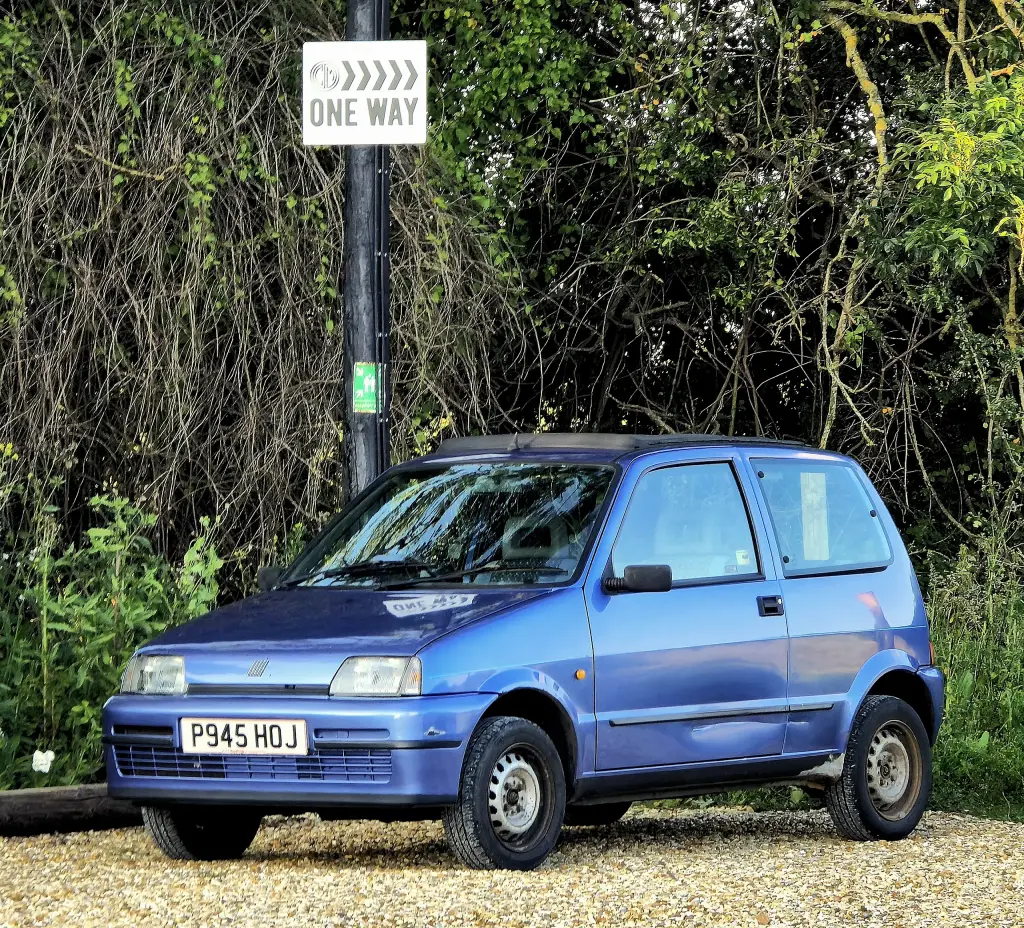
The Fiat Cinquecento, type 170, is a city car that Fiat manufactured and marketed from 1991 to 1998 over a single generation. It is a three-door hatchback with four seats and a front-engine, front-wheel-drive layout, built at Fiat Auto Poland, which had also built its predecessor, the Fiat 126. Production ended in 1998 with the arrival of the Fiat Seicento.
Fiat Cinquecento at a glance
| Production | 1991–1998 |
|---|---|
| Internal code | Type 170 |
| Body | three-door hatchback, four seats |
| Layout | front engine, front drive |
| Built at | Fiat Auto Poland |
| Engines | 704 cc two-cylinder, 899/903 cc four, 1,108 cc FIRE |
| Power | 31 PS, 39–40 PS and 54 PS |
| Suspension | independent front and rear |
| Brakes | front discs |
| Designer | Ermanno Cressoni with Antonio Piovano |
| Replaced | Fiat 126 |
| Replaced by | Fiat Seicento |
Based on one source, the English Wikipedia article.
History of the Fiat Cinquecento
The origins of the Cinquecento go back to the early 1980s, when research projects of the Consiglio Nazionale delle Ricerche in Rome studied a super-economical vehicle, from which a series of prototypes coded X1/72 to X1/79 evolved. In parallel FSM, not yet owned by Fiat, was working on the BOSMAL small car project that led to the Beskid 106 concept. Fiat’s acquisition of FSM meant the Polish prototype was abandoned in favour of a car that took over some of the ideas of the Italian X1/7 series; until 1993 the cars built in Poland were sold as FSM rather than as Fiat. Patrick Le Quément, Renault’s chief designer, drew similar inspiration from the BOSMAL study for the first Renault Twingo.
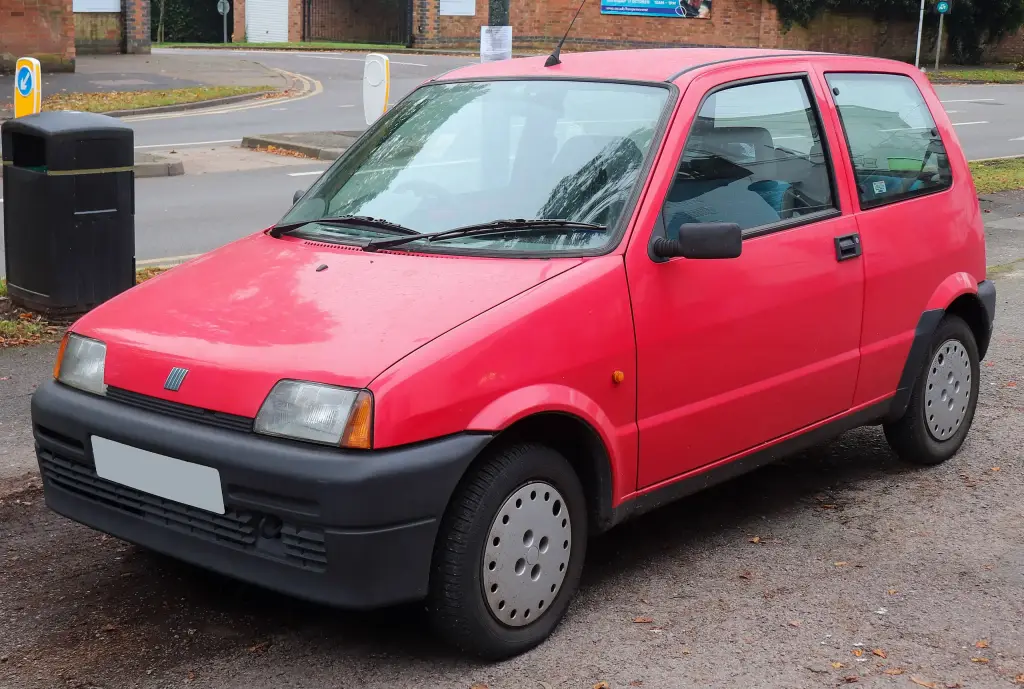
The Cinquecento was launched in December 1991 to replace the Fiat 126. It was designed by Ermanno Cressoni with Antonio Piovano, while the interior was the work of Claudio Mottino and Giuseppe Bertolusso. The car had independent suspension at both ends, front disc brakes, side impact beams, a crumple zone and galvanised body panels, and used unassisted rack-and-pinion steering. Options included central locking, power windows, a sunroof, a full-length retractable canvas roof, a split rear seat, headlight range adjustment and air conditioning. A right-hand-drive version for the British market followed in June 1993, making the Cinquecento one of the few city cars sold in the United Kingdom.
Two engines were offered at first, with a 1.1-litre FIRE "sporting" unit added later. The smallest, a 704 cc overhead-valve two-cylinder of 31 PS, or 30 PS with a catalytic converter, was intended for sale in Poland only and came from the 126p BIS, an evolution of the 126p cancelled when Cinquecento production began. To suit the front-wheel-drive layout it was heavily redesigned, and its crankshaft now turned in the opposite direction; it kept a carburettor.
The larger engine was the 903 cc 40 PS version of the long-serving Fiat 100 overhead-valve four, an engine that began as the 633 cc unit of the 1955 Fiat 600 and served in many small Fiats from the 850 onwards. It had single-point fuel injection and was the base engine in most markets; fiscal limits cut its capacity to 899 cc in 1993, with output falling slightly to 39 PS. Though it kept the overhead-valve, chain-driven pushrod layout, it gained hydraulic tappets and twin-coil distributorless ignition.
In 1994 Fiat introduced the Cinquecento Sporting with the 1,108 cc single-overhead-cam FIRE engine of 54 PS from the entry-level Punto, mated to a close-ratio gearbox. It also had a lower ride height, a front anti-roll bar, 13-inch alloy wheels, colour-coded bumpers and mirrors, and inside a tachometer, sports seats, red seat belts and a leather steering wheel and gear knob. The Sporting gave rise to a rallying trophy and to a Group A Kit-Car version.
From 1992 to 1996 Fiat built and sold an electric variant, the Cinquecento Elettra, with a lead-acid battery pack giving a range of 100 km or a nickel-cadmium pack giving 150 km. Unlike purpose-built electric cars it used two packs, one in the engine bay and one under the rear seat in place of the fuel tank. At 140,000 francs, roughly 23,000 US dollars, it was relatively popular in Italy, France and Switzerland. Fiat also offered factory Abarth extras, but these were cosmetic only, with a front apron and fog lights, a rear apron, side skirts, a rear spoiler with a third brake light and optional 13-inch Speedline alloys; there were no engine upgrades and no separate Abarth model. Several concept cars were based on the Cinquecento, among them the 1992 Italdesign proposal and the 1993 Lucciola by Fabrizio Giugiaro, a design that instead reached production in South Korea as the Daewoo Matiz in 1998.
Design and features
- Two layouts: the 704 cc engine was mounted longitudinally and the larger units transversely, a rare combination in one model.
- Modern structure: galvanised panels, a crumple zone and side impact beams.
- Independent suspension: at both the front and the rear.
- Sporting: a 54 PS FIRE engine, close-ratio gearbox and sports trim from 1994.
- Elettra: an electric version with 100 or 150 km of range from 1992 to 1996.
Fiat Cinquecento versions
- Cinquecento 704: two-cylinder Polish-market model of 31 PS.
- Cinquecento 903 and 899: four-cylinder base engine of 40 or 39 PS.
- Cinquecento Sporting: 1,108 cc FIRE engine of 54 PS from 1994.
- Cinquecento Elettra: electric version sold from 1992 to 1996.
- Abarth extras: cosmetic body parts and wheels offered as factory options.
The Cinquecento replaced the Fiat 126 and was itself replaced by the Fiat Seicento. More cars are in the Fiat collection.
Sources
- Fiat Cinquecento, English Wikipedia: origins, design, engines, Sporting, Elettra, Abarth extras