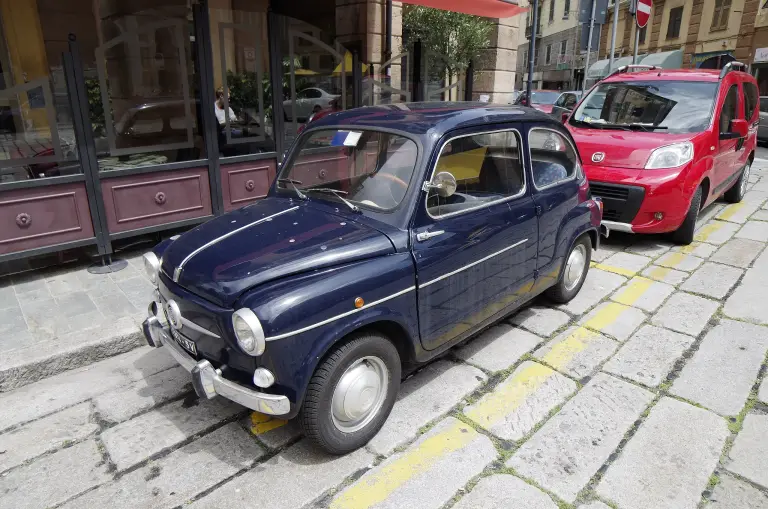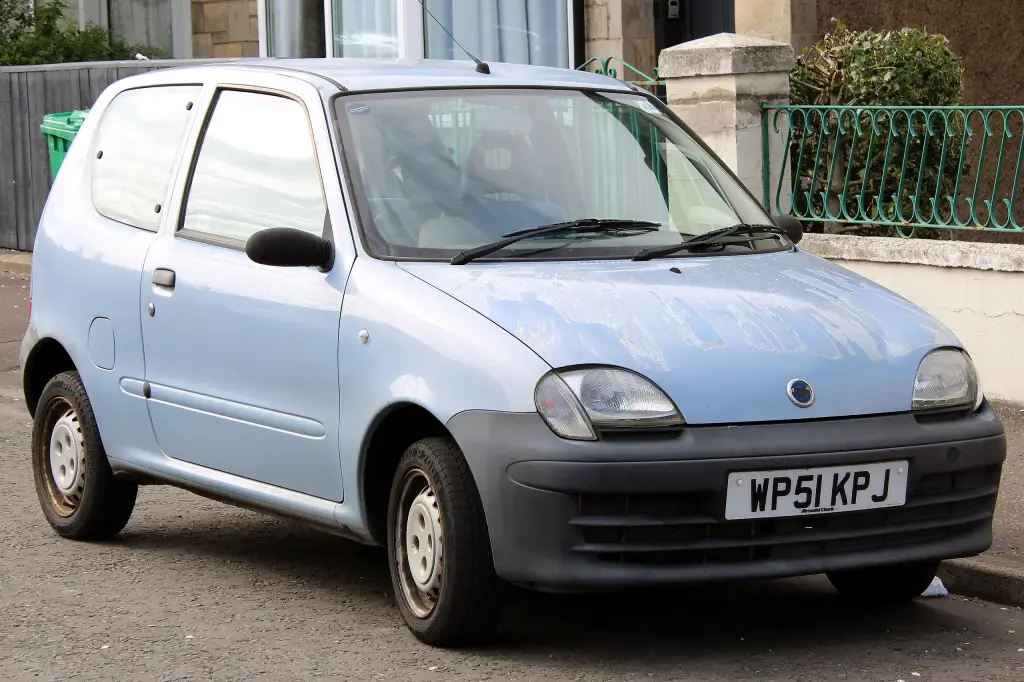
The Fiat Seicento, type 187, is a city car introduced by Fiat at the end of 1997 as a replacement for the Fiat Cinquecento, on which it was also based. It kept the same engines, chassis and general dimensions as its predecessor but grew by 90 mm in length, to 3,340 mm, and was built in Fiat’s factory in Tychy, Poland.
Fiat Seicento at a glance
| Production | 1997–2010 |
|---|---|
| Internal code | Type 187 |
| Length | 3,340 mm |
| Built at | Fiat factory in Tychy, Poland |
| Engines | 899 cc pushrod, 1,108 cc FIRE |
| Power | 40 PS and 54 PS |
| Trim levels | S, SX, Citymatic, Sporting |
| Euro NCAP | 1.5 stars |
| Also called | Fiat 600 from 2005 |
| Units built by April 2004 | 1.1 million |
History of the Fiat Seicento
The Seicento did not differ much from the Cinquecento it replaced. It retained the same engines, chassis and general dimensions, although it gained 90 mm in length for a total of 3,340 mm. Like the Cinquecento and the Polski Fiat 126 before it, the car was built in Fiat’s Polish factory at Tychy. By April 2004, 1.1 million units had been produced. The name comes from the Italian word for 600, and the Seicento is regarded as the spiritual successor to the Fiat 600, a link marked later by rebadging the car as the 600.
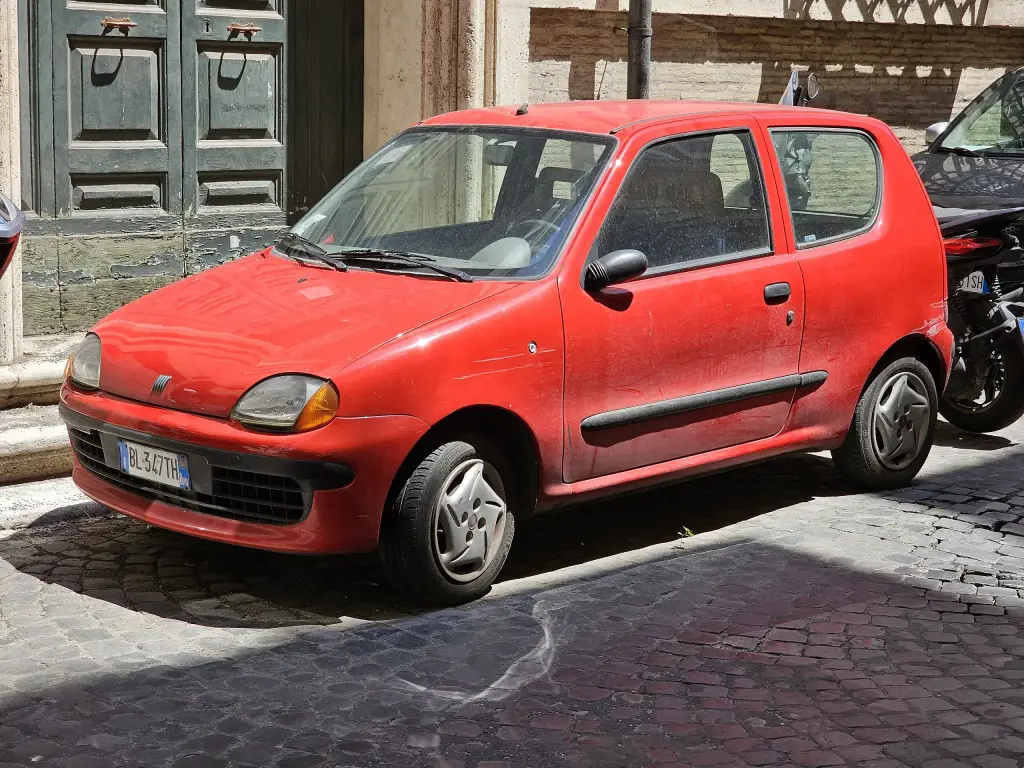
In Euro NCAP crash tests the Seicento was awarded only 1.5 stars, fractionally beating the worst performers in the history of the programme, the Rover 100 and the original Chrysler Voyager MPV. For comparison, another small car, the Smart Fortwo, earned three stars.
At launch three trim levels were offered. The basic S had black bumpers and spartan equipment and initially the 899 cc 40 PS engine of the 100 series. The SX was a slight upgrade with colour-coded bumpers, electric windows, central locking and a sunroof, and was also available as the Citymatic with a clutchless manual gearchange. The Sporting used the larger 1,108 cc FIRE engine of 54 PS, suspension lowered by 20 mm and added anti-roll bars, and brought 13-inch alloy wheels and sports seats. An Abarth styling kit was available with a body kit and optional 14-inch Abarth wheels, and a close-ratio gearbox, sill kick plates, embroidered headrests, a leather gear lever and steering wheel, colour-highlighted bumper trim, side skirts and a spoiler could also be ordered. Both the Sporting and the Abarth versions could be had with ABS, air conditioning and power steering, but few owners paid for the options.
In 1999 the FIRE engine was used in the special Suite version, which came with air conditioning, and a special edition called the Soleil was sold in some markets, based on the SX but with a full-length electrically folding fabric roof. In October 2000, after an update, all cars received clear indicator lenses and the Sporting gained a restyled body kit, while power steering remained optional on the lower models. A Michael Schumacher edition of the Sporting with ABS and the Abarth styling kit was launched at the same time to celebrate the Ferrari driver’s Formula One success; it differed from the ordinary Sporting with the Abarth kit mainly in chrome gear lever surrounds, Michael Schumacher’s signature on the boot lid and side skirts, and a numbered limited-edition plate on the passenger door.
The model was withdrawn from the United Kingdom market in 2004 and production of right-hand-drive cars ceased after the arrival of the more practical Panda, while the left-hand-drive car was facelifted with new wheels and the new Fiat logo at the rear. In 2005 the Seicento name was replaced by 600 to mark the fiftieth anniversary of the original 1955 car, with changes to the front fascia and the interior, where the name Fiat appeared on the seats; the new versions were called Class and 50th Anniversary.
Two engines were offered: the old 899 cc pushrod unit of 40 PS in early S and SX models, dropped from western European markets because of emissions rules, and the 1,108 cc FIRE of 54 PS used in the Sporting from launch. Both used single-point injection; from 2001 the FIRE engine was fitted universally with multi-point injection and replaced the 899 cc unit as emissions rules tightened. Until 2005 Fiat also built a battery-electric Seicento Elettra, produced in series in Italy from 1996 to 1998 and then to order in Poland. It had a 30 kW three-phase asynchronous motor powered by eighteen 12-volt lead-acid batteries in the engine bay and beneath the rear seats, reached 100 km/h and had a range of 90 km. The German tuner Novitec added a turbocharger and a six-speed gearbox to extract 100 PS from the 1,108 cc FIRE engine, and Giannini produced an aggressive body kit. Production ceased in 2010; no direct replacement was announced, as the Panda of 2003, the 500 of 2007 and the budget Palio had taken over its market.
Design and features
- Cinquecento base: the same engines, chassis and dimensions, with 90 mm more length.
- Built in Tychy: the Polish plant that had also built the Cinquecento and the 126.
- Sporting: a 54 PS FIRE engine, lowered suspension, anti-roll bars and 13-inch alloys.
- Elettra: an electric version with a 30 kW motor and 90 km of range.
- Weak crash score: 1.5 stars in Euro NCAP, among the lowest results of the programme.
Fiat Seicento versions
- Seicento S: basic trim with black bumpers and the 899 cc engine.
- Seicento SX and Citymatic: colour-coded trim and a clutchless manual gearbox.
- Seicento Sporting: 1,108 cc FIRE engine of 54 PS with lowered suspension.
- Suite and Soleil: special versions with air conditioning or a fabric roof.
- Michael Schumacher edition: Sporting with ABS and the Abarth styling kit.
- Fiat 600: the 2005 name change, offered as Class and 50th Anniversary.
The Seicento replaced the Fiat Cinquecento and revived the spirit of the Fiat 600. More cars are in the Fiat collection.
Sources
- Fiat Seicento, English Wikipedia: launch, dimensions, trims, engines, Elettra, end of production