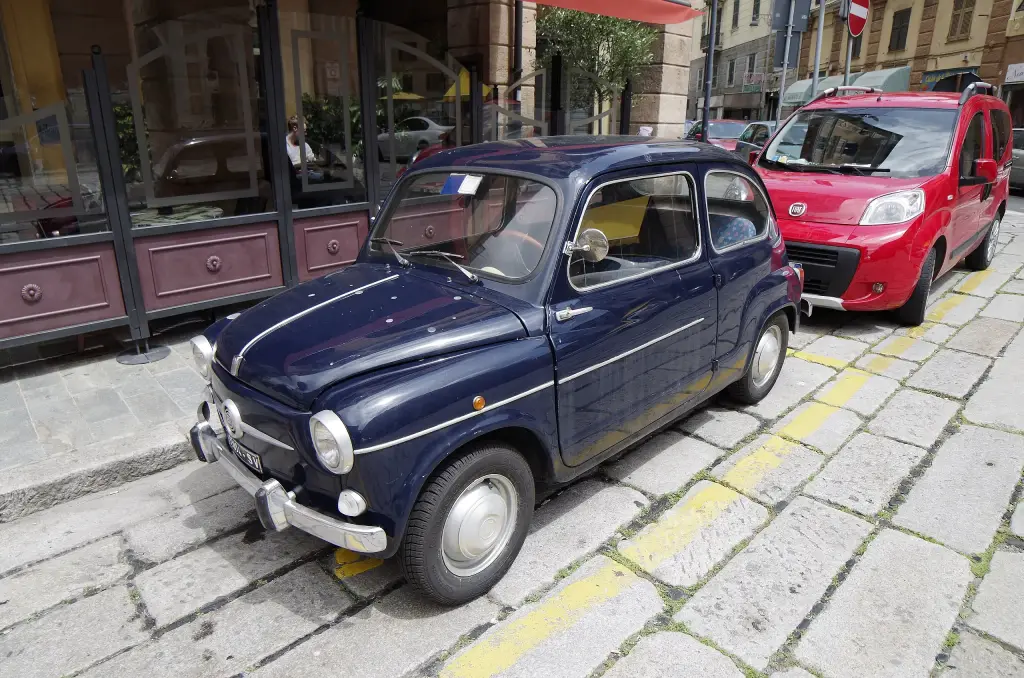
The Fiat 600, known in Italy as the Seicento, was a small rear-engined city car and economy family car built by Fiat from 1955 to 1969 in two-door fastback saloon and four-door Multipla forms. It is regarded as an icon of the Italian economic miracle, and 2,695,197 were produced at the Mirafiori plant in Turin.
Fiat 600 at a glance
| Production | 1955–1969 |
|---|---|
| Assembly | Mirafiori, Turin, Italy |
| Body | two-door saloon, four-door Multipla |
| Engine | rear-mounted 633 cc water-cooled four |
| Later engine | 767 cc |
| Top speed | 95 km/h (633 cc), 110 km/h (767 cc) |
| Length | 3.22 m |
| Transmission | four-speed transaxle, synchromesh on three gears |
| Units built | 2,695,197 |
| Licence production | SEAT in Spain, Argentina, Yugoslavia |
History of the Fiat 600
Project 100
Codenamed Progetto 100, the 600 followed the layout of the Volkswagen Beetle and the Renault 4CV. Its design brief called for a weight of around 450 kg, room for four people and luggage, and a cruising speed of no less than 85 km/h. Five prototypes were built between 1952 and 1954, all different from one another; chassis number 000001, with engine number 000002, is believed to be the only survivor. It used an innovative single-cam two-cylinder engine intended to simplify maintenance and had no clutch pedal, but that design was not chosen. At the launch in 1955 the Fiat engineer Dante Giacosa said the aim had been to create something new, in the interest of progress and simplification.
Engineering
The 600 was Fiat’s first rear-engined car and, unlike the Beetle or the later Fiat 500, it was water-cooled, with an ample cabin heater. Its engine was an all-new tipo 100 four that stayed in production for 45 years; with 633 cc the top speed was 95 km/h, and 110 km/h with the 767 cc version. The car had hydraulic drum brakes on all four wheels. At the front a single double-mounted leaf spring, which also acted as a stabiliser, was combined with gas-charged shock absorbers, while the rear used independent coil-over-shock units with semi-trailing arms. All 600s had a four-speed transaxle with synchromesh on three gears, and generators with mechanical external regulators. It measured 3.22 m and cost 590,000 lire at launch.
The range grows
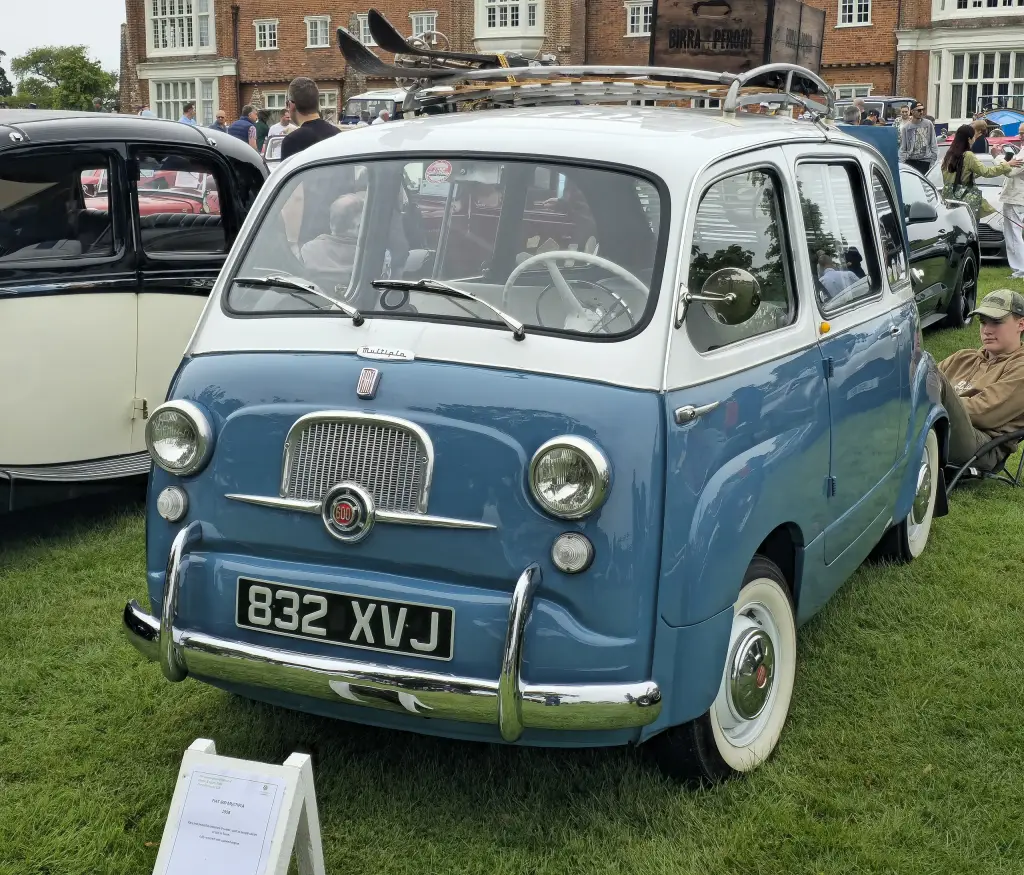
A year after the debut, in 1956, Fiat added a soft-top version and the six-seater Fiat 600 Multipla, a precursor of modern multi-purpose vehicles. The millionth 600 was built in February 1961, less than six years after the launch, when Fiat reported a rate of 1,000 cars a day. The 600 also provided the blueprint for the smaller 2.97 m Nuova 500 of 1957, and its platform later underpinned the 850 saloon, coupé and spider from 1964.
Production abroad
The 600 was built under licence in several countries. In Spain SEAT made it from 1957 to 1973, 797,319 of them, and it became the car that motorised the country, nicknamed Seiscientos. SEAT built its own derivatives, including the luxury 600 D/E/L Especial, the Descapotable cabriolet, the Formicheta commercial version and the four-door SEAT 800 of 1964–1967, the only four-door 600 and the only one with a longer wheelbase, developed in-house without a Fiat equivalent. In Argentina the car was nicknamed Fitito and in Yugoslavia Fića or Fićo. Fiat replaced the 500 and 600 with the 126 and 127; in Spain SEAT developed the 1974 SEAT 133 on the 600 platform, which Fiat also sold for a while as the Fiat 133, a cheaper alternative to the 127.
Design and features
- Rear-engined and water-cooled: Fiat’s first rear-engined car, with a proper heater.
- Tipo 100 engine: an all-new four that remained in production for 45 years.
- Compact package: 3.22 m long, with room for four and their luggage.
- Chassis layout: double-mounted front leaf spring and independent rear suspension with semi-trailing arms.
- Multipla: a six-seater on the same mechanicals, seen as an early minivan.
Fiat 600 versions
- Fiat 600 (1955): two-door fastback saloon with the 633 cc engine.
- Fiat 600 with 767 cc engine: the later, faster version.
- Fiat 600 Multipla (1956): six-seater with three rows of seats.
- SEAT 600: Spanish production from 1957 to 1973.
- SEAT 800: four-door derivative with a longer wheelbase, 1964–1967.
- Fiat 133: the SEAT 133 sold by Fiat as a cheaper alternative to the 127.
The 600 gave its layout to the smaller Fiat 500 and its platform to the Fiat 850; the name returned on the six-seat Fiat Multipla. More cars are in the Fiat collection.
Sources
- Fiat 600, English Wikipedia: development, engineering, production figures, Multipla and foreign production