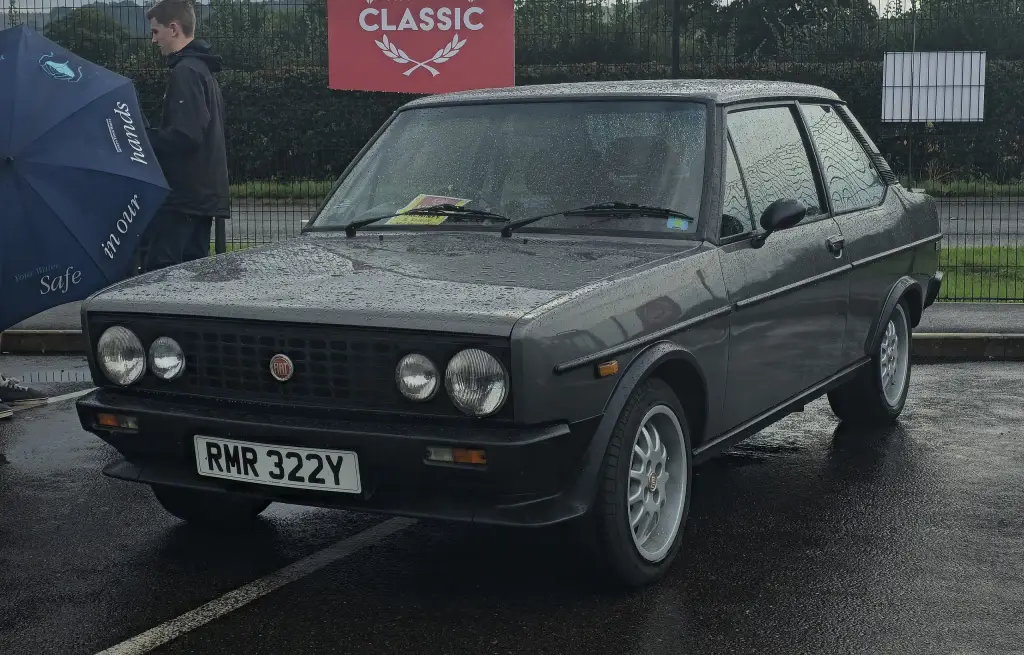
The Fiat 131 is a mid-size family car that Fiat built from 1974 to 1984. It was marketed as the Mirafiori, after the Turin district where it was made, and succeeded the Fiat 124. Two-door and four-door saloons and a five-door estate were offered on a single generation, and production reached 1,513,800 cars.
Fiat 131 at a glance
| Production | 1974–1984 |
|---|---|
| Also called | Fiat Mirafiori |
| Predecessor | Fiat 124 |
| Bodies | 2-door saloon, 4-door saloon, 5-door estate |
| Layout | front engine, rear-wheel drive |
| Engines | 1,297 cc and 1,585 cc OHV four |
| Later engines | DOHC fours with toothed belt |
| Transmission | 4-speed, 5-speed, 3-speed automatic |
| Front suspension | MacPherson struts, anti-roll bar |
| Rear suspension | live axle, trailing arms, Panhard rod |
| Total production | 1,513,800 |
based on one source
History of the Fiat 131
Chassis and running gear
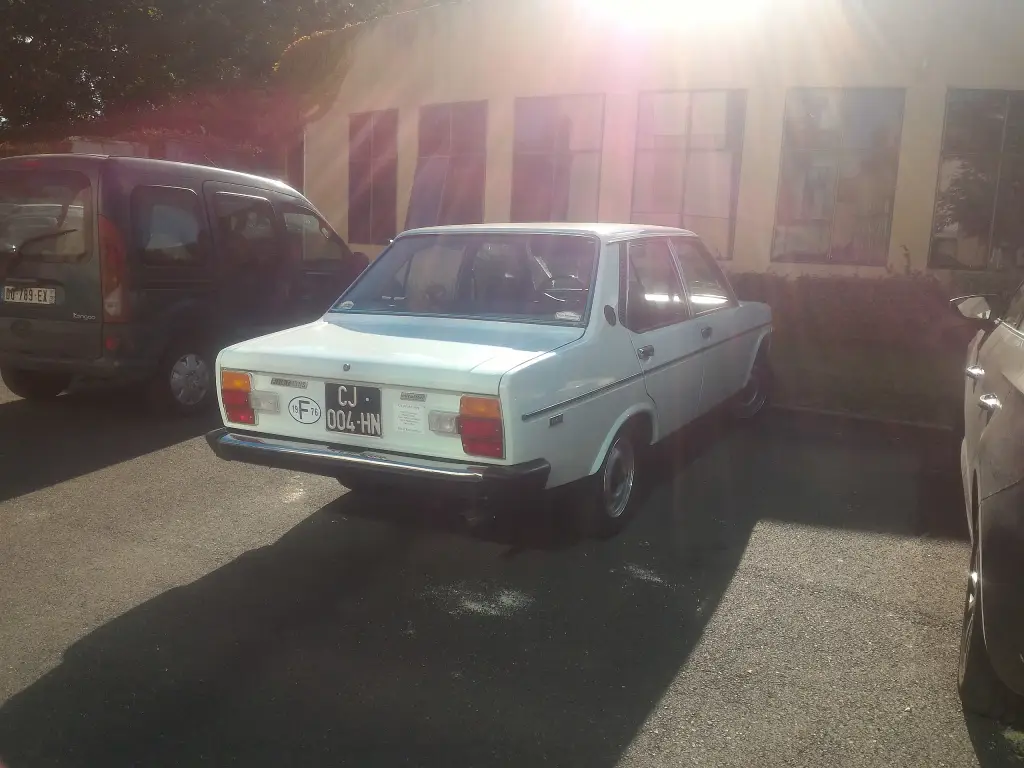
The 131 used steel monocoque bodywork in a three-box design with a front engine and rear-wheel drive. The engine was mounted longitudinally, the gearbox sat directly behind it, and a tubular propeller shaft under the transmission tunnel drove a solid live rear axle. The engines were inline fours derived from those of the outgoing 124, with a cast iron cylinder block and an aluminium alloy cylinder head.
Initially the range used pushrod valve gear, which Fiat described as the first engine in the world with OHV valve gear and a belt-driven camshaft. Double overhead camshaft engines with a toothed timing belt came later in the model’s life. Fuel was supplied by a single Weber ADF twin-choke carburettor from a tank mounted in the boot, and ignition used contact breakers, usually with Marelli distributors.
The front suspension was fully independent, with MacPherson struts, track control arms and an anti-roll bar. At the rear the live axle was located by double unequal-length trailing arms and a Panhard rod, with coil springs and direct-acting dampers; Fiat’s design proved superior to many contemporary arrangements for stability and handling. Front brakes were discs with a single-piston sliding caliper, while the rear used drums, a step back from the all-disc 124. A tandem master cylinder with vacuum servo and two separate circuits worked through a rear load-sensing valve that varied the braking bias with load. The handbrake was floor-mounted and operated the rear axle through Bowden cables. Inside, the secondary dashboard switches were lit by a single central bulb with fibre-optic distribution.
Series 1, 1974–1978
The 131 Mirafiori was introduced at the 55th Turin Motor Show in late October 1974. Buyers chose between 1,297 cc and 1,585 cc OHV engines from the family first used in the Fiat 124, both with a Weber 32 ADF downdraught carburettor. A four-speed manual was standard, and a five-speed manual or a three-speed torque-converter automatic were optional on the 1600 only. The initial range comprised eleven models across three body styles: two-door saloon, four-door saloon and the Familiare estate, called Estate in Britain.
There were two trim levels. The entry-level 131 Mirafiori, also called Normale or Standard, had single square headlamps, wheels and dished hubcaps from the 124 and simplified interior furnishings. The better-appointed 131 Mirafiori Special could be recognised by quadruple circular headlamps, a specific grille, side rubbing strips, chrome window surrounds and rubber bumper inserts. Inside it added triple square dials, a padded adjustable steering wheel, cloth upholstery and reclining seats, while air conditioning, a tachometer, a limited-slip differential and a vinyl roof were exclusive to the Special. Every body style could be combined with either engine and trim except the Special estate, which came only with the larger engine.
Initial sales were disappointing, since the car was launched at the height of the oil crisis and during strikes and hyperinflation at home; parts and material costs rose while sales fell. Sales gradually built up and the car did well in export markets. In 1975 it went on sale in the United States with a DOHC 1.8 litre four carried over from the 124 but with more emissions equipment, and a GM three-speed automatic was available. Near Turin, Salvatore Diomante’s Autocostruzioni S.D. offered a 131 Diplomatic limousine conversion almost five metres long.
131 Abarth Rally
In 1976 Fiat built 400 examples of the 131 Abarth Rally for homologation, in a cooperation between Fiat, Bertone and Abarth. Bertone took part-completed two-door bodyshells from the Mirafiori production line, fitted plastic mudguards front and rear and a plastic bonnet and bootlid, and modified the metal structure to accept independent rear suspension. The cars were fully painted and trimmed, then delivered back to Fiat’s special Rivalta plant, where they received the Abarth mechanicals. The street version used a DOHC four-valve-per-cylinder derivative of the standard engine.
Revisions and end of production
The range was revised in 1978 and again in 1981, and the model remained in production until 1984.
Design and features
- Rear-wheel drive: longitudinal engine, gearbox behind it and a live rear axle on trailing arms and a Panhard rod.
- Belt-driven camshaft: the early pushrod engine was presented as the first of its kind with a belt-driven camshaft.
- Two trims: the plain Mirafiori and the Special with quad headlamps and extra instruments.
- Familiare estate: a five-door body offered across the range.
- Abarth Rally: 400 homologation cars built with Bertone and Abarth in 1976.
Fiat 131 versions
- 131 Mirafiori: base trim with single square headlamps.
- 131 Mirafiori Special: quadruple headlamps, better trim and more options.
- 131 Familiare: five-door estate, sold as Estate in Britain.
- 131 Abarth Rally: 400 two-door homologation cars with four-valve twin-cam engines.
- 131 Diplomatic: limousine conversion by Autocostruzioni S.D.
The 131 replaced the Fiat 124 and was followed in the range by cars such as the Fiat 132 and the front-wheel-drive Fiat Ritmo. More cars are in the Fiat collection.
Sources
- Fiat 131, English Wikipedia: chassis, engines, Series 1 range, Abarth Rally, production