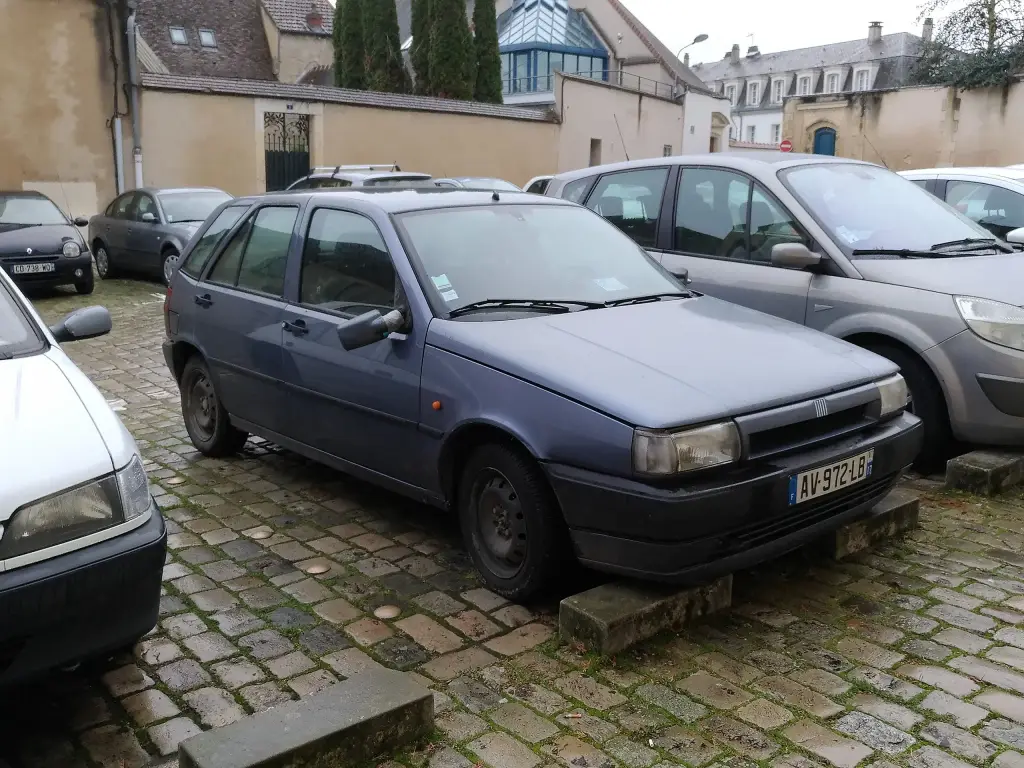
The Fiat Tipo, Type 160, was a compact car designed by the I.DE.A Institute and produced by Fiat between 1988 and 1995. It was initially available only as a five-door hatchback, was made entirely from galvanised body panels to resist rust, and was built on a completely new platform later used by Alfa Romeo and Lancia.
Fiat Tipo at a glance
| Production | 1988–1995 |
|---|---|
| Internal type | 160 |
| Design | I.DE.A Institute; dashboard by Rodolfo Bonetto |
| Body | five-door hatchback, three-door from 1993 |
| Construction | galvanised body panels, new platform |
| Engines | 1.1 to 2.0 16v petrol; 1.7 and 1.9 diesel, 1.9 turbodiesel |
| Power | 58 to 148 PS |
| Awards | European Car of the Year 1989 |
| Facelift | 1993 |
| Replaced by | Fiat Bravo and Brava |
History of the Fiat Tipo
A packaging breakthrough
The Tipo was unveiled in January 1988 and went on sale in Europe in June 1988, reaching the United Kingdom on 16 July. Its boxy styling gave it packaging that was innovative for the class: rear passenger room was greater than in the rear-wheel-drive Ford Sierra, in a car of a similar size to the smaller Ford Escort, an approach comparable to the Fiat Uno launched five years earlier. The car was made entirely of galvanised body panels to avoid rust and sat on a completely new platform that was later used for Alfa Romeo and Lancia models. The dashboard was designed by Rodolfo Bonetto. In 1989 the Tipo won the European Car of the Year award and the Semperit Irish Car of the Year, and it was also built in Brazil and Turkey.
Range and engines
The first range included base, DGT, S, SX and 16v trim levels; early Italian-market DGT cars were badged digit in recognition of the digital dashboard, a name soon dropped after a dispute over its ownership. Power from 58 to 148 PS came from 1.1, 1.4, 1.6, 1.7, 1.8, 1.8 16-valve, 2.0 and 2.0 16-valve petrol engines, plus 1.7 and 1.9 diesels and a 1.9 turbodiesel. The 1.1 base engine was widely regarded as underpowered for a car that was otherwise roomy for five adults with above-average equipment, and it was never sold in the United Kingdom. The top of the range was the 2.0 Sedicivalvole, whose 16-valve engine came from the Lancia Thema; in a much smaller and lighter body it gave a top speed of about 210 km/h, making it faster than the Volkswagen Golf GTI of the time. Britain initially received only the 1.4 and 1.6, with the 1.8 and 2.0 petrol engines and the diesels arriving in the early 1990s. Fiat and the motoring press hoped the Tipo would repeat the success of the Uno, which had sold over 40,000 cars in Britain in 1988, but sales fell short of expectations; the digital dashboard of the higher models proved controversial and unreliable.
The 1993 facelift
The Tipo was facelifted in 1993, when a three-door version was added along with minor exterior changes, recognisable by slightly different grilles and headlamps, and an improved specification. Stiffer bodyshells, a driver’s airbag and side impact bars were added, the trim levels became S, SX and SLX, and a new eight-valve 2.0 GT joined the range. Italian production ended in the summer of 1995, when the three-door Fiat Bravo and five-door Fiat Brava replaced the car; the Tempra saloon and estate were replaced by the Marea in 1996. The final two years brought a significant increase in sales, mostly of the low-priced 1.4-litre models.
Brazil
The Tipo was imported into Brazil from Italy from September 1993 and was the best-selling imported car in 1994 and 1995, reaching fifth place in overall sales in 1995. The imported cars came in three trims tied to their engines: the basic 1.6 i.e., the luxurious 2.0 eight-valve and the sporting 2.0 16-valve Sedicivalvole; seventeen 1.7-litre cars were also brought in, all in Estoril Blue and fully equipped. Numerous fires were reported in Italian-built Tipos in June 1995, damaging the car’s reputation. Local production began in December 1995 in a single trim with a 1.6-litre eight-valve engine and multi-point injection, 10 PS more than the old 1.6 i.e. for 92 PS, and it became the first Brazilian-built car to offer a driver’s airbag as an option in 1996. The locally made car was more expensive than the import, partly because many parts still had to be brought in, and with the bad publicity sales fell by 83 per cent in 1996 instead of doubling as planned. With volumes 95 per cent below plan, Fiat ended production early, announcing on 9 March 1997 that it would stop within 60 days.
Design and features
- Galvanised body: every panel was galvanised to avoid rust.
- New platform: later shared with Alfa Romeo and Lancia models.
- Packaging: more rear room than a Ford Sierra in an Escort-sized car.
- 2.0 Sedicivalvole: the Lancia Thema engine in a light body, about 210 km/h.
- 1993 update: three-door body, airbag and side impact bars.
Fiat Tipo versions
- Tipo 1.1 and 1.4: base versions, the 1.1 not sold in Britain.
- Tipo DGT: early model with the digital dashboard.
- Tipo S, SX and 16v: the original higher trim levels.
- Tipo Sedicivalvole: 2.0 16-valve with the Lancia Thema engine.
- Tipo (1993): facelift with a three-door body and an eight-valve 2.0 GT.
- Brazilian Tipo: 1.6 eight-valve, built from December 1995.
The Tipo used a platform later shared with other Fiat group cars and was replaced by the Fiat Bravo and Brava; its saloon relative was the Fiat Tempra, and the two-door Fiat Coupé was built on the same platform. More cars are in the Fiat collection.
Sources
- Fiat Tipo, English Wikipedia: design, engines, awards, the 1993 facelift and Brazilian production