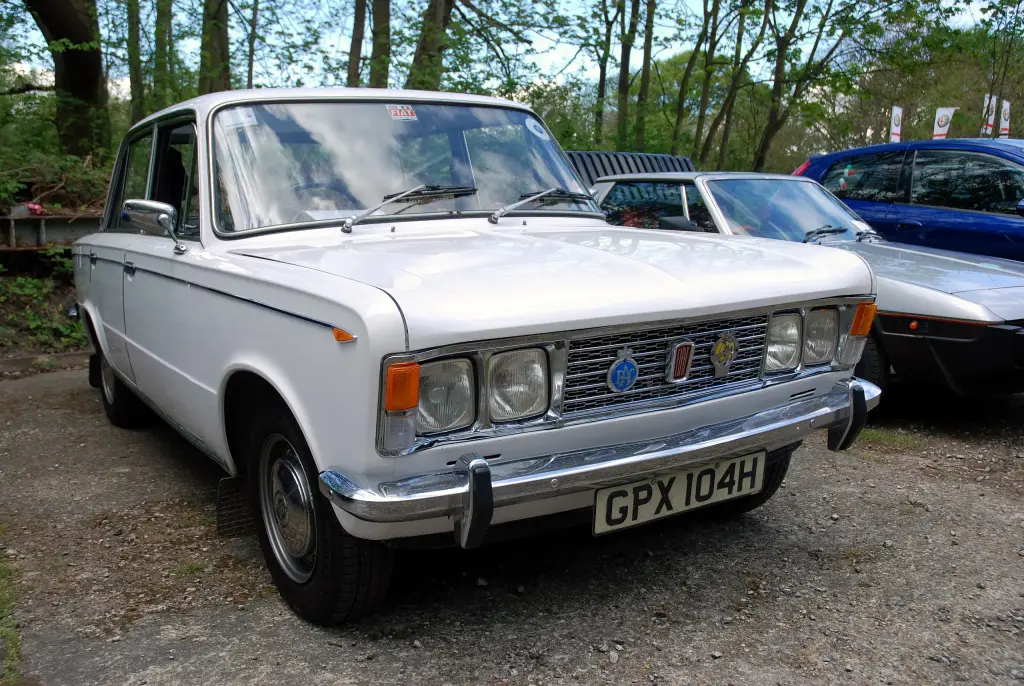
The Fiat 125 was a large family saloon made by Fiat from 1967 to 1972, with derivatives built under licence outside Italy until the 1990s. It blended saloon space with sports-car performance, a combination European volume makers adopted more widely in the following decade.
Fiat 125 at a glance
| Production | 1967–1972 (Italy) |
|---|---|
| Class | large family car |
| Body | four-door saloon |
| Engine | 1,608 cc twin-cam four-cylinder |
| Bore and stroke | 80 × 80 mm, square |
| Power | about 90 hp at 5,600 rpm; 100 hp in the 125 S |
| Transmission | four-speed manual, all-synchromesh |
| Brakes | discs front and rear, vacuum servo |
| Suspension | independent front, live rear axle |
| Licence production | Polski Fiat 125p and others into the 1990s |
History of the Fiat 125
An interim car by Dante Giacosa
In the mid-1960s Fiat’s mid-size 1500 and 1800 were growing old, while their intended replacement, Project 132, was still at an early stage. Engineer Dante Giacosa proposed a car assembled from parts that already existed: the platform of the Fiat 1500, the central body structure of the Fiat 124, newly designed front and rear sections, and an updated version of the twin-cam engine from the 124 Sport. Eighteen months later the result was the Fiat 125, introduced at the 1967 Geneva Motor Show.
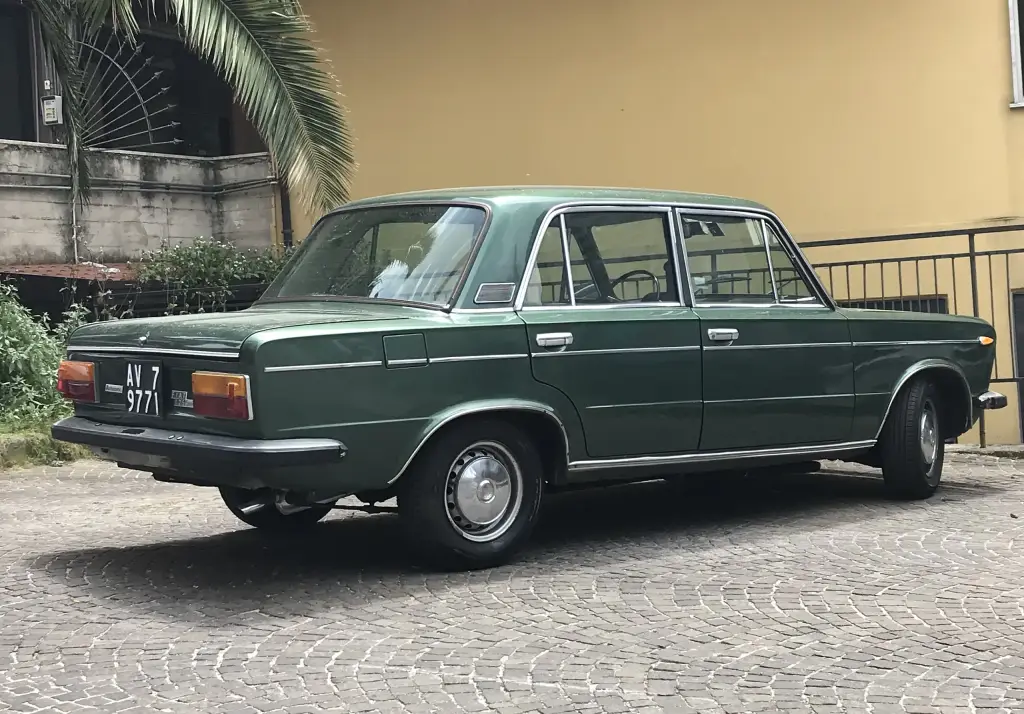
Engine, gearbox and chassis
The 1,608 cc four was made by lengthening the stroke of the 1,438 cc engine from 71.5 to 80 mm, which gave a square bore and stroke. In its initial form it produced about 90 hp, but at 5,600 rpm rather than the 6,500 rpm of the smaller unit, which improved torque distribution and smoothness. The technical package included four disc brakes with a vacuum servo and a four-speed, fully synchronised gearbox with Porsche-type synchronisers. Suspension followed the 1500 with slightly wider tracks; the rear live axle kept the geometry of the 1500 C but lost its anti-roll bar in favour of a pair of longitudinal rods, which Fiat described in its brochures as a wishbone layout. Maximum speed in third gear was 125 km/h, against about 100 km/h for the 1500 C.
Equipment and reception
The interior was spacious, free of exposed sheet metal, and marked the return of circular instruments to a Fiat. The 125 was one of the first cars to fit intermittent windscreen wipers as standard; from late 1967 an electronic rev counter was offered as an option, alongside a steering lock, whitewall tyres, a radio and the semi-automatic Idroconvert transmission already known from the 850. Buyers praised performance and robustness but missed a fifth gear, which the Alfa Romeo Giulia Super offered.
The 125 S
A more powerful 125 S added 10 hp through dual carburettors and mechanical refinements taken from the 124 Sport engine. It also brought Cromodora alloy wheels, tinted glass and a richer interior, split front and rear braking circuits with a mechanical rear brake corrector, a steering box derived from the Fiat Dino Coupé, iodine headlamps and radial tyres as standard. The fuel tank grew from 45 to 50 litres and boot space fell from 400 to 380 dm³. The 125 S came close to the Giulia in performance and competed in Germany with the BMW 1600 and 1600 TI.
1970 update and the end
At the 1970 Turin Motor Show the base car was left largely unchanged while the 125 S became the 125 Special, with revised headlamps, grille, wheel covers, interior trim and steering column. Italian production ended in 1972. Abroad the car lived on in licence-built forms: the Polski Fiat 125p, made by FSO, married the body of the 125 to the engines, gearbox, transmission and suspension of the 1300 and 1500.
Design and features
- Twin-cam engine: a longer-stroke version of the 124 Sport unit, tuned for torque rather than peak revs.
- Four-wheel disc brakes: with a vacuum servo, unusual in the class in 1967.
- Porsche-type synchronisers: a fully synchronised four-speed gearbox.
- Comfort equipment: intermittent wipers as standard, an electronic rev counter as an option.
- Rear axle location: longitudinal rods replaced the anti-roll bar of the 1500.
Fiat 125 versions
- Fiat 125: the standard saloon, about 90 hp.
- Fiat 125 S: dual carburettors, about 100 hp, alloy wheels and split braking circuits.
- Fiat 125 Special: the 1970 renaming of the 125 S with revised styling and trim.
- Polski Fiat 125p: FSO body of the 125 with 1300/1500 mechanicals, built in Poland.
The 125 used the platform of the Fiat 1300 and 1500 and the centre section of the Fiat 124 body, and it was meant to be replaced by what became the Fiat 132. More cars are in the Fiat collection.
Sources
- Fiat 125, English Wikipedia: production dates, engine and chassis, the 125 S and the 1970 update
- Fiat 1300 and 1500, English Wikipedia: origin of the Polski Fiat 125p