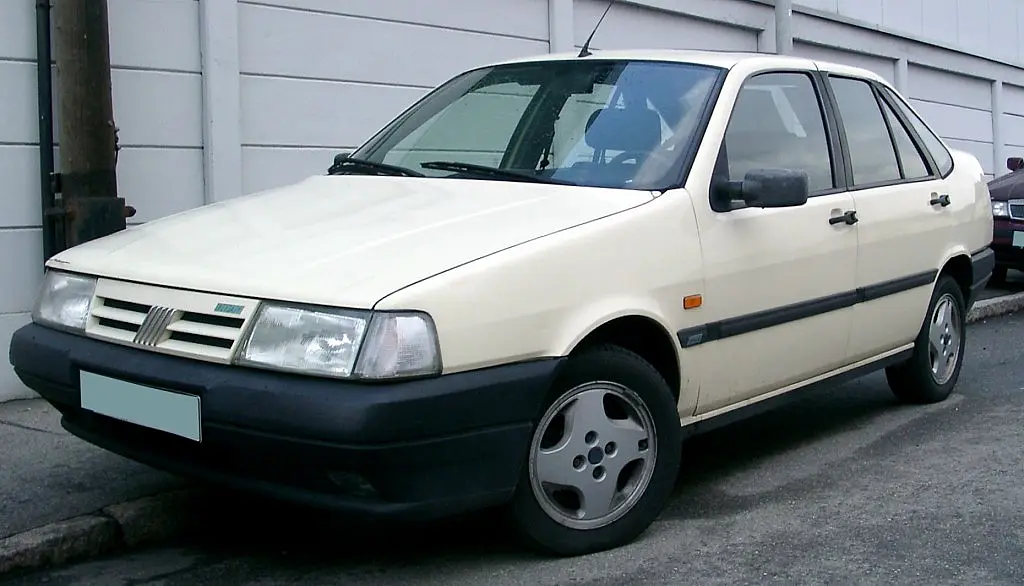
The Fiat Tempra, type 159, is a small family car manufactured by Fiat from 1990 to 1996, replacing the Fiat Regata. The original project was called Tipo 3, placing it between the Fiat Tipo and the larger Croma, and it shared its Type Three platform with the Lancia Dedra and the Alfa Romeo 155. It was named the 1991 Semperit Irish Car of the Year.
Fiat Tempra at a glance
| Production | 1990–1996 (Brazil to 1998) |
|---|---|
| Internal code | Type 159 |
| Bodies | four-door saloon, Tempra SW estate, Brazilian two-door coupé |
| Platform | shared with Lancia Dedra and Alfa Romeo 155 |
| Engines | 1.4, 1.6 and 1.8 petrol; 1.9 diesel and turbodiesel |
| Transmission | five-speed manual, Selecta CVT, four-speed automatic on the 2.0 SX |
| Four-wheel drive | permanent, estate with the two-litre engine, 56/44 split |
| Launched | Geneva Motor Show, March 1990 |
| Award | Semperit Irish Car of the Year 1991 |
| Brazilian turbo | 165 PS, 213 km/h |
Based on one source, the English Wikipedia article. No free photographs of the model were available, so the article has no photographs.
History of the Fiat Tempra
The saloon was first shown in newspapers in November 1989 and introduced in March 1990 at the Geneva Motor Show, with the station wagon, marketed as the Tempra SW, arriving two months later in Turin. The initial engine range comprised 1.4, 1.6 and 1.8-litre petrol units and normally aspirated and turbocharged 1.9-litre diesels. The car began to be produced in Brazil for Latin American markets after being introduced in Aruba in September 1991.
The engine range was similar to that of the Tipo. At first the 1.4 and 1.6-litre models had carburetted engines, but both were discontinued after 1992 because of new European emission standards, so all models from 1993 onwards had catalytic converters and electronic fuel injection. The standard transmission was a five-speed manual, with a continuously variable transmission offered as an option, a first on a mid-size saloon, although CVT units had already been available on the Uno, Panda, Ritmo and Tipo. The CVT, called the Selecta, was available only with the 1.6-litre engine and either body style, and from July 1991 the 2.0-litre SX could be ordered with a four-speed automatic.
At the March 1992 Geneva Motor Show a version with permanent four-wheel drive was introduced. It was available only as an estate and only with the two-litre engine, and its four-wheel-drive system had a slight front bias of 56/44 per cent. During the six-year production run few changes were made apart from a minor facelift in April 1993, which brought a new front grille, other small styling changes and new equipment levels. Main parts, most notably the doors, were shared with the Fiat Tipo, and the Lancia Dedra was the closest relative, sharing all mechanical components.
Only two trim levels were offered in the early years, the standard S and the SX, both reasonably equipped for the price. The SX had power windows, power locks, adjustable seat belts and steering wheel, front fog lights, body-coloured bumpers, velvet upholstery and a futuristic digital dashboard, and could be ordered with anti-lock brakes, alloy wheels, a sunroof, electronic climate control and a rear window wiper that was standard on the estate. The April 1993 facelift widened the range from the standard L, sold in the United Kingdom only with the 1.4-litre engine, through the S and SX to the top SLX, which in Britain came only with the 1.8 and 2.0-litre engines. Extra safety features were added at the same time, including body reinforcements, side protection bars in the doors and a driver’s airbag, standard or optional depending on the market, and the four-wheel-drive estate continued in some countries such as Switzerland.
In Brazil the Tempra was built from 1991 to 1998 and had two exclusive options. A two-door coupé body was offered with any engine from 1992 to 1995, and a 2.0-litre turbo was sold as the two-door Tempra Turbo from 1994 to 1995 and as the four-door Tempra Turbo Stile from 1996 to 1997. That engine produced 165 PS and 260 Nm, and period tests recorded 0 to 100 km/h in 8.2 seconds and a top speed of 213 km/h for the two-door in 1994; it was only the second turbocharged car to enter series production in Brazil, after the Uno Turbo in the same year. The car was also assembled in Turkey by Tofaş, where SX A and SX AK trims were sold and the 1,000,000th Tofaş-built car was a Tempra 2.0 i.e. 16V, a 148 PS version that was not offered in the rest of Europe. In Vietnam it was assembled in complete knock-down form by Mekong Auto until 2000.
In Italy a panel van version of the estate was sold as the Marengo, with basic equipment, heavily tinted rear windows and no rear seats, usually with the naturally aspirated diesel engines. The Italian magazine Quattroruote reported water ingress through the windscreen seals between 1990 and 1992, resolved by using more sealant when fitting the glass, and high oil consumption, especially from the 1,581 cc engine, a defect also known on cars sharing that unit.
Design and features
- Tipo family: the saloon and estate on the Type Three platform of the Tipo, Dedra and 155.
- Selecta CVT: a continuously variable transmission offered for the first time on a mid-size saloon.
- Four-wheel-drive estate: permanent drive with a 56/44 front bias and the two-litre engine.
- Digital dashboard: part of the generous SX equipment.
- Marengo van: a commercial estate without rear seats for the Italian market.
Fiat Tempra versions
- Tempra S and SX: early trim levels, the SX with a digital dashboard.
- Tempra L and SLX: entry and top trims added with the 1993 facelift.
- Tempra SW: the estate version introduced two months after the saloon.
- Tempra 4×4 SW: permanent four-wheel drive with the two-litre engine.
- Tempra Turbo and Turbo Stile: Brazilian two-door and four-door turbo models.
- Marengo: panel van version of the estate sold in Italy.
The Tempra was the saloon and estate companion of the Fiat Tipo and replaced the Fiat Regata. More cars are in the Fiat collection.
Sources
- Fiat Tempra, English Wikipedia: launch, engines, transmissions, four-wheel drive, facelift, Brazil and Turkey