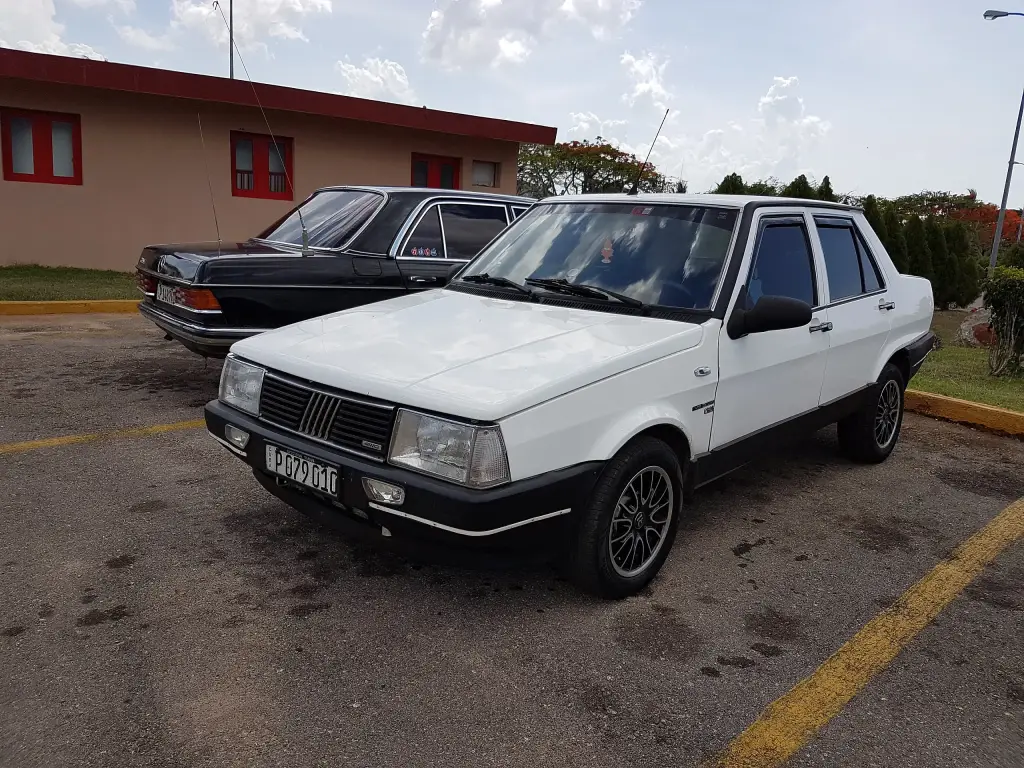
The Fiat Regata was produced by Fiat from 1983 until 1990. The name covered the saloon and estate versions of the Fiat Ritmo hatchback, corresponding to the facelifted Ritmo, and the car was offered with three petrol and two diesel engines; Argentine production continued until 1995 with other Fiat engines.
Fiat Regata at a glance
| Production | 1983–1990 |
|---|---|
| Also built | Argentina, by Sevel, 1985–1995 |
| Basis | Fiat Ritmo, pre-facelift |
| Body | four-door saloon, five-door estate |
| Petrol engines | 1,301 cc 68 hp, 1,498 cc 82 hp, 1,585 cc 100 hp |
| Diesel engines | 1,714 cc 58 hp, 1,929 cc 65 hp |
| Transmission | five-speed manual, four-speed on base cars |
| Drag coefficient | 0.37, reduced to 0.35 in 1986 |
| Replaced by | Fiat Tempra |
History of the Fiat Regata
The 1983 launch
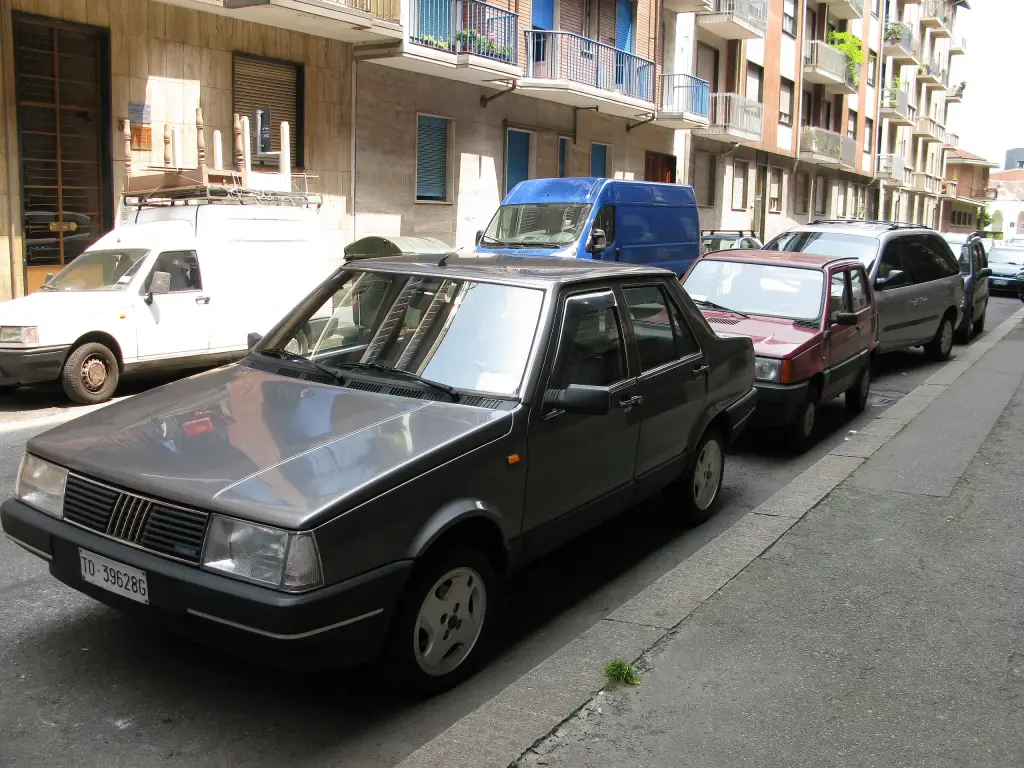
The Regata was unveiled at the Frankfurt Motor Show in September 1983. It was developed from the pre-facelift Ritmo, known in the United Kingdom and the United States as the Fiat Strada, and used almost all of its mechanicals, although the wheelbase was stretched slightly. It aimed at a higher price point, with better trim and more standard equipment than the Ritmo, following a European trend of pushing saloon versions of C-segment hatchbacks upmarket, as with the Ford Orion and Volkswagen Jetta. The body was a conventional four-door three-box design that bore little external resemblance to the original Ritmo, though it hinted at that car’s 1982 facelift. In Sweden the car was called Regatta, because Regata was uncomfortably close to a derogatory term for an overbearing woman, and the same name was used in South America except Venezuela.
Engines and equipment
The petrol range began with the 1,301 cc four of 68 hp in the Regata 70 and the 1,498 cc unit of 82 hp in the Regata 85, both single-overhead-camshaft engines. A double-overhead-camshaft 1,585 cc four of 100 hp powered the Regata 100, and two diesels followed: a 1,714 cc straight four of 58 hp in the Regata D and, from 1984, a 1,929 cc version of 65 hp in the Regata DS. After fourteen months diesels accounted for about thirty per cent of production. The Regata 100, the top model, came with a check panel, an early on-board computer giving fuel consumption, average speed, range and optimal gear selection. An economy model called ES, for Energy Saving, used an early start-stop system, with detail aerodynamic changes, a higher compression ratio and different valve timing on the 1.3-litre engine for 65 hp, an engine cut-off when idling and electronic ignition. Apart from the cheapest versions, a five-speed manual gearbox was standard.
Weekend and Marengo
The Regata Weekend estate arrived in November 1984 with all the saloon’s engines but no automatic option, replacing the 131 Panorama that had been kept in production alongside the Regata. It had a folding rear bumper that improved access to the load area and doubled as a seat able to support 150 kg when folded down, and its suspension and brakes were uprated for the extra weight. A two-seater glazed van derivative called the Marengo, available only with the larger diesel, made its debut at the Brussels commercial vehicle show in early 1985.
1986 update and the end
A mid-life update in April 1986 brought new doors with an altered window line, new handles, grille, bumpers and wheel trims and modified rain gutters, which together cut the drag coefficient from 0.37 to 0.35. The 1,585 cc engine gained fuel injection as the 100S i.e., also sold with a catalyst as the 90 i.e., while a catalysed and fuel-injected 1,498 cc unit powered the 75 i.e. The 85 Automatic gave way to the 70 Automatic with a 65 hp 1.3. On the diesel side a turbocharged 1,929 cc engine of 80 hp was introduced as the Turbo DS, and the 1,714 cc unit was reduced to 1,697 cc but raised to 60 hp with lower consumption. Weight came down slightly. Production ended in February 1990, when the Tempra was introduced.
Argentine production
Sevel began building the Regata in Argentina in 1985 and continued until 1995, making 56,789 cars with limited exports to Venezuela and Chile. It was called Regatta there too, and was considered somewhat upmarket in Latin America. The Regatta 85 had an 82 hp 1.5-litre engine and the 100S a 100 hp 1.6; a light facelift in November 1987 brought the 2000 Twincam, which replaced the 100S with the Croma’s two-litre engine, ten more horsepower and considerably more torque. The 2000 reached 100 km/h in 9.8 seconds, had a rear spoiler and was claimed to reach 182 km/h. A more thorough facelift in 1988 produced the Regatta Edición II, and for 1990 both engines were replaced by the 87 hp 1,581 cc unit from the Fiat Tipo, later joined by a cheaper 1.4 S with the 1,372 cc Tipo engine.
Design and features
- Ritmo mechanicals: the pre-facelift hatchback’s running gear with a slightly longer wheelbase.
- Check panel: an early trip computer on the Regata 100.
- ES economy model: an early start-stop system and electronic ignition.
- Weekend estate: a folding rear bumper that doubled as a 150 kg seat.
- Aerodynamics: the 1986 update cut the drag coefficient from 0.37 to 0.35.
Fiat Regata versions
- Regata 70 and 85: 1.3 and 1.5-litre petrol saloons.
- Regata 100: twin-cam 1.6 with 100 hp and the check panel.
- Regata D and DS: 1.7 and 1.9-litre diesels.
- Regata ES: economy version with an engine cut-off at idle.
- Regata Weekend: the estate from November 1984.
- Marengo: two-seat glazed van with the larger diesel.
The Regata was the saloon form of the Fiat Ritmo and replaced the estate version of the Fiat 131; it gave way to the Fiat Tempra. More cars are in the Fiat collection.
Sources
- Fiat Regata, English Wikipedia: launch, engines, equipment, Weekend and Marengo, the 1986 update and Argentine production