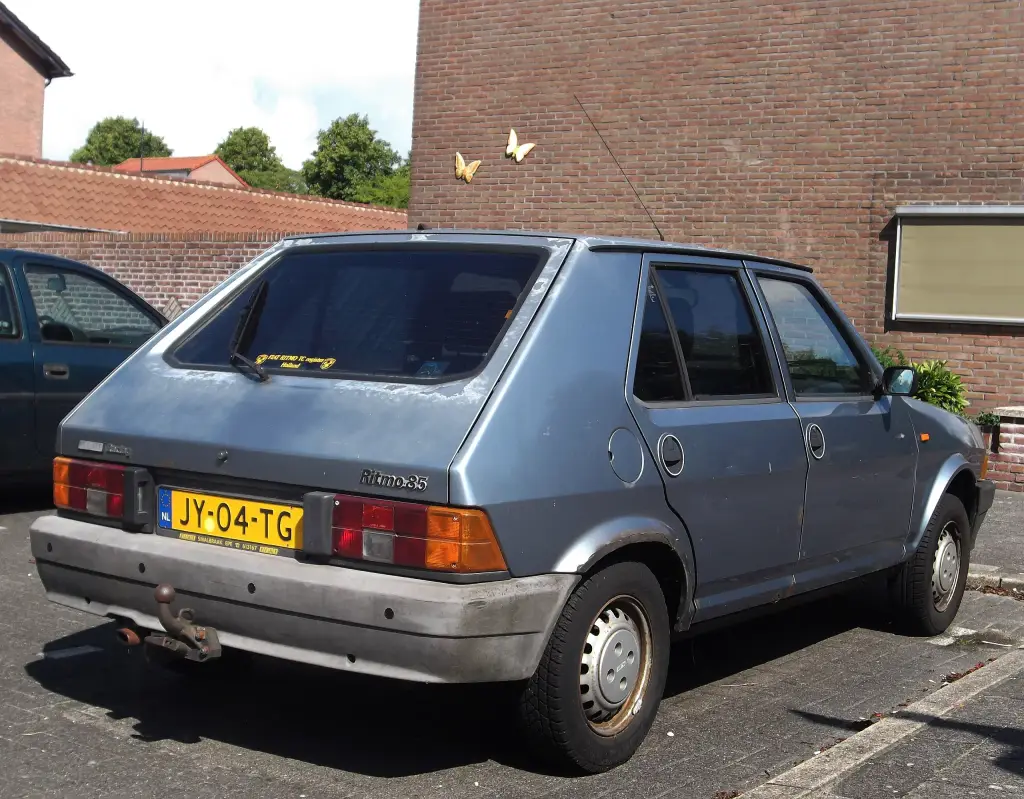
The Fiat Ritmo is a small family car that Fiat manufactured and marketed from 1978 to 1988, with two facelifts. It has a front-engine, front-wheel-drive layout and was offered as a three-door or five-door hatchback or as a two-door cabriolet. Export versions for the United Kingdom, the United States and Canada were marketed as the Fiat Strada, and in 1979 SEAT began building the Ritmo under licence in Spain.
Fiat Ritmo at a glance
| Production | 1978–1988 |
|---|---|
| Also called | Fiat Strada, SEAT Ritmo |
| Predecessor | Fiat 128 |
| Replaced by | Fiat Tipo |
| Designer | Sergio Sartorelli, Centro Stile |
| Bodies | 3- and 5-door hatchback, 2-door cabriolet |
| Engines | 1.1, 1.3 and 1.5 petrol; 1.7 diesel |
| Power | 60 to 75 PS petrol, 55 PS diesel |
| Drag coefficient | 0.38 |
| Total production | 1,790,000 |
based on one source
History of the Fiat Ritmo
Development
Fiat began designing the Ritmo hatchback as a replacement for the 128 sedan in 1972, following the body style of its 127 supermini as European makers started launching small family hatchbacks, notably the Volkswagen Golf in 1974. Before the launch the press speculated that the project codename, 138, would become the production name, but Fiat chose Ritmo instead of another three-digit number. The name derives from the Italian for rhythm, and Strada from the Italian for road.
The Ritmo was styled by Sergio Sartorelli at Fiat’s Centro Stile in Turin and launched in April 1978 at the Turin Motor Show. It was manufactured at the Cassino plant using the Robogate system developed by Fiat’s subsidiary Comau, which automated bodyshell assembly and welding with robots. That gave rise to the advertising slogan Handbuilt by robots, remembered from a television campaign showing robots assembling Ritmo bodyshells to Rossini’s The Barber of Seville.
The exterior had plastic bumper fascias integrated into the styling, combining strong round shapes with overall sharp lines to reach a drag coefficient of 0.38. The plastic bumpers also resisted damage from impacts at speeds of up to 6 km/h.
First series, 1978
The initial four-cylinder range used 1.1-litre (60 PS), 1.3-litre (65 PS) and 1.5-litre (75 PS) petrol engines inherited from the Fiat 128, although they were noticeably quieter in the better-insulated Ritmo. Suspension was independent all round, brakes were front discs with rear drums, and the wheels were 13 inches in diameter. Gearboxes ran from a standard four-speed manual, with five speeds optional on CL models, to an optional three-speed automatic derived from Volkswagen. Boot capacity ranged from 330 to 1,100 litres with the rear seats folded. The Ritmo finished second in the European Car of the Year awards, narrowly behind the Simca-Chrysler Horizon, a car similar in concept.
In Italy the range was designated by engine output: the 60 L in three- and five-door form, the 60 CL, the 65 L five-door and the 65 CL. The CL models were better equipped, and the 60 CL accounted for 80 per cent of total initial sales in Italy. The whole range offered numerous optional accessories unseen in earlier Fiats: larger tyres, a rev counter, a stereo, safety seatbelts and headrests, a passenger-side mirror, a split-fold rear seat, tinted windows, a rear wiper, a rear window defroster, metallic paint and a sunroof, the most expensive option. Instrumentation sat in a rectangular pod with modular slots for various gauges and switches. Export markets also received a 1.5-litre 75 CL with a five-speed manual, a model initially unavailable in Italy.
Interior colour was determined by the exterior paint: beige with light blue, red, green or medium green; blue with white, royal blue, light blue or silver; and brown with orange, grey or copper. The Ritmo was criticised for its basic interior trim, such as the absence of fabric on the door panels, and Fiat responded in 1979 with revisions and the Targa Oro range, based on the Ritmo 65 and distinguished by mink or black paint with gold striping, gold accents on the alloy wheels, fog lights, dark bumper bars and velour trim.
From February 1979 the 75 CL could be ordered with the Volkswagen-derived automatic, the Automatica being the only 1.5-engined version marketed in Italy. At the same time the 60 L for Italy and some export markets had its 1.1-litre 128-derived engine replaced by a 1,049 cc petrol engine built by Fiat of Brazil; a new carburettor and altered timing kept power and torque the same as the 1.1, itself ten horsepower up on the engine as installed in the 127. The 60 CL, the fastest-selling Ritmo in Italy at the time, kept the 1,116 cc engine.
Diesel and Super
At the 1980 Geneva Motor Show Fiat added a five-door-only diesel, the Ritmo D, available in L and CL trim with a 1,714 cc engine of 55 PS. To accommodate the considerably heavier engine the steering rack was slowed from 3.5 to 4 turns and the suspension adjusted, but a 65.5 per cent forward weight distribution was hard to mask and both handling and braking suffered compared with petrol Ritmos. In 1981 the Targa Oro and 75 models were replaced by the five-door-only Ritmo Super, sold as the Superstrada in some export markets, with higher specification.
Production and replacements
Total production reached 1,790,000, and the Ritmo was replaced by the Fiat Tipo when production ended in early 1988. In Spain, SEAT built the Ritmo under licence from 1979 and restyled it in 1982 as the SEAT Ronda.
Design and features
- Robogate: bodyshells were welded by Comau robots at Cassino, the basis of the Handbuilt by robots advertising.
- Plastic bumpers: integrated fascias that resisted impacts up to 6 km/h and helped reach Cd 0.38.
- Wide range: three- and five-door hatchbacks and a two-door cabriolet.
- Long options list: from a rev counter and sunroof to a split-fold rear seat.
- Strada abroad: the same car was sold in Britain, the United States and Canada under that name.
Fiat Ritmo versions
- Ritmo 60 L and 60 CL: 1.1-litre and later 1,049 cc models, the CL with more equipment.
- Ritmo 65 L and CL: 1.3-litre versions.
- Ritmo 75 CL and Automatica: 1.5-litre cars, the latter with a Volkswagen-derived automatic.
- Targa Oro: 1979 special range with gold striping and velour trim.
- Ritmo D and Ritmo Super: the 1.7 diesel of 1980 and the 1981 five-door replacement for the 75.
The Ritmo replaced the Fiat 128 and was replaced by the Fiat Tipo, with the smaller Fiat 127 as its styling reference. More cars are in the Fiat collection.
Sources
- Fiat Ritmo, English Wikipedia: development, Robogate, first series, engines, diesel, production