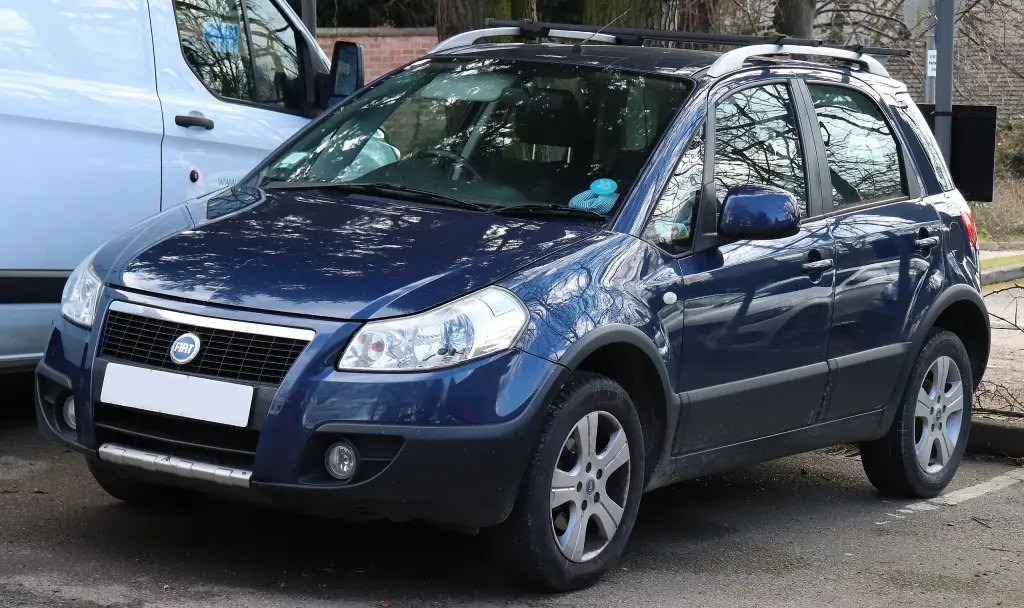
The Fiat Sedici is a subcompact crossover SUV that was co-developed by Fiat and Suzuki, mainly for the European market. Introduced in December 2005, it was manufactured until October 2014, with the last model year being 2015. Its name comes from the Italian word for sixteen, because four by four makes sixteen.
Fiat Sedici at a glance
| Production | 2005–2014 |
|---|---|
| Class | subcompact crossover SUV |
| Developed with | Suzuki, which sold it as the SX4 |
| Design | Italdesign Giugiaro |
| Built at | Magyar Suzuki, Hungary |
| Expected output | 60,000 a year, a third of them Fiat |
| Drive | switchable 4×2 and 4×4 |
| Engines | 1.6-litre Suzuki petrol, 1.9-litre Fiat turbodiesel |
| Facelift | March 2009, with Euro 5 engines |
| Front-drive version | from May 2008 |
History of the Fiat Sedici
A joint project
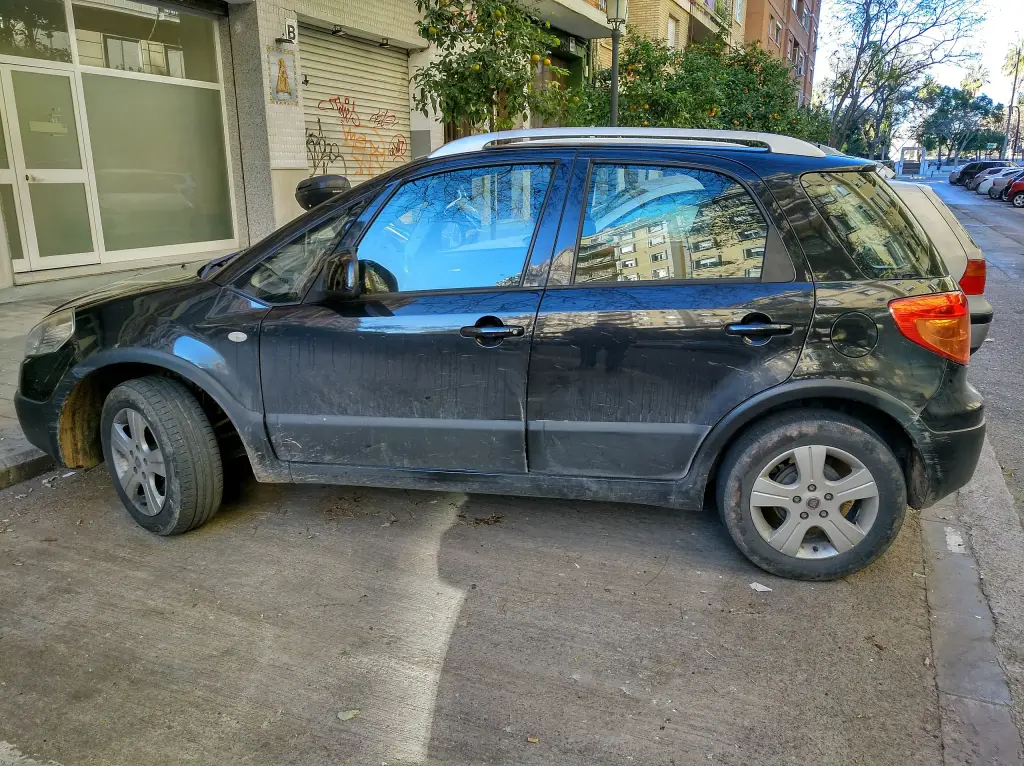
The Sedici was introduced in December 2005 at the Bologna Motor Show and built at the Magyar Suzuki plant in Hungary. The expected production volume was 60,000 units a year, one third of them to be sold by Fiat and two thirds by Suzuki under the SX4 badge. The design was created by Giorgetto Giugiaro’s Italdesign Giugiaro studio and was presented as an alternative to mini multi-purpose vehicles, which have a more boxy appearance. It was the official car of the 2006 Winter Olympics.
Four-wheel drive and equipment
Because the car is four-wheel drive, it could be considered a 4×4, and the driver can change between 4×2 and 4×4 transmission modes by flicking a switch. Electronic stability control was on the options list and a diesel particulate filter was a standard feature. Two engines were available: a 1.6-litre Suzuki petrol unit and a 1.9-litre Fiat turbodiesel. The model was the second best-selling SUV on the Italian market in November 2006 and, by June 2007, the best-selling such vehicle. From 2012 it was also sold in Israel, with a four-speed automatic or a five-speed manual gearbox. During 2010 the Sedici was withdrawn from the United Kingdom because of poor sales.
The front-drive version
The front-wheel-drive Sedici was unveiled in May 2008. It was available with the same engine choices as the 4×4 and in two trim levels, Dynamic and Emotion, at a price in Italy about 2,000 euros below the four-wheel-drive car.
The 2009 facelift
In March 2009 the Sedici received a more substantial upgrade, with a changed front grille similar to that of the Bravo and a new bumper. Inside there was more sophisticated instrumentation, new fabrics and redesigned air conditioning vents, and the range moved to Euro 5 compliant engines. The 1.9-litre MultiJet was replaced by the more modern 2.0-litre MultiJet producing 135 PS, while the 1.6-litre petrol was upgraded to 120 PS with lower fuel consumption. The facelift coincided with the withdrawal from the United Kingdom, although a handful of facelifted cars were sold there. Manufacture continued until October 2014.
Design and features
- Joint development: engineered with Suzuki, which sold the same car as the SX4.
- Switchable drive: a switch moves the car between 4×2 and 4×4 modes.
- Two engines: a 1.6-litre Suzuki petrol and a 1.9-litre Fiat turbodiesel.
- Italdesign body: styled by Giorgetto Giugiaro’s studio as an alternative to boxy mini MPVs.
- Standard particulate filter: a DPF was fitted as standard equipment.
Fiat Sedici versions
- Sedici 4×4: the original version introduced in December 2005.
- Sedici 4×2: front-wheel-drive version from May 2008, in Dynamic and Emotion trim.
- Facelifted Sedici: from March 2009, with a Bravo-style grille and Euro 5 engines.
- Suzuki SX4: the two-thirds share of production sold under the Suzuki badge.
The Sedici shared its market with the Fiat Panda, which also offered four-wheel drive, and its facelift grille followed the Fiat Bravo. More cars are in the Fiat collection.
Sources
- Fiat Sedici, English Wikipedia: joint development, production, equipment, front-drive version, facelift