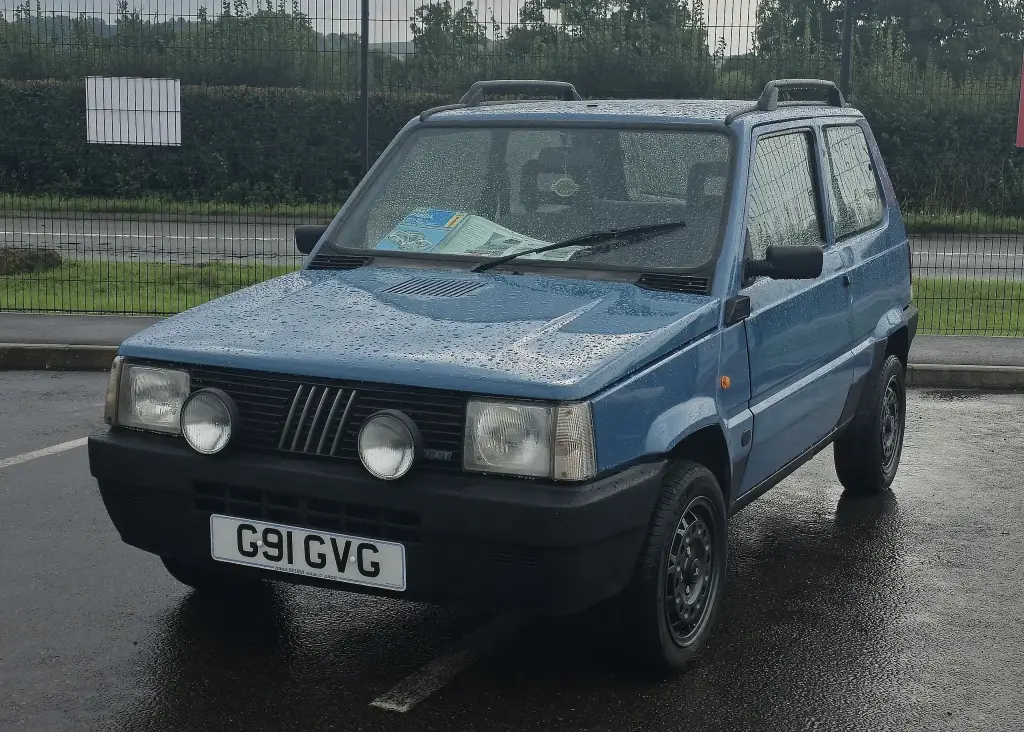
The Fiat Panda is a city car manufactured and marketed by Fiat. The first generation, introduced in 1980, was a two-box, three-door hatchback designed by Giorgetto Giugiaro and Aldo Mantovani of Italdesign and built until 2003, with an all-wheel-drive variant added in 1983. Three further generations have followed, and in 40 years Panda production has reached over 7.8 million vehicles.
Fiat Panda at a glance
| Production | since 1980 |
|---|---|
| Generations | four, the first built until 2003 |
| First generation | Type 141, designed by Italdesign |
| Designers | Giorgetto Giugiaro and Aldo Mantovani |
| Four-wheel drive | added in 1983 |
| Second generation | 2003, designed by Bertone |
| Award | European Car of the Year 2004 |
| Third generation | 2011, built at Pomigliano d’Arco |
| Fourth generation | Grande Panda, built in Serbia |
| Total production | over 7.8 million, about 4.5 million of them first generation |
| Name | from Empanda, Roman goddess of travellers |
History of the Fiat Panda
A car like a pair of jeans
The Panda began as a design brief rather than a model. Fiat’s chief executive Carlo De Benedetti asked for a straightforward container with a spacious and spartan interior, weighing and costing no more than the Fiat 126 it was replacing, and conceived in the spirit of the Citroën 2CV and the Renault 4. In the late 1950s the head of Renault, Pierre Dreyfus, had called for the R4 to have an egalitarian approach, like blue jeans, which people can wear in any situation once pretension and social conformity are set aside.
It was the first time Fiat had entrusted the development of a high-volume model to an outside company. Giugiaro and Mantovani spent 15 days in the summer of 1976 in Porto Cervo, Sardinia, designing the car under the working name Zero. Giugiaro developed the packaging and styling, Mantovani the technical approach. Giugiaro took particular inspiration from a folding lounge chair for the seats, simple, easy to maintain, modular and inexpensive to manufacture, and insisted that the cargo area should take no fewer than two 50-litre wine demijohns along with a full complement of passengers. From the outset the project used monocoque construction with a nearly flat floor and a roof high enough for upright seating. The two men completed the design for its 7 August deadline, discovering only then that De Benedetti had left Fiat.
From Zero to Panda
Despite that departure, Italdesign presented Fiat with two full-scale models, four alternative side designs, an interior mock-up and a study of the competition. Under the prototyping designation Progetto 141, Fiat commissioned production studies, a master model, provisional tooling and pre-production prototypes, and within a year Italdesign had made 20 rolling chassis. In February 1978 Fiat test-marketed prototypes to potential customers and dealers at an unpublicised event in Milan’s Novegro Park, where response cards asked participants to judge the exterior and interior, spaciousness, instruments, engine size, price and the provisional name Rustica.
In January 1979 production was delayed by protracted union negotiations over Fiat’s plans to move production from Cassino, Sulmona and Termini Imerese to Turin and Desio. An agreement was reached between December 1979 and January 1980. On 26 February 1980 Fiat presented the production models to President Sandro Pertini in the gardens of Rome’s Quirinal Palace, and the car officially debuted at Geneva on 5 March carrying the name Panda, after Empanda, the Roman goddess and patroness of travellers. The World Wildlife Fund had resisted the use of the name but acquiesced when Fiat made a substantial financial contribution, delivered, as local custom allowed a cheque to be written on any surface, on the bonnet of an actual Panda. In the two months after the show Fiat received over 70,000 orders.
Four generations
The first Panda went on sale in Italy in late February 1980, ahead of its Geneva premiere, and right-hand-drive models reached the United Kingdom in May 1981. Fiat added an all-wheel-drive variant in 1983, and SEAT of Spain marketed a variation of the first generation under licence, at first as the Panda and later as the Marbella from 1986 to 1998. The first generation stayed in production until 2003 and accounts for about 4.5 million of the 7.8 million Pandas built; in early 2020 its 23-year run was counted by Autocar as the twenty-ninth most long-lived single generation car in history.
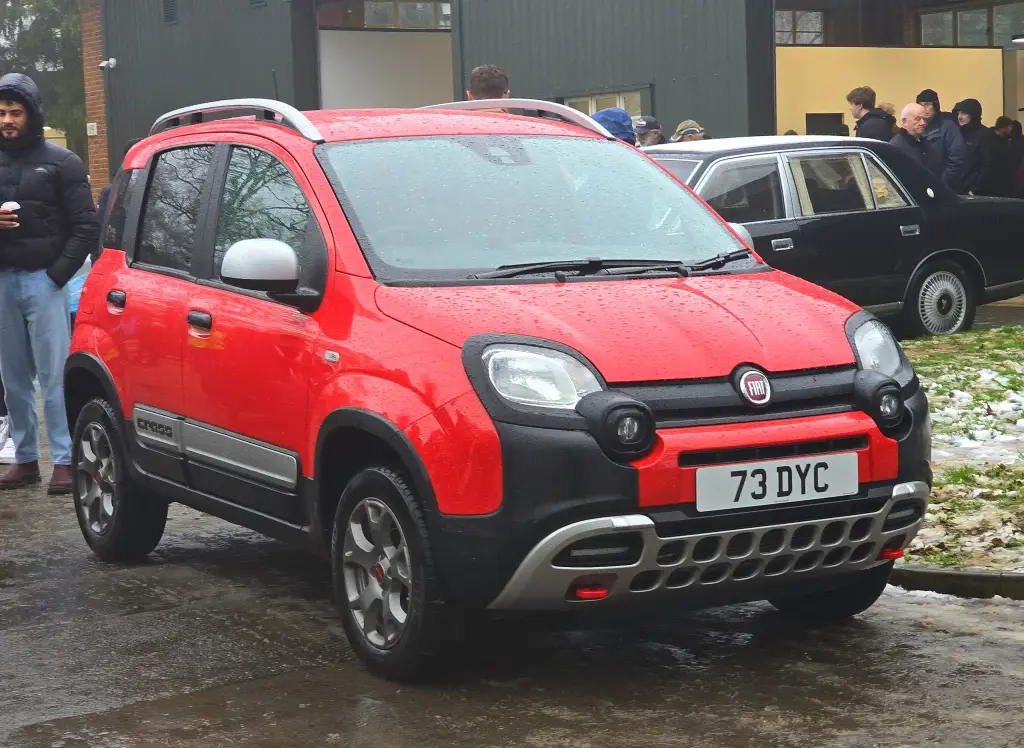
The second-generation Panda was launched in 2003 as a five-door hatchback designed by Giuliano Biasio of Bertone, and won the European Car of the Year award in 2004. The third generation debuted at the Frankfurt Motor Show in September 2011, was designed at Fiat Centro Stilo under the direction of Roberto Giolito and is built in Italy at Pomigliano d’Arco. The fourth generation is marketed as the Grande Panda to distinguish it from the third, which is sold alongside it; developed under Stellantis, it is produced in Serbia.
Design and features
- Utilitarian brief: inexpensive, easily maintained and robustly simple from the start.
- Italdesign packaging: monocoque body, flat floor and a high roof for upright seating.
- Simple seats: inspired by a folding lounge chair and easy to maintain.
- Four-wheel drive: offered from 1983, a formula the later Panda Cross continues.
- Long-lived first generation: built from 1980 to 2003, with about 4.5 million made.
Fiat Panda versions
- First generation: Type 141, three-door hatchback from 1980, built until 2003.
- Panda 4×4: all-wheel-drive variant introduced in 1983.
- SEAT Panda and Marbella: licence-built Spanish versions, the Marbella from 1986 to 1998.
- Second generation: five-door from 2003, designed by Bertone.
- Third generation: from 2011, built at Pomigliano d’Arco.
- Grande Panda: fourth generation, built in Serbia under Stellantis.
The Panda replaced the Fiat 126 in the range and was conceived in the spirit of cars like the Fiat 500. More models are in the Fiat collection.
Sources
- Fiat Panda, English Wikipedia: design brief, Italdesign development, launch, generations, production figures