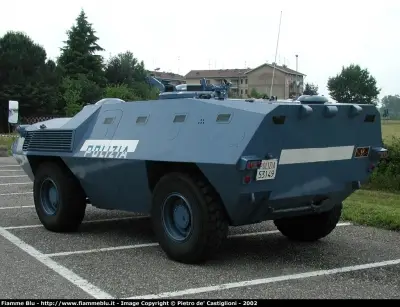
The Fiat CM6614 is a 4×4 wheeled armoured personnel carrier developed as a joint venture between Fiat and Oto Melara of Italy. The hull is welded steel and the vehicle is amphibious. The first prototype was built in 1972.
Fiat CM6614 at a glance
| Type | wheeled armoured personnel carrier |
|---|---|
| Developed by | Fiat and Oto Melara |
| First prototype | 1972 |
| Layout | 4×4, amphibious |
| Hull | welded steel, 8 mm |
| Armament | optional 12.7 mm machine gun turret |
| Smoke launchers | three per side, electrically operated |
| Tires | run-flat, with piano-string inserts |
| Licence version | KM900 in South Korea |
| Turret variant | CM6616 with 20 mm autocannon |
History of the Fiat CM6614
Layout
The CM6614 hull is welded steel of uniform 8 mm thickness. The driver sits at the front left with five episcopes to the front and side giving a field of vision of 200 degrees. The engine and transmission are on the front right, so that as much space as possible is left for the soldiers carried. The crew compartment at the rear has a powered ramp for rapid disembarkation and embarkation, and there is a hatch on each side in the middle of the vehicle. It also has a fume extractor, vision blocks and firing ports, so that troops can fire their personal weapons safely from inside.
The carrier could be fitted with a simple hand-operated turret with a 12.7 mm heavy machine gun, and the turret could be folded down for airlift and strategic transport. On each side of the turret are three electrically operated smoke and fog grenade launchers. The vehicle is amphibious, with run-flat tyres whose internal material is made of piano strings; in the water it is driven by the movement of the wheels, and buoyancy comes from the shape of the hull. There is no trim vane, so the vehicle is not fully waterproof: a sensor measures the water level and starts pumps to empty it. The CM6614 is useful in rescue missions and emergencies such as natural disasters, and for that reason it remains in service with the mobile police of the Italian State Police.
Armour problems
Italian-built CM6614s of 1976 and 1977 showed major flaws in their armour steel during trials in South Korea. When a projectile struck the armour, the whole plate cracked like glass instead of forming a single hole, and brand-new vehicles also suffered cracks at high temperatures, cutting the vehicle apart without any human interference.
South Korea and the KM900
In the 1970s South Korea needed wheeled armoured vehicles to protect cities and airfields against North Korean special forces by moving defending troops quickly. In 1976 it received a sample of the Thyssen Henschel UR-416 from West Germany and a CM6614 from Italy. South Korea first chose the UR-416 for licence production, but political tension with the United States led Washington to block NATO members from selling such vehicles to the country. Refused by West Germany, South Korea turned to Fiat, which was eager to sell the CM6614, and signed a contract for a licence under the designation KM900.
To avoid the NATO restriction, Italy and South Korea shipped the vehicles in parts to third countries and rerouted them to Pusan for assembly by Asia Motors, now Kia. During the trials South Korea found the flaws in the Italian armour and asked for the transfer of armour steel and run-flat tyre technology, so that it could fix the problem and produce locally. The transferred technology went to Korean steel and tyre makers and research groups and became the basis for Korean-made armour steel later used in main battle tanks, self-propelled howitzers, infantry fighting vehicles and even the navy’s destroyers. KM900 and KM901 vehicles entered service in 1977, mainly with the Capital Defence Command of the Republic of Korea Army and airfield security of the Republic of Korea Air Force; the air force began replacing them with K200A1 carriers in 1997 and the army retired the last ones by mid-2016.
Variants and operators
The CM6616 was a version of the CM6614 with a turret armed with a 20 mm autocannon, designed, built and installed by Oto Melara. The KM900 was the licence version built by Asia Motors, and the KM901 is a KM900 with a dozer blade. Among current operators, Italy uses the CM6614 with the State Police, and it serves with the armies or police of Argentina, Libya, Peru, Tunisia and Venezuela; the CM6616 serves Libya and Peru. Former users include the Italian Air Force, the Italian Army, South Korea and Somalia.
Design and features
- Welded steel hull: uniform 8 mm armour with a driver’s field of view of 200 degrees.
- Powered ramp: rapid loading and unloading of troops through the rear.
- Firing ports: troops can use their weapons from inside, with a fume extractor fitted.
- Amphibious: wheel-driven in water, with automatic pumps and run-flat tyres.
- Folding turret: a 12.7 mm machine gun turret that folds down for air transport.
Fiat CM6614 versions
- CM6614: the basic amphibious APC with an optional 12.7 mm turret.
- CM6616: Oto Melara turret with a 20 mm autocannon.
- KM900: South Korean licence version built by Asia Motors.
- KM901: KM900 fitted with a dozer blade.
Fiat’s other military 4×4 was the Fiat Campagnola, and the light truck of the same period was the Fiat 616. More vehicles are in the Fiat collection.
Sources
- Fiat CM6614, English Wikipedia: layout, armour, amphibious features, Korean licence production and operators