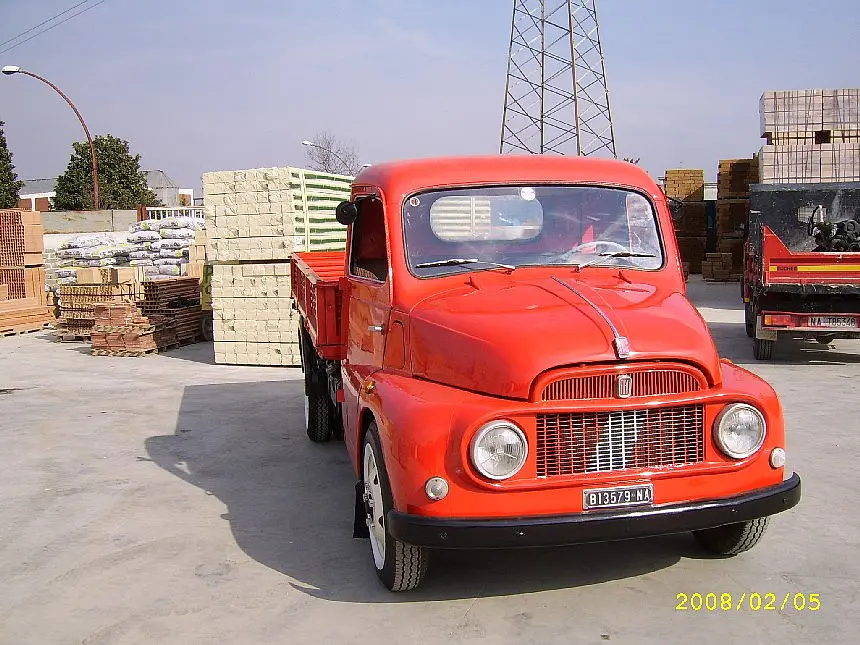
The Fiat 616 was a light lorry produced by the Italian manufacturer Fiat Veicoli Industriali from 1965 to 1978, in replacement of the earlier Fiat 615. It had a gross vehicle weight of 3.5 tonnes and was built in three series, with a bonneted cab and a diesel engine throughout.
Fiat 616 at a glance
| Production | 1965–1978 |
|---|---|
| Maker | Fiat Veicoli Industriali |
| Predecessor | Fiat 615 |
| Gross weight | 3.5 tonnes |
| Payload | about 1,700 kg depending on body |
| Cab | bonneted, with the engine ahead of the cab |
| Series | N1, N2/3, N3/4 |
| N1 engine | 2,693 cc four-cylinder diesel, 51 CV |
| N2/3 engine | 2,339 cc three-cylinder diesel, 51 CV |
| N3/4 engine | 3,119 cc four-cylinder diesel, 70 CV |
| Later engines | 8030 of 61.5 CV and 8040 of 81.5 CV |
| Replaced by | Iveco Fiat Daily and OM Grinta |
Based on one source, the Italian Wikipedia article.
History of the Fiat 616
A light lorry with a long nose
The 616 replaced the Fiat 615 in 1965. It was a vehicle with a gross weight of 3.5 tonnes and a payload of around 1,700 kg, depending on the body fitted. The cab was of the long-nose type, with the engine bonnet placed in front of the driving cab rather than under the seats. Several series were presented over the model’s life.
Series N1 and N2/3
The first series, N1, was in production from 1965 to 1966. It used the model 230 diesel engine, a square four-cylinder with a bore and stroke of 95 by 95 mm and a displacement of 2,693 cc, with indirect injection, producing 51 CV DIN at 3,500 rpm.
The N2/3 series followed from 1966 to 1968 with a new model 803A engine, a direct-injection three-cylinder diesel of long-stroke design, 95 by 110 mm, and 2,339 cc. It still produced 51 CV DIN, at 3,200 rpm, but it suffered from excessive vibration.
Series N3/4
Partly for that reason, the N3/4 series that went on sale in 1969 returned to four cylinders with the 804A engine of 3,119 cc and a maximum output of 70 CV DIN. With the reorganisation of Fiat’s transport vehicles carried out by the group in 1971, the 616 N3/4 adopted the engine of the new and larger 40NC model, the 8030, capable of 61.5 CV. Alongside it came the 8040 engine of the larger 50NC, enlarged in both capacity, from 2,592 to 3,456 cc, and output, which reached 81.5 CV.
Badges and the end
The most obvious visual difference between the N2 and N3 series was the Fiat logo, which changed from the type used on the 128 car, whose front the 616 resembled, to the larger diamond badge, joined from 1974 by the I in the lower left corner that marked the newly created Iveco. For some export countries the 616 N3 was sold under the OM brand, with no other difference. In 1978 the 616 N3 was replaced by the new model developed by Iveco, the Fiat Daily and OM Grinta.
Design and features
- Bonneted cab: the engine sat ahead of the cab, in the long-nose style.
- 3.5-tonne gross weight: a payload of about 1,700 kg depending on the body.
- Three diesel series: from the 2,693 cc four to the 2,339 cc three and back to four cylinders.
- Iveco badge: the letter I appeared in the logo from 1974.
- OM branding: the 616 N3 was sold as an OM in some export markets.
Fiat 616 versions
- 616 N1: 1965–1966, 2,693 cc indirect-injection four of 51 CV.
- 616 N2/3: 1966–1968, 2,339 cc direct-injection three of 51 CV.
- 616 N3/4: 1968–1978, 3,119 cc four of 70 CV.
- 616 with 8030: 61.5 CV engine from the 40NC after the 1971 reorganisation.
- 616 with 8040: 3,456 cc engine of 81.5 CV from the 50NC.
The 616 replaced the Fiat 615 and was replaced by the Iveco Daily. Heavier models of the period include the Fiat 619, and more vehicles are in the Fiat collection.
Sources
- Fiat 616, Italian Wikipedia: weights, cab, series, engines, badges and successor