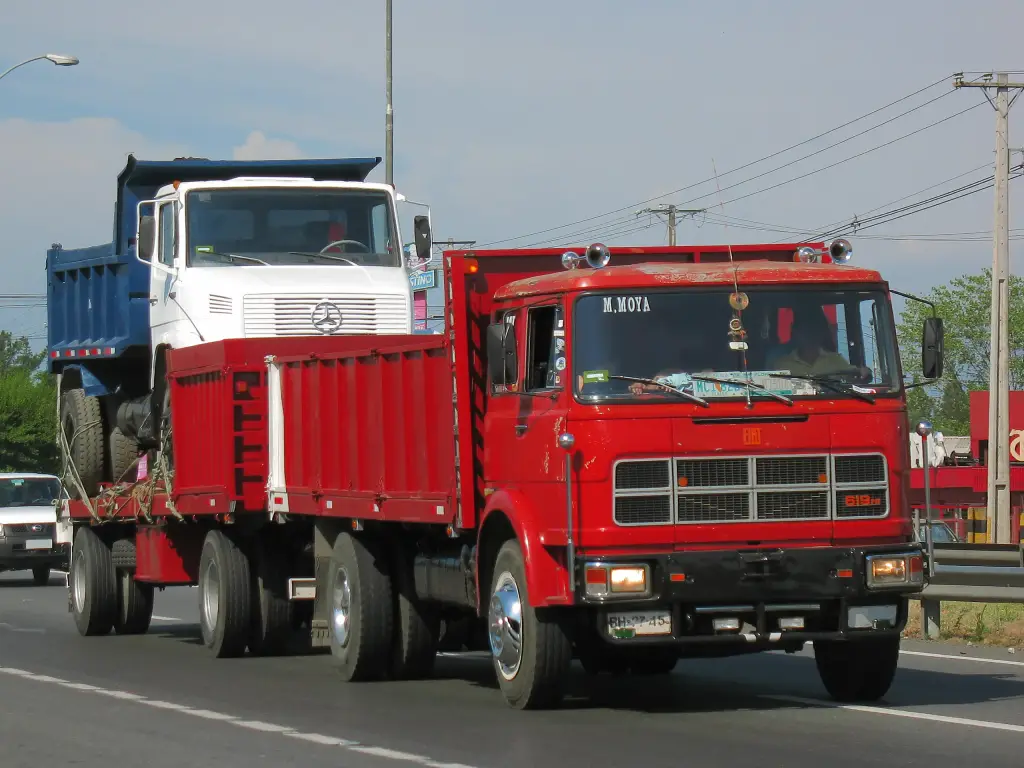
The Fiat 619 is a multi-purpose truck and road tractor for semi-trailers, manufactured from 1964 to 1980 as part of the Fiat Veicoli Industriali family of heavy vehicles. It was intended to replace the Fiat 682, although that model stayed in production until 1984, partly because of demand from the African market.
Fiat 619 at a glance
| Production | 1964–1980 (until 1994 in South America) |
|---|---|
| Type | chassis truck and road tractor |
| First generation | 619 N and 619 T, baffo cab |
| Second generation | 619 N1 and 619 T1 from 1970, Fiat H cab |
| Engines | 12,883 cc six with 210 hp; 13,798 cc six with 260 hp |
| 619 T1 engine | type 221 straight six, 12,883 cc, 208 hp |
| Gearbox | Fiat 4 + 4 |
| Top speed | 95 km/h (619 T1) |
| Marketed as | Unic in France, Magirus-Deutz in Germany |
| Predecessor | Fiat 682 |
Based on one source, the English Wikipedia article.
History of the Fiat 619
The Fiat 619 was part of the Fiat Veicoli Industriali range of heavy vehicles and was meant to replace the Fiat 682, which had been in production since 1952. In the event the 682 continued to be built until 1984, not least because the African market kept asking for it.
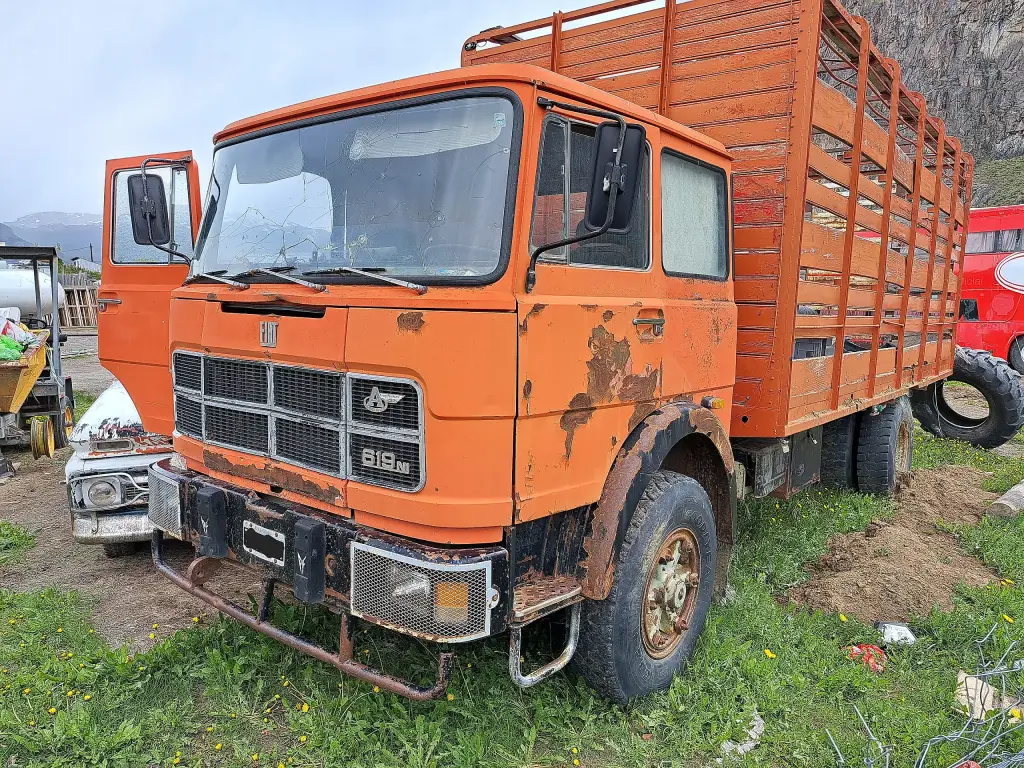
The first generation included two versions: the Fiat 619 N as a chassis truck and the Fiat 619 T as a road tractor. At that time the letters after the number stood for "naphtha" in the case of N and "tractor and semi-trailer" in the case of T. Both used the characteristic Fiat baffo cabin, named after the moustache-shaped trim on its front. That cabin became the emblem of Fiat heavy trucks from 1955 to 1974 and was designed to comply with the new Italian highway code of 1952, which imposed new rules on vehicle dimensions in line with the 1949 Geneva Convention on international transport.
The second generation, the Fiat 619 N1 and 619 T1, was launched in 1970 with the more spacious Fiat H cabin, which remained in use until 1991. The first 619s had a 12,883 cc engine of 210 hp; with the N1 and T1 this changed to a unit of 13,798 cc and 260 hp. The 619 T1 used a type 221 straight-six diesel of 12,883 cc and 208 hp, combined with a Fiat 4 + 4 gearbox, and reached a maximum speed of 95 km/h.
The two vehicles were built in advance of the European rules that set mass limits of 19 tonnes for two-axle vehicles and 26 tonnes for three-axle vehicles, and they were quite popular in Northern Europe. That strength in foreign markets ended up defining the 619 as the export truck of the range. It was also marketed as a Unic in France and as a Magirus-Deutz in Germany, and in South America, where it was produced until 1994, it was nicknamed pico de loro, parrot beak, after the shape of its cabin.
Design and features
- Baffo cabin: the moustache-fronted cabin used by Fiat heavy trucks from 1955 to 1974.
- H cabin: the more spacious second-generation cab, in use until 1991.
- Two roles: chassis truck as the 619 N and road tractor as the 619 T.
- Export model: popular in Northern Europe and built in South America until 1994.
- Big sixes: 12,883 and 13,798 cc diesels of 208 to 260 hp.
Fiat 619 versions
- 619 N: first-generation chassis truck with the baffo cabin.
- 619 T: first-generation road tractor for semi-trailers.
- 619 N1: second-generation chassis truck with the H cabin and the larger engine.
- 619 T1: second-generation tractor with the 12,883 cc type 221 engine.
The 619 was meant to replace the Fiat 682 and belonged to the same heavy range as the Fiat 642. More vehicles are in the Fiat collection.
Sources
- Fiat 619, English Wikipedia: production dates, versions, cabs, engines, gearbox, export markets