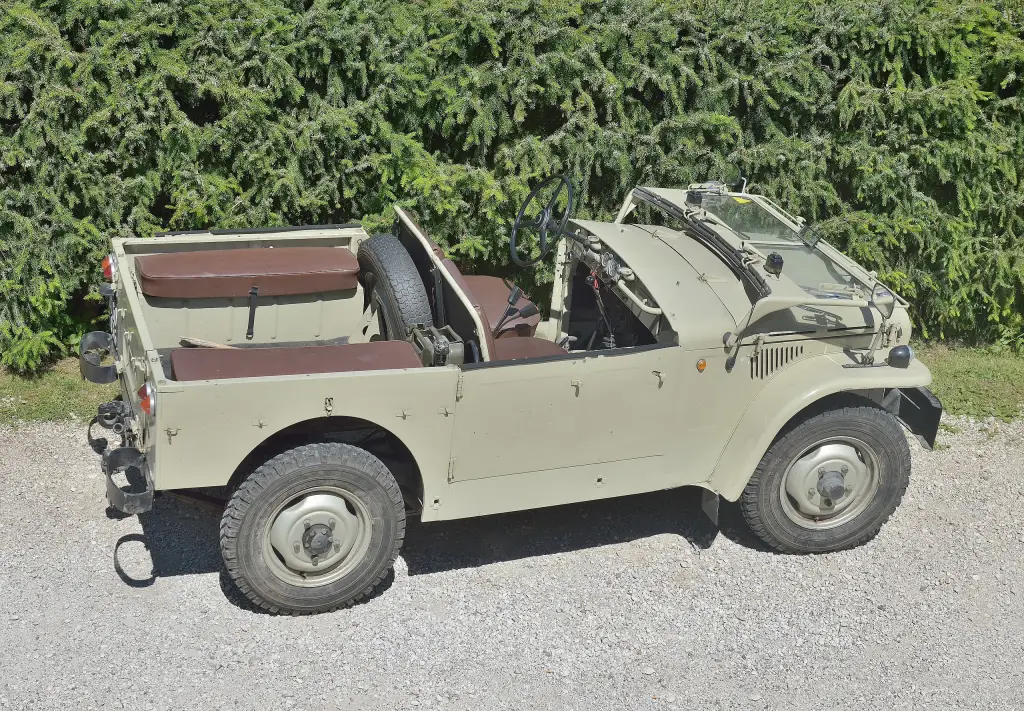
The Fiat Campagnola is a heavy-duty off-road vehicle produced by Fiat from 1951 to 1987. Production started in 1951 and the vehicle was upgraded in 1974. It was inspired by the Willys Jeep and was developed for the Italian Ministry of Defence, which wanted a replacement for the Willys MB it had received from the Allies.
Fiat Campagnola at a glance
| Production | 1951–1987 |
|---|---|
| Also called | Fiat 1101, Fiat 1107 Nuova Campagnola |
| Class | light off-road vehicle |
| Inspiration | Willys Jeep |
| 1101 engine | 1,901 cc petrol, 53 hp |
| Diesel engine | 1,905 cc, 40 hp, from 1953 |
| 1107 engine | 1,995 cc petrol, from the Fiat 132 |
| Optional | Sofim 2.5-litre diesel |
| Wading depth | 70 cm |
| Licence production | Zastava AR51 and AR55 in Yugoslavia |
History of the Fiat Campagnola
A tender for the army
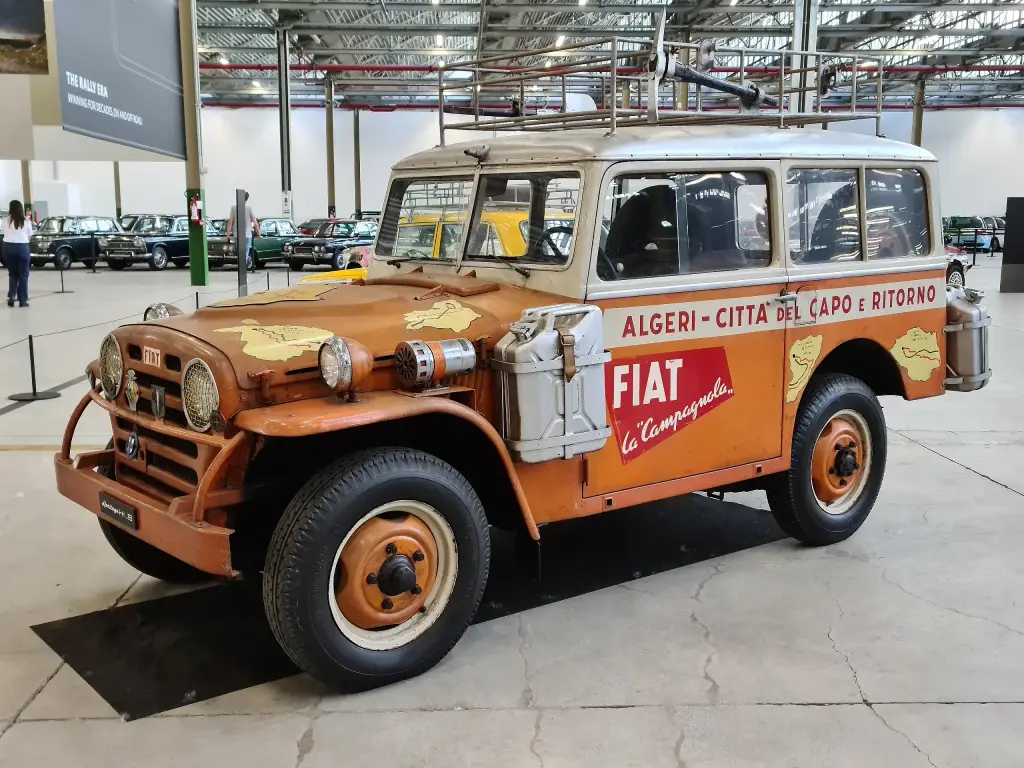
At the beginning of the 1950s the Italian Ministry of Defence launched a call for tenders for a light off-road vehicle to replace the Willys MB inherited from the Allies, by then worn out and increasingly difficult to keep efficient. Fiat had in fact already begun, in secret and under the direction of the engineer Giacosa, the study of a four-wheel-drive vehicle inspired by the Willys, on the suggestion of the ministry itself. The project was called 1101 and first named Alpina; the name was later changed to Campagnola so as not to emphasise its military use, since Alpina recalled too strongly the army corps of the same name.
Fiat and Alfa Romeo answered the tender with the 1101 and the 1900 M respectively. The Turin off-roader was already well advanced when the tender was published, while Alfa Romeo had to make up time, creating a usable vehicle in a few months with a Land Rover as the starting point for its prototype. Fiat won the competition, helped by the considerably lower cost of the Campagnola and the simplicity of its construction.
The 1101 Campagnola
The Campagnola 1101 proved to be a good vehicle, with a sturdy steel frame with side members. Most other parts, including the 1,901 cc petrol engine producing 53 hp at 3,700 rpm, came from the Fiat 1400 and 1900. All four wheels were driven through a semi-synchronised four-speed gearbox with centre shift and a two-speed transfer case, with front-wheel drive engaged. At the rear there was a rigid axle on leaf springs with hydraulic telescopic shock absorbers, while the front wheels were independently suspended on slightly inclined double wishbones with coil springs and hydraulic shock absorbers.
In 1953 Fiat added the Campagnola Diesel, which, like the Fiat 1400 Diesel and the 615 N light lorry, was powered by a four-cylinder in-line engine of 1,905 cc with a maximum output of 40 hp at 3,200 rpm. It reached a top speed of 85 km/h.
The Nuova Campagnola
The Campagnola was redesigned for launch in June 1974 and produced in that form until 1987, as the 1107. The new vehicle used the petrol engine of the Fiat 132 with a longer stroke that raised the capacity to 1,995 cc. In the Campagnola the light alloy cylinder head carried a single side-mounted camshaft driven by a toothed belt, with valve movement by pushrods and rockers. A Sofim 2.5-litre diesel was available as an option.
The large square engine compartment gave easy access to the engine bay, which was designed to allow wading to a depth of 70 cm. The 57-litre fuel tank was placed well out of reach of rocks and flying stones, under the twin passenger seat beside the driver. Torsion bars suspended all four wheels, with two shock absorbers for each rear wheel and one for each front wheel; all six were of identical specification and therefore interchangeable. Road testers in the United Kingdom praised the smoothness of the ride over rough ground, which compared very favourably with the Land Rover of the time. A military version appeared in 1976 and was known as the AR76, and was updated again in 1979.
Abroad
In 1976 the French army was about to replace its Jeeps and several prototype series were made. Renault offered the Campagnola TRM500, a derivative of the Fiat vehicle using the engine of the Renault R20, but the Peugeot P4 was chosen. In Yugoslavia, Zastava began production of the Zastava AR51 in 1954 under licence from Fiat, delivering 17 examples to the Yugoslav People’s Army by the end of that year. In 1955 the focus changed to the new AR55, the last change in design, on which all later Zastava Campagnolas were based. Production lasted until 1974 and 9,089 AR55 military vehicles were built; from the initials AR it earned the nickname Aerka.
Design and features
- Purpose-built for the army: developed after a Ministry of Defence tender to replace the Willys MB.
- Boxed steel frame: sturdy side-member chassis with leaf-sprung rigid rear axle.
- Four-wheel drive: semi-synchronised four-speed gearbox and a two-speed transfer case.
- Wading ability: the Nuova Campagnola was designed to ford 70 cm of water.
- Interchangeable dampers: six identical shock absorbers on the 1107, torsion-bar suspension.
Fiat Campagnola versions
- 1101 Campagnola: 1951–1973, 1,901 cc petrol engine of 53 hp.
- Campagnola Diesel: from 1953, 1,905 cc engine of 40 hp.
- 1107 Nuova Campagnola: from June 1974, 1,995 cc petrol or Sofim 2.5 diesel.
- AR76: military version of 1976, updated in 1979.
- Renault TRM500: French prototype derivative with a Renault R20 engine.
- Zastava AR51 and AR55: licence-built Yugoslav versions, 1954–1974.
The Campagnola took its engine from the Fiat 1400, and the Nuova Campagnola used an enlarged unit from the Fiat 132. More cars are in the Fiat collection.
Sources
- Fiat Campagnola, English Wikipedia: military tender, 1101 and 1107 models, engines, chassis, Zastava licence