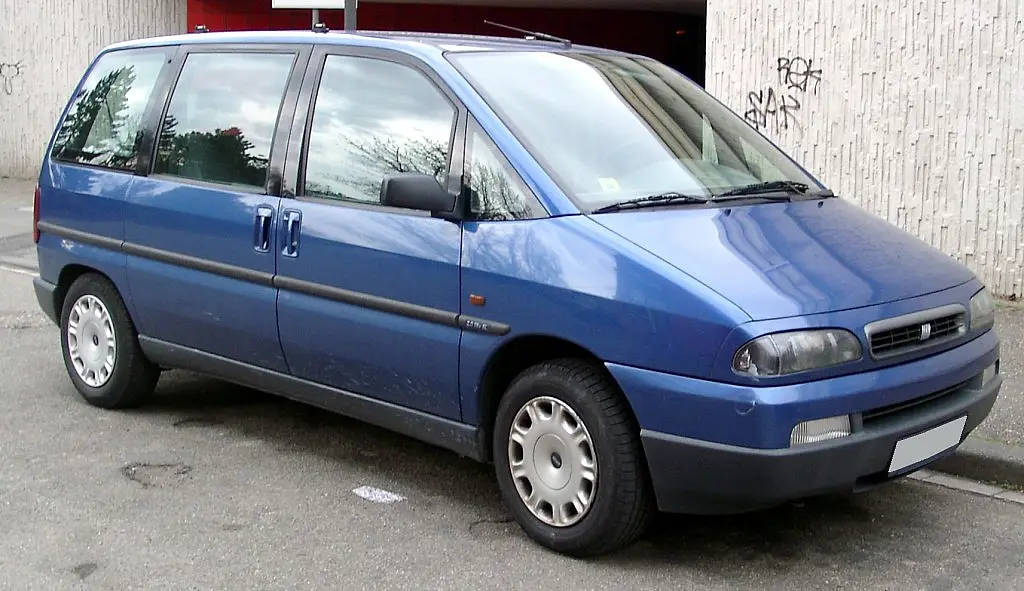
The Fiat Ulysse was Fiat’s version of the Eurovans, a family of large MPVs from the Citroën, Peugeot, Fiat and Lancia marques produced at the jointly owned Sevel Nord factory in France. The Eurovans were launched in March 1994 and production ceased in November 2010 for the Fiat and Lancia models. The cars differ little technically and visually, being a prime example of badge engineering.
Fiat Ulysse at a glance
| Production | 1994–2010 |
|---|---|
| Class | large MPV |
| Built at | Sevel Nord, France |
| Sister models | Citroën Evasion, Peugeot 806, Lancia Zeta |
| Second generation | Citroën C8, Peugeot 807, Lancia Phedra |
| First generation | 1994–2002 |
| Second generation | 2002–2014 |
| Seats | up to seven |
| Doors | sliding rear side doors |
| Engines | PSA petrol and diesel |
| Named after | Ulysses, the Roman name for Odysseus |
based on one source; the English article covers the shared Eurovans range, so the text is limited to what applies to the Ulysse
History of the Fiat Ulysse
The Eurovans
The Eurovans were a family of large MPVs from Citroën, Peugeot, Fiat and Lancia produced at the jointly owned Sevel Nord factory in France. The term Eurovan was not used by the brands themselves in sales literature but by the motoring press to refer to the vans collectively. The cars share mechanicals and body structure with the Sevel Nord light commercial vans, the Citroën Jumpy or Dispatch, the Fiat Scudo and the Peugeot Expert.
The first-generation Eurovans were marketed as the Citroën Evasion, the Fiat Ulysse, the Lancia Zeta or Z and the Peugeot 806. For the second generation all were renamed except the Fiat Ulysse, the others becoming the Citroën C8, the Lancia Phedra and the Peugeot 807. The Fiat was named after Ulysses, the Roman name for Odysseus, the hero of Homer’s Odyssey.
First generation, 1994–2002
The first generation was introduced in June 1994. The cars are smaller than American vans such as the Chrysler Voyager, which is also sold in Europe, and like the Toyota Previa and American minivans they had sliding rear side doors, a trait shared with their commercial siblings. While the Voyager also came in Grand versions with a longer body and wheelbase, the Eurovans came in one size only.
The four versions were almost identical, differing in grilles, lower tailgates and tail lights, wheel covers or alloy wheels, exterior and interior badging and trim levels. In October 1998 the Eurovans were mildly facelifted, and the Ulysse received the same treatment. Inside, the gear lever was mounted on the dashboard rather than the floor and the handbrake sat on the door side of the driver’s seat, which allowed the middle console to be removed and opened a passage between the front seats. Seating configurations included two fixed front seats, swivelling on some models, three individual removable seats in the middle row and either two individual removable seats or a three-seater bench in the third row.
The first generation used PSA’s XU and XUD engines regardless of brand, later replaced by the PSA EW and DW families. All were mated to five-speed manual transmissions apart from the 2.0 16-valve EW petrol, which could be ordered with a four-speed automatic.
Second generation, 2002–2014
The second generation was launched in 2002, the Peugeot 807 in June followed by the Citroën C8 in July. The floorpan, wheelbase and rear end were not transformed, but all exterior dimensions including the front and rear tracks were increased, and the extra length of almost 30 cm greatly enhanced interior volume. The new Eurovans had a much more bubbly, contemporary look and a modern dashboard with centrally mounted gauges.
Differences between the versions became more marked, covering full front fascias and rear sections including head and tail lights, as well as different interior colour themes. The middle and third row seats gained fore and aft sliders and adjustable backs, and a three-seater bench was again available in the third row, fitting the standard runners with back-lowering and tilt-forward arrangements to increase boot space. The Fiat and the Lancia were slightly wider than the PSA vans, and the Lancia Phedra was longer than the other Eurovans. The Citroën C8 and Peugeot 807 later received two light facelifts, the first in February 2008 and the second in 2012, while production of the Fiat Ulysse ended in November 2010.
Design and features
- Badge engineering: one MPV built at Sevel Nord and sold under four marques.
- Sliding doors: rear side sliding doors shared with the Sevel commercial vans.
- Flexible seating: up to seven places with removable middle-row seats.
- Dashboard gear lever: a column of controls that freed a passage between the front seats.
- PSA engines: XU and XUD units first, later the EW and DW families.
Fiat Ulysse versions
- Ulysse first generation: the 1994–2002 MPV with PSA XU and XUD engines.
- Ulysse second generation: the 2002–2010 car with a longer body and sliding seats.
- Citroën Evasion and C8: the Citroën versions, called Synergie in the UK for the first generation.
- Peugeot 806 and 807: the Peugeot versions of the same vehicle.
- Lancia Zeta and Phedra: the Lancia versions, the Zeta not sold in the UK.
The Ulysse shared its Sevel Nord base with the Fiat Scudo van, and sat above the smaller Fiat Doblò in the range. More cars are in the Fiat collection.
Sources
- Eurovans, English Wikipedia: Sevel Nord production, both generations, Ulysse details, engines