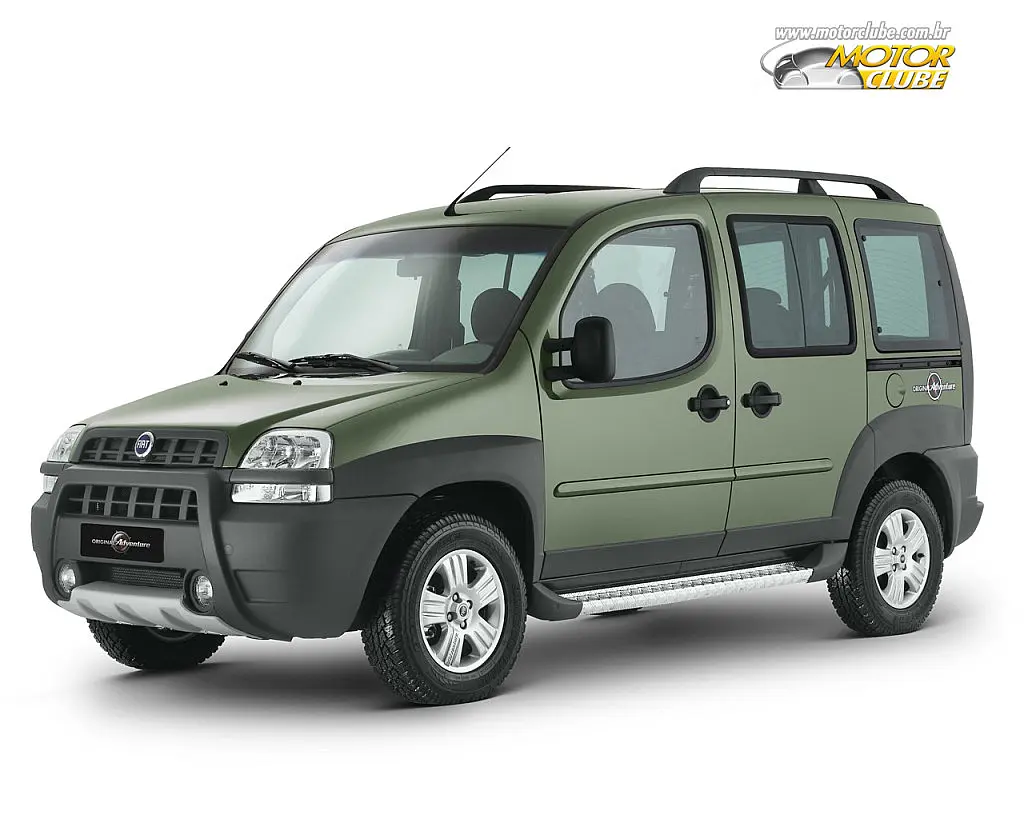
The Fiat Doblò is a panel van and leisure activity vehicle produced by Fiat since 2000. It was unveiled at the Paris Motor Show in October 2000 and the first cars were sold in January 2001. Three generations have followed, the second adopted in 2010 and the third, based on the Citroën Berlingo, unveiled in June 2022.
Fiat Doblò at a glance
| Production | since 2000 |
|---|---|
| Class | panel van and leisure activity vehicle |
| First shown | Paris Motor Show, October 2000 |
| First generation platform | Fiat Strada, derived from the Palio |
| Payload | up to 730 kg |
| Load volume | 3.2 cubic metres |
| Built in | Turkey, Brazil, Russia and Vietnam |
| Award | International Van of the Year 2006 |
| Second generation | 2010, Fiat Small platform |
| Third generation | 2022, based on the Citroën Berlingo |
History of the Fiat Doblò
First generation
The Doblò was first launched to the public in the Netherlands and went on sale in January 2001. It carried a payload of up to 730 kg with an interior volume of 3.2 cubic metres. The van used the platform of the Fiat Strada, itself derived from the Palio, with a rigid axle and leaf springs at the rear instead of the torsion beam with coil springs used on the Palio.
It was manufactured at Fiat’s Tofaš subsidiary factory in Bursa, Turkey, in Brazil from 2002, and in Russia and Vietnam. Turkish models had an engine range that included a 1.4-litre petrol unit, a 1.9-litre MultiJet and a 16-valve 1.3-litre MultiJet. In North Korea, Pyonghwa Motors built the Doblò as the Pyeonghwa Ppeokkugi from mid-2003; the car was not successful and production stopped in 2004.
A facelifted version arrived in October 2005, restyled with changes to the front and rear light groups and to the whole design of the front. The first-generation Doblò received the International Van of the Year award for 2006.
Brazil and the Adventure
The Brazilian Doblò was launched in late 2001 as a 2002 model with two 16-valve petrol engines, a 1.3-litre Fire and a 1.6-litre Torque. From 2004 to 2009 the only engine offered in Brazil was an eight-valve 1.8-litre Ecotec supplied by General Motors do Brasil, first as a petrol unit and later as a flex-fuel one.
In September 2003 Fiat Brazil introduced an off-road-styled, two-wheel-drive version called the Doblò Adventure, also with the 1.8-litre Ecotec four. It had bigger bumpers and mouldings, ride height raised by 6 cm and the spare wheel mounted on the rear. In 2009 the whole Adventure line, which also included the Idea, Strada and Palio Weekend, gained a locking differential and was rebadged Adventure Locker. Only in the 2010 model year were the Brazilian Doblò and Doblò Adventure updated with the European facelift of 2005. The Brazilian Doblò was discontinued in December 2021 after 160,000 units assembled in 20 years, as slow sales made compliance with the coming emission standards unviable.
Electric versions
Micro-Vett built an electric Doblò with three battery options: an 18 kWh Altairnano lithium-ion pack that could be recharged in less than ten minutes with a 125 kW rapid charger, a 43 kWh lead-acid pack giving a range of 150 km, and a pack of sixty 200 Ah lithium modules. The vehicle used a 30 kW motor, with 60 kW peak, from Ansaldo Electric Drives and the vehicle reached 120 km/h. A 60-day demonstration starting on 2 October 2007 covered 7,500 km on an urban delivery circuit. The Doblò received three stars for adult occupants, three for toddlers and one for pedestrians from Euro NCAP in 2004.
Second and third generations
The all-new Doblò, type 263, was launched at the beginning of 2010 and is built in Turkey by Tofaš. It uses the Fiat Small platform derived from the Grande Punto, with a bi-link independent rear suspension instead of a torsion beam, a 790-litre luggage compartment and CO2 emissions of 129 g/km with the 90 PS 1.3 MultiJet engine. It was also sold by Opel and Vauxhall as the Combo, and from 2015 to 2022 in the United States as the RAM ProMaster City. From July 2011 a pickup called the Doblò Work Up, or Fiat Pratico in Turkey, was offered, along with a raised roof version and an extended-wheelbase Cargo Maxi; the Cargo XL combined both with a one-tonne payload and the 105 hp 1.6 MultiJet. The range took the International Van of the Year 2011 award at the Hanover motor show in 2010. The third-generation Doblò is a rebadged version of the 2018 Citroën Berlingo, unveiled in June 2022 and therefore also sold as the Opel and Vauxhall Combo, Peugeot Partner and Toyota ProAce.
Design and features
- Van and car in one: a panel van and leisure activity vehicle on a passenger-car platform.
- Payload and volume: up to 730 kg and 3.2 cubic metres in the first generation.
- Rigid rear axle: leaf springs instead of the Palio’s torsion beam, for load carrying.
- Electric conversions: Micro-Vett versions with three battery options.
- Badge-engineered generations: also sold as the Opel and Vauxhall Combo and the RAM ProMaster City.
Fiat Doblò versions
- First generation: from 2000, on the Strada and Palio platform, facelifted in 2005.
- Doblò Adventure: Brazilian two-wheel-drive model with raised ride height, from 2003.
- Doblò Work Up: pickup from July 2011, sold as the Fiat Pratico in Turkey.
- Doblò Cargo Maxi and Cargo XL: extended wheelbase and high roof van versions.
- Second generation: type 263 from 2010, on the Fiat Small platform.
- Third generation: from 2022, a rebadged Citroën Berlingo.
The Doblò sits below the Fiat Scudo and the larger Fiat Ducato in the commercial range. More vehicles are in the Fiat collection.
Sources
- Fiat Doblò, English Wikipedia: generations, production sites, Brazilian versions, electric conversions, safety