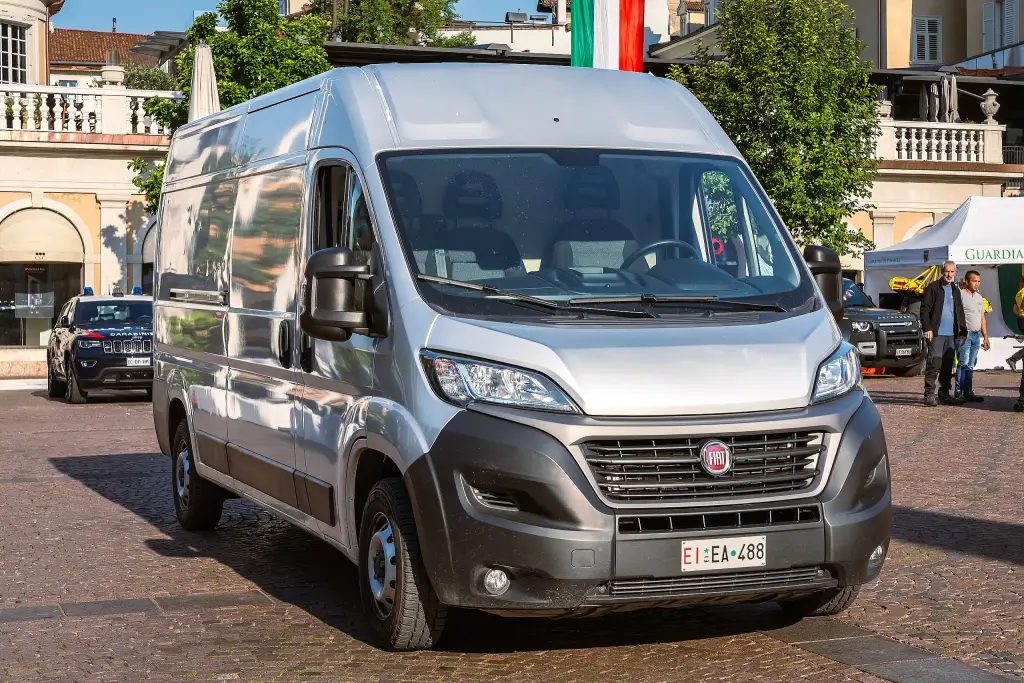
The Fiat Ducato is a light commercial vehicle jointly developed by FCA Italy and the PSA Group and mainly manufactured by Sevel, the joint venture between the two companies, since 1981. It has also been sold as the Citroën C25, Peugeot J5, Alfa Romeo AR6, Talbot Express and Ram ProMaster, and more than 3.5 million have been built.
Fiat Ducato at a glance
| Production | since 1981 |
|---|---|
| Class | light commercial vehicle |
| Developed by | Fiat and PSA, built by Sevel |
| Main plant | Sevel Sud, Atessa, Italy |
| Also built in | Brazil, Turkey, Mexico and Russia |
| First-generation engines | 1.8 and 2.0 petrol, 1.9 diesel |
| Payload variants | Ducato 10, 13, 14 and Maxi 18 |
| Badge-engineered as | Citroën C25, Peugeot J5, Talbot Express, Alfa Romeo AR6 |
| Later names | Citroën Jumper, Peugeot Boxer, Ram ProMaster, Opel Movano, Toyota Proace Max |
| Four-wheel drive | converted by Dangel with a central viscous coupling |
Based on one source, the English Wikipedia article.
History of the Fiat Ducato
The Ducato was first launched in 1981 and resulted from Fiat’s collaboration with PSA Peugeot Citroën, with development starting in 1978. The vehicles were manufactured at the Sevel Val di Sangro plant in Atessa, in central Italy, and at the Sevel Campania plant in Pomigliano d’Arco near Naples, together with the similar Alfa Romeo AR6, Citroën C25 and Peugeot J5 versions. The Peugeot J5 was sold in the United Kingdom as the Talbot Express between 1986 and 1994. The collaboration had earlier produced the Fiat 242 and Citroën C35 from 1974, and in Europe the Ducato is still built at the Sevel Sud factory in Atessa, with other production in Brazil, Turkey, Mexico and Russia.
For the Fiat, first-generation engines were 1.8 and 2.0-litre four-cylinder petrol units or a 1.9-litre diesel, with trim levels base, S and SX. Model variants were named after their carrying capacity: Ducato 10 for one tonne, Ducato 13 for 1.3 tonnes, Ducato 14 for 1.4 tonnes and Ducato Maxi 18 for 1.8 tonnes. The first-generation Ducato was very popular as a basis for campervan conversions, and from 1990 Fiat offered campervan manufacturers a platform developed especially for the purpose. The name Ducato refers to the ducat coin, the third Fiat light commercial vehicle after the Fiorino and the Marengo to be named after ancient coinage.
In August 1992 some Ducatos were built with a T29C electric DC motor from Leroy-Somer and sold as the Ducato Elettra. It was powered by 28 six-volt valve-regulated lead-acid gel cells producing 168 volts and 160 amperes, carried in a wooden box weighing 868 kg. The transporter measured 4,765 by 1,965 by 2,100 mm, had a maximum gross weight of 3,190 kg, a payload of 750 kg and a range of up to 70 km.
The Fiat Talento was first sold in 1981 as a short-wheelbase version of the Ducato and was discontinued in 1994, before the name returned in 2016 on a rebadged Renault Trafic. The Alfa Romeo AR6 was a badge-engineered Ducato sold in Italy only, in two wheelbase lengths and as a passenger van, commercial van or pick-up; it was the last commercial vehicle sold by Alfa Romeo and was built at Pomigliano d’Arco until 1 January 1986, when Alfa Romeo left the commercial vehicle business, while Ducato production continued there until the plant closed in 1994.
The Citroën C25 and Peugeot J5 were 2.5-tonne vans built from October 1981 until 1993, with transversely mounted engines, a petrol unit from the Peugeot 504 and a diesel from the Citroën CX, both coupled to a Citroën gearbox. In February 1982 the range was extended with a pick-up and a minibus, a series 2 with a larger grille arrived in 1991, and both were replaced in 1994 by the Jumper and Boxer, which were based on the second-generation Ducato. The Talbot Express was sold only in the United Kingdom and was the last Talbot-badged vehicle.
Later the Ducato became the basis of a wide family of vehicles. It entered North America as the Ram ProMaster in May 2014, gained an electric version presented in July 2019 and on sale from 2020, and from the 2022 model year was also rebadged as the Opel and Vauxhall Movano, with the Toyota Proace Max following in 2023. Four-wheel-drive versions can be ordered, converted by the French company Dangel using a central viscous coupling. The Ducato is the most common motorhome base in Europe, with around two-thirds of motorhomes using it.
Design and features
- Joint development: engineered by Fiat and PSA and built by the Sevel joint venture.
- Payload naming: Ducato 10, 13, 14 and Maxi 18 named after their carrying capacity.
- Campervan base: around two-thirds of European motorhomes are built on the Ducato.
- Electric version: the Ducato Elettra of 1992 and a modern electric model from 2020.
- Dangel 4WD: four-wheel drive converted with a central viscous coupling.
Fiat Ducato versions
- Ducato 10, 13, 14 and Maxi 18: first-generation payload variants.
- Fiat Talento: short-wheelbase Ducato sold from 1981 to 1994.
- Alfa Romeo AR6: Italian-market badge-engineered version, 1981–1986.
- Citroën C25 and Peugeot J5: sister vans built until 1993.
- Talbot Express: British-market version sold from 1986 to 1994.
- Ram ProMaster: North American version from 2014.
The Ducato is the larger relative of the Fiat Talento and shares its market with the Fiat Scudo. More vehicles are in the Fiat collection.
Sources
- Fiat Ducato, English Wikipedia: development, first generation, plants, badge-engineered versions, Elettra