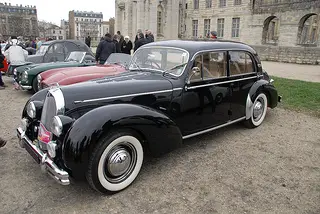
The Fiat 2800 was a car produced by Fiat between 1938 and 1944. Taking up the stylistic innovations of the 1500 C, it was the last substantially new model to leave the Fiat factories before the Second World War. It is said that its design was proposed to Fiat’s management by Benito Mussolini, who wanted a flagship to set against the Mercedes-Benz cars of the time.
Fiat 2800 at a glance
| Production | 1938–1944 |
|---|---|
| Body | six- or seven-seat torpedo, saloon, military CMC |
| Coachbuilder | Farina (torpedo versions) |
| Engine | 2,852 cc straight-six, overhead valves |
| Power | 85 PS (63 kW) at 4,000 rpm |
| Top speed | 130 km/h |
| Total built | 624 |
| Military version | 2800 CMC, 1939–1943 |
| Royal use | Quirinal Palace garage |
| Post-war use | first presidents of the Republic |
History of the Fiat 2800
A flagship for the state
The 2800 followed the styling ideas of the 1500 C and was the last new Fiat design of the pre-war period. The Farina works built six cars in a six- to seven-seater torpedo body; these entered the garage of the Royal House at the Quirinal Palace and became the representative cars of the royal family and, after the war, of the first presidents of the Republic. The same coachbuilder built a seventh example, a special military torpedo, for the personal use of King Vittorio Emanuele III as commander-in-chief of the armed forces.
For official ceremonies and the reception of heads of state and popes, the King used an imperial black 2800 that he named “Alcinoo”, after one of his best thoroughbreds. The car has been the subject of a book, “The King’s Last Car” by Marco Linari, which follows the flagship through the great parades of both the monarchy and the republic, from 1938 to 1962, and its later forgetting in a Rome garage until the dealer Raffaele Bacelliere found it again eight years later. Among those who travelled in the 2800 torpedo were Benito Mussolini, Adolf Hitler, Francisco Franco, Umberto II, Harry Truman, Evita Perón and Charles de Gaulle, as well as the first four heads of state of the Republic: Enrico De Nicola, Luigi Einaudi, Giovanni Gronchi and Antonio Segni. The car is now kept at the Onda Rossa Museum in Caronno Pertusella, in the province of Varese.
Two of these cars were used by King Vittorio Emanuele III and by Pietro Badoglio during their escape from Rome to Pescara; the torpedo named Alcinoo carried the sovereigns’ luggage.
Engineering
The engine was a straight-six with overhead valves of 2,852 cc, producing 85 PS at 4,000 rpm and giving a top speed of 130 km/h. Between 1938 and 1944 only 624 examples of the 2800 were built in both civilian and military forms.
Fiat 2800 CMC
In 1939 Fiat introduced the 2800 CMC, for Corta Militare Coloniale, used by the commands of the Royal Army during the Second World War. It differed from the civilian car in its more spartan bodywork and larger tyres. Production continued until 1943, with the last one completed in 1944.
Design and features
- Straight-six power: 2,852 cc with overhead valves, 85 PS at 4,000 rpm.
- 130 km/h: a high top speed for an Italian saloon of 1938.
- State limousine: six Farina torpedos served the royal house and later the presidents.
- Named cars: the King’s black 2800 was known as “Alcinoo”.
- Military variant: the spartan CMC with larger tyres for colonial and army commands.
Fiat 2800 versions
- 2800 torpedo: six- to seven-seat open body by Farina.
- Military torpedo: a seventh Farina car for King Vittorio Emanuele III.
- 2800 CMC: Corta Militare Coloniale, spartan body and larger tyres, 1939–1943.
The 2800 sat above the Fiat 1300 and 1500 in the pre-war range, and the later flagship line continued with the Fiat 1800 and 2100. More cars are in the Fiat collection.
Sources
- Fiat 2800, English Wikipedia: production, royal and presidential use, engine data and the CMC