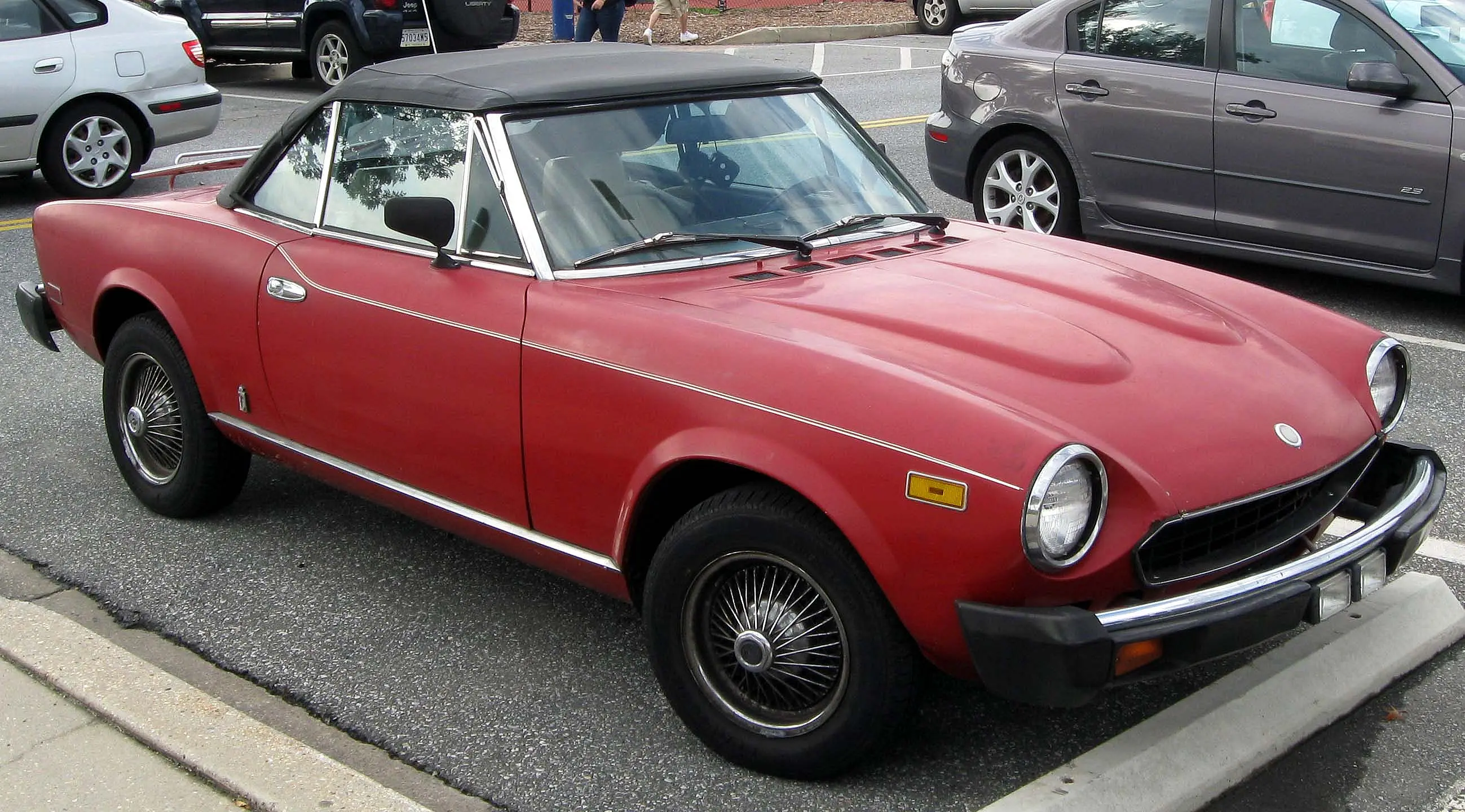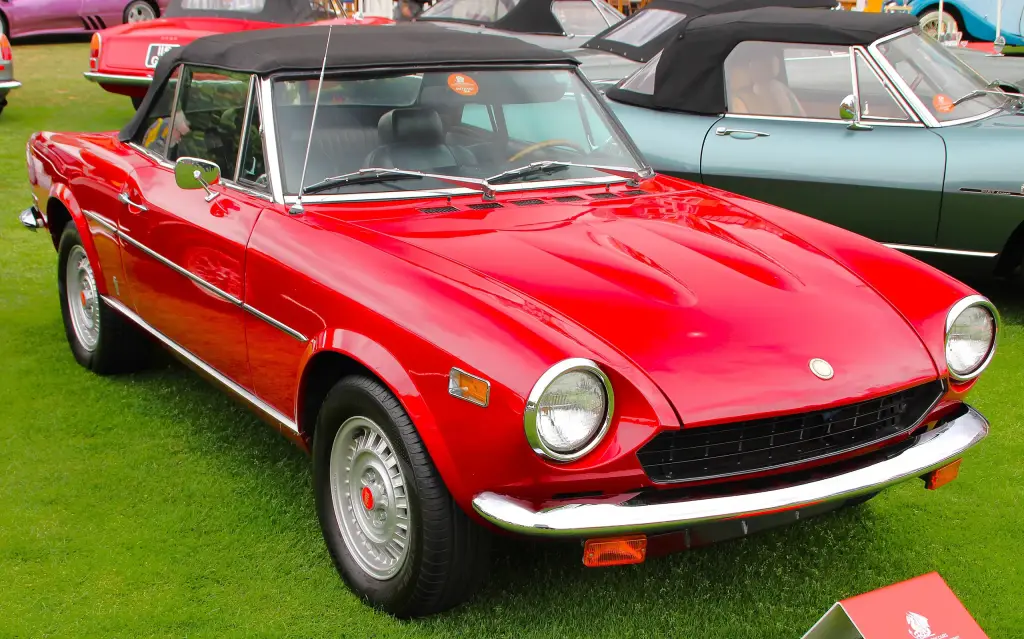
The Fiat 124 Sport Spider is a two-seat convertible sports car that Fiat marketed from the 1966 to 1982 model years, after which Pininfarina built it under its own name until 1985. The body was designed and manufactured by Pininfarina, with styling by Tom Tjaarda, and the car used the twin-cam version of Fiat’s 124 engine family.
Fiat 124 Sport Spider at a glance
| Production | 1966–1982 (Fiat), 1982–1985 (Pininfarina) |
|---|---|
| Also called | Spider 2000, Pininfarina Azzurra, Pininfarina Spidereuropa |
| Designer | Tom Tjaarda, Pininfarina |
| Layout | front engine, rear drive, monocoque |
| Body | two-door convertible |
| Engine | 1,438–1,995 cc double-overhead-cam four |
| Power | 102 hp in the 1981 North American 2.0, 128 hp in the 124 CSA |
| Transmission | five-speed manual; three-speed automatic optional 1979–1985 |
| Suspension | unequal-length wishbones front, live axle with Panhard rod rear |
| Brakes | four-wheel discs from 1969 |
| Built in | Turin, then San Giorgio Canavese |
| Rally version | Fiat Abarth 124 Rally, homologated 1972 |
Based on one source, the English Wikipedia article.
History of the Fiat 124 Sport Spider
The Sport Spider debuted at the Turin Auto Show in November 1966. It was designed and built at the Pininfarina works rather than in a Fiat plant, although Fiat designed and manufactured the 124 Sport Coupé in-house. The Spider shared its running gear with the 124 coupé and saloon but used a shorter platform and a shorter wheelbase, and its monocoque body carried a front engine driving the rear wheels.
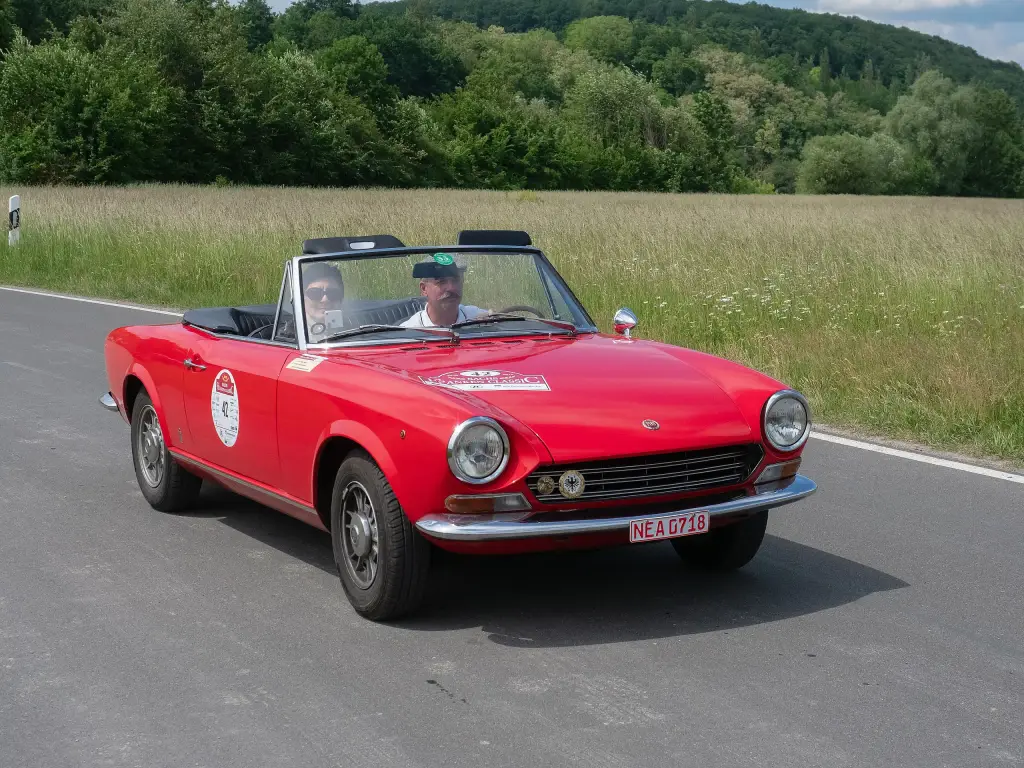
The build series were designated internally as AS, BS, BS1, CS and CSA. The AS cars used a torque tube to take power to the rear axle; this crack-prone arrangement was replaced during 1969 by a trailing-arm rear axle on the BS, which was built alongside the AS for the first six months of 1970. Early AS cars have smaller tail lights, while the BS received a mesh grille and black-rimmed instruments. In July 1970 came the 1.6-litre BS1, recognisable by twin humps on the bonnet and bumper overriders. The CS series arrived in 1972, and in the same year Fiat launched the 124 CSA, a sports version needed for the type approval of its rally car, with 128 hp; fewer than a thousand were built in three years.
The engine was a double-overhead-cam, aluminium crossflow-head development of the 124 saloon’s pushrod unit, designed by Aurelio Lampredi. Capacity rose from 1,438 cc in 1966 to 1,608 cc in 1970, was reduced to 1,592 cc in 1973, then grew to 1,756 cc in 1974 and 1,995 cc in 1979, when the model was renamed the Spider 2000. It was the first mass-produced twin-cam engine to use a reinforced-rubber timing belt, an arrangement that became almost universal afterwards. Bosch fuel injection replaced Weber carburettors in the middle of 1980, and a supercharged Volumex version was offered near the end of production in Europe only, at 35 per cent more than a fuel-injected Spidereuropa.
Fiat built the car in Turin until October 1981, when Pininfarina took over manufacture at San Giorgio Canavese; serial numbers started again from zero and the eleventh digit of the vehicle identification number changed from 8 to 5. The Fiat Spider 2000 ended production in July 1982, and after the Italian summer holidays Pininfarina began building the car as the Spider Azzurra for North America and the Spidereuropa for Europe, which continued until 1985. In North America, where the Spider had been sold since 1968, a General Motors three-speed automatic was available from 1979 to 1985, and for 1981 a 102 hp engine with a catalytic converter and Bosch L-Jetronic injection became standard.
For rallying, Fiat presented the Fiat Abarth 124 Rally in November 1972, also known as the 124 Abarth Stradale. It received FIA group 4 homologation and replaced the 1.6-litre Sport Spider rally cars then in use, at a time when the 124 had already won the 1972 European Rally Championship with Raffaele Pinto and Gino Macaluso.
Design and features
- Lampredi twin cam: an aluminium crossflow head with two overhead camshafts and a rubber timing belt.
- Pininfarina body: a two-seat convertible built in the coachbuilder’s own factory.
- Simple hood: the soft top could be raised or lowered by a seated driver.
- Four-wheel disc brakes: fitted to the Spider from 1969.
- Rally pedigree: the 124 CSA and the Abarth 124 Rally were homologation cars for group 4 competition.
Fiat 124 Sport Spider versions
- 124 Sport Spider AS: first series with a torque-tube rear axle and small tail lights.
- 124 Sport Spider BS and BS1: trailing-arm rear axle, mesh grille, then the 1.6-litre engine.
- 124 CSA: Abarth-developed 128 hp version built in fewer than 1,000 examples.
- Spider 2000: 1,995 cc engine from 1979, with fuel injection and a catalytic converter for California.
- Volumex: supercharged European model sold near the end of production.
- Pininfarina Azzurra and Spidereuropa: Pininfarina-badged cars built from 1982 to 1985.
The Spider shares its engine family with the Fiat 124 saloon and coupé and was sold alongside the mid-engined Fiat X1/9. More cars are in the Fiat collection.
Sources
- Fiat 124 Sport Spider, English Wikipedia: production years, series, engines, North American models, Abarth Rally