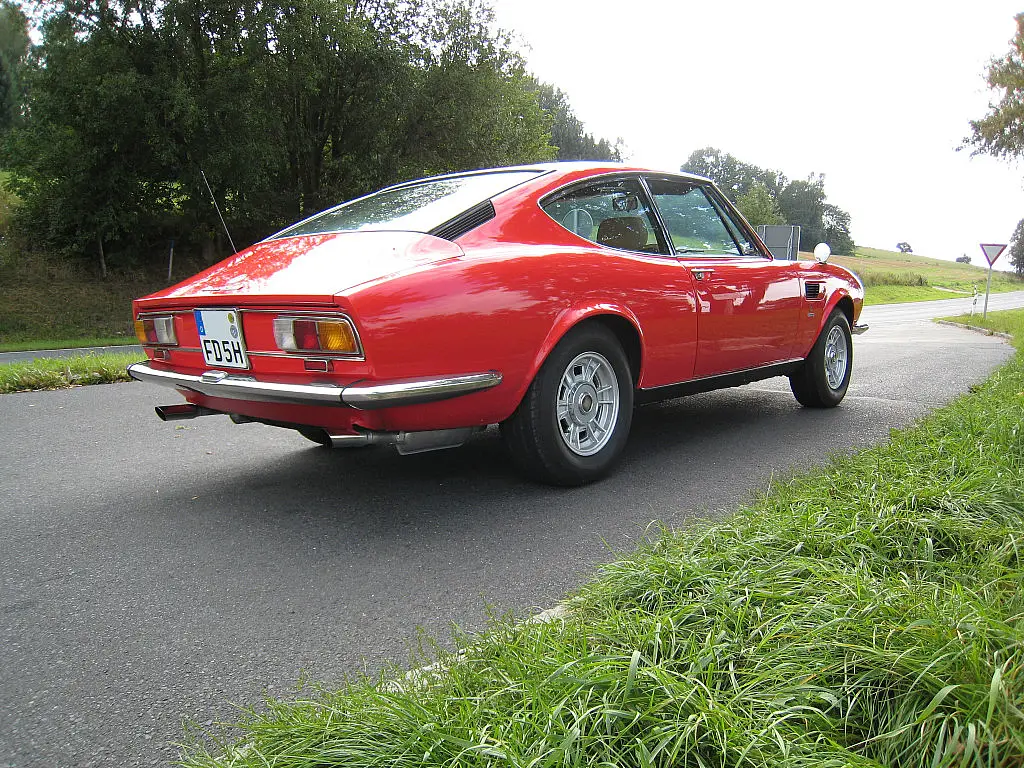
The Fiat Dino, type 135, is a front-engine, rear-wheel-drive sports car produced by Fiat from 1966 to 1973. The Dino name refers to the Ferrari Dino V6 engine, built by Fiat and installed in these cars to reach the production numbers Ferrari needed to homologate the engine for Formula 2 racing.
Fiat Dino at a glance
| Production | 1966–1973 |
|---|---|
| Type | 135 |
| Layout | front engine, rear-wheel drive |
| Engine | 2.0-litre all-aluminium DOHC V6; 2.4 litres from 1969 |
| Power | 160 PS (2.0), 180 PS (2.4) |
| Transmission | five-speed manual |
| Spider | Pininfarina, two-seater, from October 1966 |
| Coupé | Bertone, 2+2 on a 270 mm longer wheelbase, from March 1967 |
| Rear suspension | live axle on leaf springs (2.0), independent (2.4) |
| Gearbox (2.4) | dogleg ZF with revised ratios |
History of the Fiat Dino
Why the Dino existed
The Dino road cars came about because Enzo Ferrari needed to homologate a V6 for Formula 2. In 1965 the Commission Sportive Internationale of the FIA drew up new rules for the 1967 season: Formula 2 engines could have no more than six cylinders and had to derive from a production engine in a GT car homologated with at least 500 examples built within twelve months. Ferrari, a small manufacturer in the mid-1960s, did not have the capacity for such numbers, so an agreement with Fiat was made public on 1 March 1965: Fiat would build the 500 engines, to be fitted in a GT car still to be decided.
Dino was the nickname of Enzo’s son Alfredo Ferrari, who died in 1956 and was credited with the original concept of the Formula 2 V6, believed to have been designed by Vittorio Jano with a 65-degree angle between the cylinder banks. In his memory, V6-engined Ferrari sports prototypes had carried the Dino name since the late 1950s. Converting the racing engine for road use and series production was entrusted to Aurelio Lampredi, who had designed several four-cylinder Ferrari engines. Interviewed in the early 1980s, Lampredi noted that things did not work out as Ferrari had foreseen: Enzo had counted on building the engines at Maranello, but Fiat’s management insisted on controlling production to avoid breaks in supply. The resulting Fiat-built V6 went into two very different cars, the front-engined Fiat Dino assembled in Turin and Ferrari’s first series-produced mid-engined sports car, sold under the new Dino marque. Even the cylinder block castings carried the name FIAT, which did not match Enzo’s hopes for the new marque.
Fiat Dino, 1966–1969
The Fiat Dino was introduced as a two-seater Spider at the Turin Motor Show in October 1966; a 2+2 Coupé on a 270 mm longer wheelbase followed a few months later at Geneva in March 1967. The two bodies had very different lines because they were designed and built by different coachbuilders: the Spider by Pininfarina and the Coupé by Bertone, where it was sketched by Giorgetto Giugiaro in 1963 and finished by his successor Marcello Gandini after Giugiaro left for Ghia. Curiously, the Spider’s type approval described it as a 2+1 seater. Its interior was below par for the class, with a vinyl-covered dashboard, a plastic-rimmed steering wheel on metal spokes and switchgear from cheaper Fiats; after a few months this was corrected, and Spiders built after February 1967 had a wood-rimmed wheel and wood dashboard trim like the Coupé. Options for both were limited to radio, metallic paint, leather upholstery and, for the Spider, a vinyl-covered hardtop with roll-bar style stainless trim.
The car had an all-aluminium double-overhead-camshaft 2.0-litre V6 with a five-speed manual gearbox. The same engine went into the mid-engined Ferrari-built Dino 206 GT. Fiat quoted 160 PS, while Ferrari in 1967 claimed 180 hp for the 206 GT prototype, although both engines were made by Fiat workers in Turin on the same line; Jean-Pierre Gabriel, in “Les Ferraris de Turin”, notes that Ferrari’s declaration had no technical basis.
Fiat Dino 2400, 1969–1973
In 1969 both Ferrari and Fiat introduced 2.4-litre Dino models. The Fiat Dino 2400 premiered at Turin in October 1969 with a larger engine and, notably, independent rear suspension. The V6 now produced 180 PS and used a cast-iron rather than light-alloy block; the same engine went into the Dino 246 GT. Where the original car had a rigid axle on leaf springs with four shock absorbers, the 2.4 used coil-sprung independent rear suspension with two shock absorbers derived from the Fiat 130. The main benefit of the larger displacement was a marked rise in torque at lower engine speeds, giving much better pickup and making the car more usable in traffic. A larger clutch, a new dogleg ZF gearbox with revised ratios, wider Pirelli Cinturato tyres and bigger brake discs and calipers improved drivability and safety. Cosmetic changes were comparatively minor: both models were badged Dino 2400, the Coupé lost its silver honeycomb grille with the round Fiat logo for a black grille and bonnet badge, and various details changed from chrome to matte black.
Design and features
- Ferrari V6: an all-aluminium 65-degree V6 built by Fiat in Turin, not Maranello.
- Two coachbuilders: a Pininfarina Spider and a Bertone Coupé, with quite different lines.
- Homologation car: the whole programme existed to put 500 engines on the road.
- 2.4 upgrade: more torque, a cast-iron block and independent rear suspension.
- ZF dogleg gearbox: fitted to the 2.4 with revised ratios.
Fiat Dino versions
- Dino Spider 2.0: Pininfarina two-seater of 1966, 160 PS.
- Dino Coupé 2.0: Bertone 2+2 of 1967 on a longer wheelbase.
- Dino Spider 2400: 2.4-litre version from 1969, 180 PS.
- Dino Coupé 2400: 2.4-litre 2+2 with independent rear suspension.
The Dino sat above the Fiat 124 in the range and borrowed its rear suspension layout from the Fiat 130. Fiat’s other V6 grand tourer was the Fiat 8V, and more cars are in the Fiat collection.
Sources
- Fiat Dino, English Wikipedia: homologation background, bodies, engines, 2400 changes