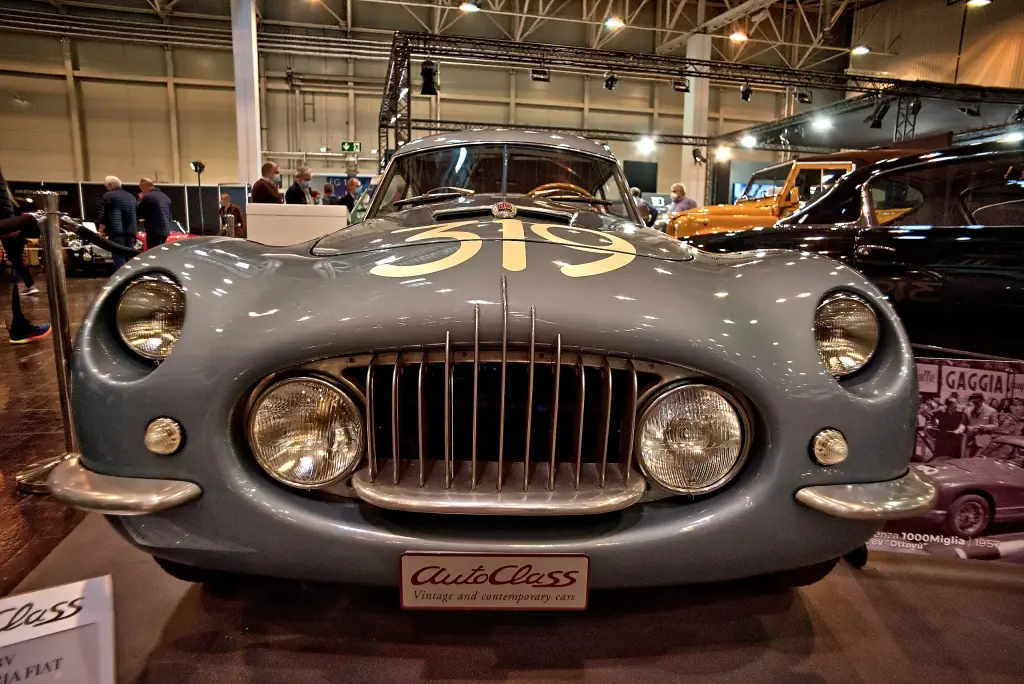
The Fiat 8V, or Otto Vu, is a V8-engined sports car produced by Fiat from 1952 to 1954. It was introduced at the 1952 Geneva Motor Show and took its name because Fiat believed at the time that Ford held a copyright on V8. With 114 cars made, the 8V was not a commercial success, but it did well in racing.
Fiat 8V at a glance
| Production | 1952–1954 |
|---|---|
| Also called | Otto Vu |
| Introduced | 1952 Geneva Motor Show |
| Engine | 1,996 cc 70° V8 |
| Carburettors | two twin-choke Weber 36 DCF 3 |
| Power | 105, 115 or 127 PS |
| Top speed | 190 km/h |
| Transmission | four-speed manual |
| Suspension | independent all round, a Fiat first |
| Brakes | drums on all four wheels |
| Cars built | 114 |
based on one source
History of the Fiat 8V
Origins
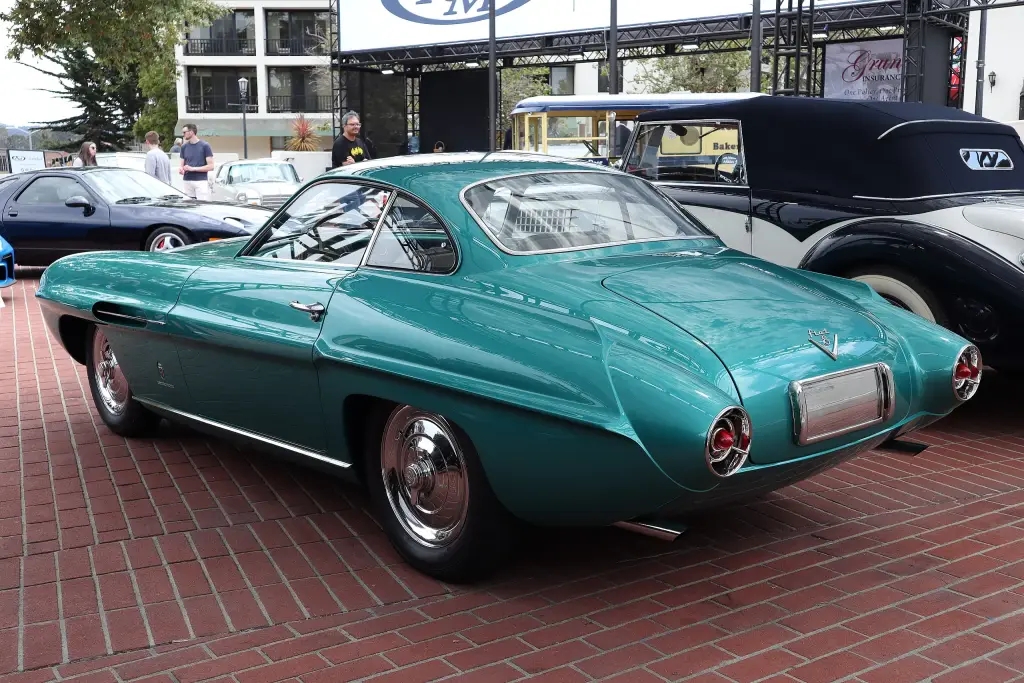
The 8V was developed by Dante Giacosa and the stylist Luigi Rapi. Its engine was a V8 originally designed for a luxury sedan, but that project was stopped. Apart from the differential, the car shared no parts with other Fiats, and many components were made by Siata, which also used them in its own cars.
The engine had a 70-degree V configuration, displaced 1,996 cc and was fitted with two twin-choke Weber 36 DCF 3 carburettors. In its first iteration, type 104.000, it had a compression ratio of 8.5:1 and produced 105 PS at 5,600 rpm, giving a top speed of 190 km/h. The improved type 104.003 had different camshaft timing and produced 115 PS at 6,000 rpm. The final type 104.006, with an 8.75:1 compression ratio, revised camshaft timing and fuel system, put out 127 PS at 6,600 rpm. The engine drove through a four-speed gearbox.
Chassis
The car had drum brakes on all four wheels and was the first Fiat with independent suspension all round.
Coachwork
Fiat’s top management were preoccupied with more run-of-the-mill projects, so only 114 of the high-performance coupés had been built when the cars were withdrawn in 1954. Nevertheless, they continued to win the Italian 2-litre GT championship every year until 1959.
Thirty-four cars had factory bodywork from Fiat’s Dipartimento Carrozzerie Derivate e Speciali, the Special Bodies Department. Other cars were bodied by Italian coachbuilders: Carrozzeria Zagato made 30 labelled Elaborata Zagato, and Ghia and Vignale also supplied bodies. Most were coupés, but some cabriolets were made as well.
An example with a factory-style glass-fibre reinforced plastic body was displayed at the 1954 Turin Motor Show. The composite bodyshell, produced by Fiat’s experimental bodywork department, weighed just 48.5 kg. That 8V belongs to the FCA Heritage collection and resides in the Centro Storico Fiat in Turin.
Ghia Supersonic
Ghia designed and produced a limited run of cars named Supersonic with special jet-age bodywork. Ghia had recently been sold by Boano to Luigi Segre, and a one-off Alfa Romeo 1900 had been built for a wealthy entrant in the 1953 Mille Miglia. That car was displayed at the Turin show the same year, and the reaction inspired Segre to plan a limited production of cars based on the Otto Vu for the American market. Only eight were completed, after mechanical issues ended the project. Several were bought by Americans, and some were heavily customised and received engine transplants. An original unrestored car sold at a Scottsdale, Arizona, auction in January 2011 for a gavel price of 1.55 million dollars, or 1.7 million with the buyer’s premium. Ghia later used the basic body shape on Jaguar XK-120-based vehicles as well as Aston Martins. The design of the Supersonic is credited to Giovanni Savonuzzi.
Design and features
- V8 for a small car: a 1,996 cc 70-degree V8 with two twin-choke Weber carburettors.
- Three states of tune: 105, 115 and 127 PS as the type 104.000, 104.003 and 104.006.
- Independent suspension: the first Fiat with independent suspension on all four wheels.
- Coachbuilt bodies: factory, Zagato, Ghia and Vignale bodywork on the same chassis.
- Racing record: Italian 2-litre GT champion every year from 1954 to 1959.
Fiat 8V versions
- 8V with factory body: 34 cars from Fiat’s Special Bodies Department.
- 8V Elaborata Zagato: 30 cars bodied by Zagato.
- Ghia and Vignale 8V: bodies from two more Italian coachbuilders.
- 8V Vetroresina: the 1954 glass-fibre car weighing 48.5 kg for the shell.
- Ghia Supersonic: eight jet-age cars based on the 8V.
The 8V was Fiat’s high-performance model of the early 1950s; the later Fiat Dino is covered separately, as is the Fiat 1400 saloon of 1950. More cars are in the Fiat collection.
Sources
- Fiat 8V, English Wikipedia: engine, chassis, coachwork, racing record, Ghia Supersonic