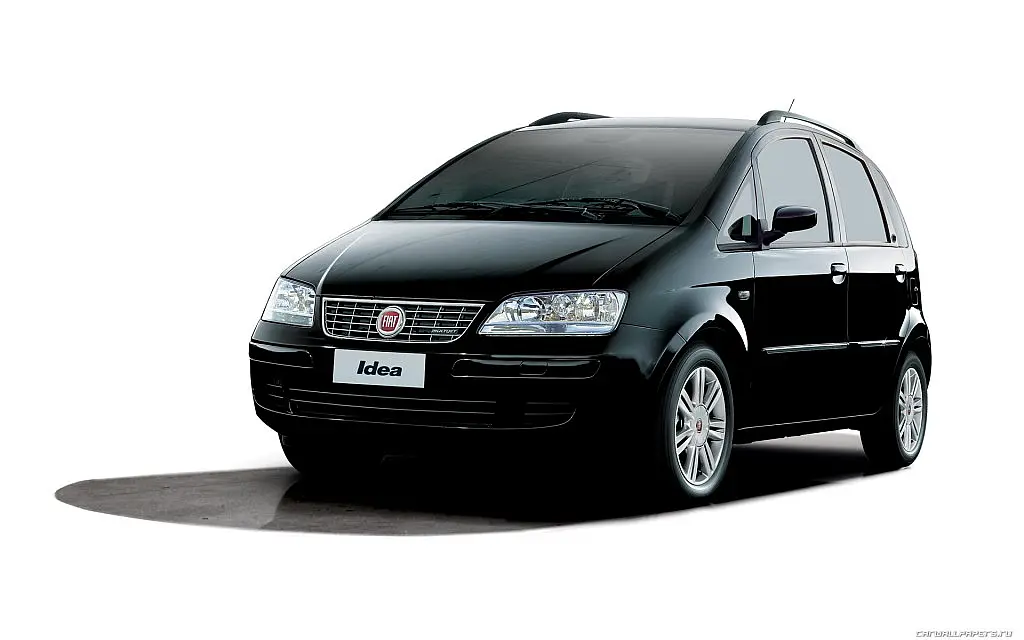
The Fiat Idea is a car manufactured and marketed by Fiat from 2003 to 2012 over a single generation with one intermediate facelift. It is a five-passenger mini MPV with five doors and a front-engine, front-wheel-drive layout. Internally designated the Type 350, it was Fiat’s first entry in the compact MPV market.
Fiat Idea at a glance
| Production | 2003–2012, to 2016 in Brazil |
|---|---|
| Class | five-door mini MPV |
| Internal code | Type 350 |
| Platform | shared with the third-generation Fiat Punto |
| Exterior design | Fabrizio Giugiaro, Italdesign |
| Interior design | Fiat Centro Stilo |
| Length | under four metres |
| Petrol engine | 1.4-litre 16-valve, 95 PS |
| Diesel engines | 1.3-litre MultiJet, 70 or 90 PS |
| Gearbox | five or six speeds, or Dualogic automated manual |
| Built at | Fiat Mirafiori |
| Replaced by | Fiat 500L |
History of the Fiat Idea
A first compact MPV
The Idea was conceived as a compact monovolume MPV, intended to combine the handling and compact size of a B-segment car under four metres long with the greater height, flexible seating, cargo configurability and versatility of an MPV. It shared its platform with the third-generation Fiat Punto, known as Project 199, and its exterior design came from Fabrizio Giugiaro at Italdesign, while the interior was designed by Fiat’s Centro Stilo. The nameplate is an acronym for Intelligent Design Emotive Architecture.
The Idea debuted at the 2003 Geneva International Motor Show. A year later came an upmarket variant, the Lancia Musa, which shared many components with a modified exterior. Both were manufactured at Fiat’s Mirafiori plant and were superseded by the Fiat 500L.
Packaging and equipment
The monovolume design is noted for its centrally located instrument cluster and high H-point. The rear seats combine 40:20:40 split folding and 60-degree reclining backrests with a 60:40 split, folding and sliding seat base, so they can slide forward or rearward to favour cargo or passenger space, recline for comfort or fold and tumble for maximum load. The front passenger seat folds flat to take tall items, and 25 storage compartments are distributed through the cabin. The seating was designed using biometric principles developed by Antonio Dal Monte at the sports medicine institute of the Italian National Olympic Committee.
Standard features included six airbags, Isofix attachments, automatic door locks, a fire prevention system with a fuel pump inertia cut-off switch, a plastic fuel tank, maxifuse-equipped electrical leads and fire-resistant interior trim, ABS with brake force distribution, anti-slip regulation, traction control, electronic stability control, a hill-holder, electric speed-sensitive power steering, 0-20-40 split rear seating and a headlight delay system marketed as Follow Me Home. A panoramic sunroof, parking sensors and dual-zone climate control were optional.
Engines
All Idea engines were Euro 4 compliant. The petrol unit was a 1.4-litre 16-valve of 95 PS, available with five- and six-speed gearboxes, and the diesels were 1.3-litre 16-valve MultiJet units of 70 or 90 PS. All could be matched with a clutchless five-speed sequential manual with a selectable fully automatic mode, marketed as Dualogic.
The Brazilian Idea
The Brazilian version was launched in late 2005 with the new 1.4-litre eight-valve 86 hp Fire engine, the same as in the Grande Punto, and the latest version of the GM-sourced 1.8-litre eight-valve of 114 hp, both with flex-fuel technology allowing petrol or ethanol. It was taller than the European car, used a dashboard derived from the Palio Mk III and offered a panoramic glass roof marketed as SkyDome. Two trim levels were exported, the ELX with the 1.4 and the HLX with the 1.8. A major facelift in 2010 brought a new front, rear and door handles, and over 265,000 Ideas were sold in Brazil, where production continued through the 2016 model year.
The Idea Adventure was a mini crossover version launched in September 2006 in São Paulo, chiefly cosmetic but with a revised suspension, Pirelli Scorpion 205/70 R15 tyres, body mouldings, 15-inch alloys, white instruments and standard double front and side airbags with ABS and EBD. In 2009 the whole Adventure line gained a locking differential and was rebadged Adventure Locker.
Design and features
- Central instrument cluster: a distinctive feature of the monovolume dashboard.
- Flexible rear seats: sliding, reclining and folding, with a 40:20:40 split.
- High H-point: easy access and a more upright driving position.
- Rich standard safety kit: six airbags, stability control and a hill-holder.
- Dualogic gearbox: a clutchless automated manual with a fully automatic mode.
Fiat Idea versions
- Idea: the European five-door mini MPV, 2003–2012.
- Lancia Musa: upmarket twin with a modified exterior, from 2004.
- Brazilian Idea: taller version with 1.4 Fire and 1.8 engines, from late 2005.
- Idea Adventure: mini crossover with raised suspension, from September 2006.
- Adventure Locker: 2009 version of the Adventure line with a locking differential.
The Idea shared its platform with the Fiat Punto and was superseded by the Fiat 500 family, whose 500L replaced it. The Fiat Multipla shows an earlier approach to the same idea, and more cars are in the Fiat collection.
Sources
- Fiat Idea, English Wikipedia: design, packaging, equipment, engines, Brazilian versions