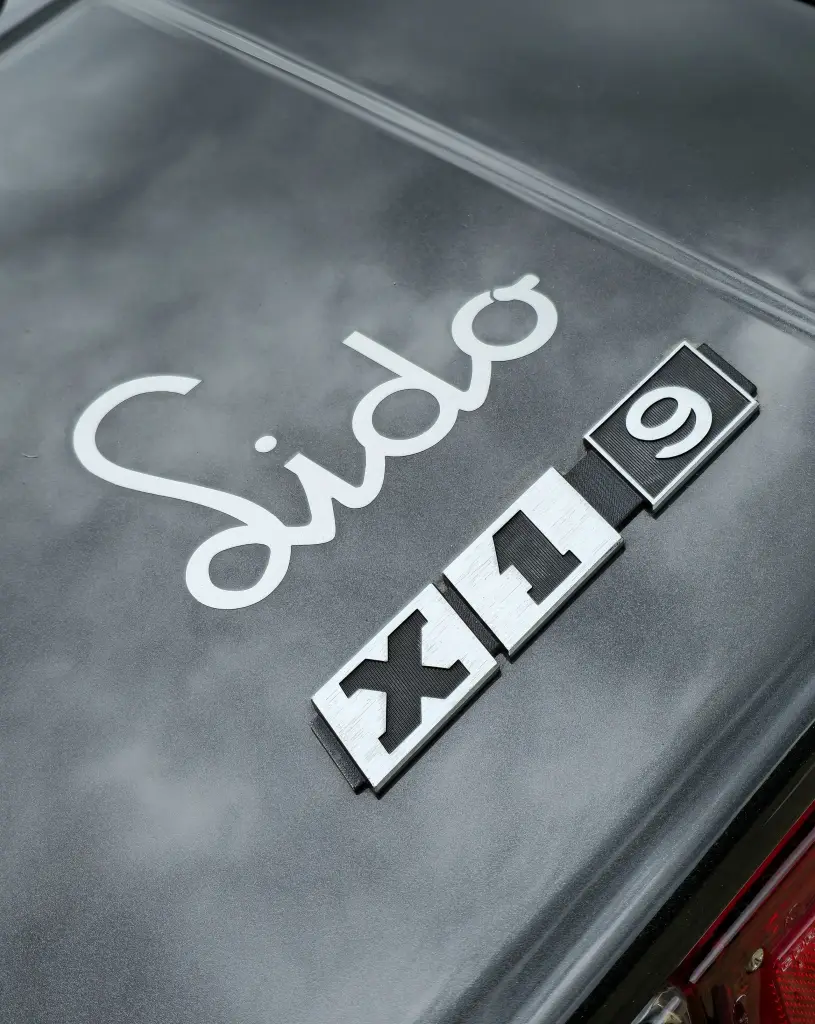
The Fiat X1/9 is an Italian two-seater mid-engined sports car designed by Bertone and manufactured by Fiat from 1972 to 1982 and subsequently by Gruppo Bertone from 1982 to 1989. With a transverse engine and gearbox mounted in the middle and driving the rear wheels, it was noted for its balanced handling, retractable headlights, a lightweight removable hardtop that could be stowed under the bonnet and storage compartments at both ends.
Fiat X1/9 at a glance
| Production | 1972–1982 by Fiat, 1982–1989 by Bertone |
|---|---|
| Class | two-seater mid-engined sports car |
| Design | Bertone, chief designer Marcello Gandini |
| Engine | 1,290 cc overhead-cam four, from the 128 |
| Power | 75 PS at 6,000 rpm |
| Torque | 97 N·m at 3,400 rpm |
| Gearbox | four-speed, all-synchronised |
| Top speed | over 170 km/h |
| Suspension | MacPherson struts front and rear |
| Brakes | 227 mm solid discs all round |
| Roof | removable targa panel, stowed in the front boot |
| Series II | 1979, with 1.5-litre Ritmo drive train |
History of the Fiat X1/9
From the A112 Runabout
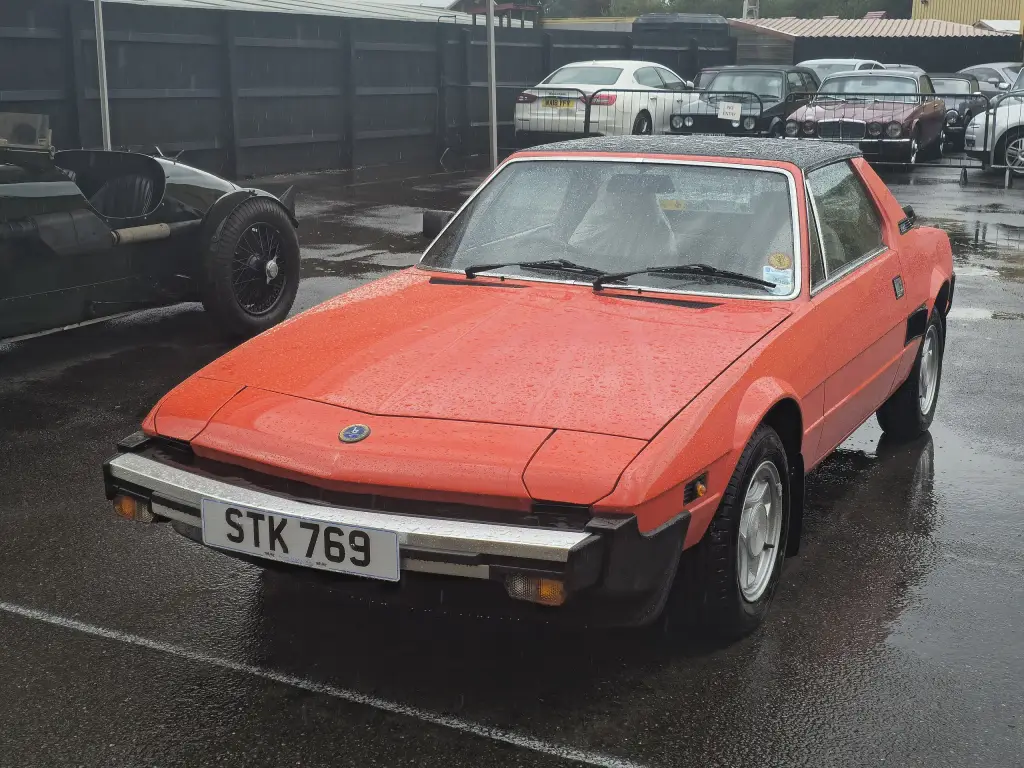
The X1/9 was developed from the 1969 Autobianchi A112 Runabout concept, with styling by Bertone under its chief designer Marcello Gandini. Although the Runabout was named for the Autobianchi A112, it was powered by a version of the brand new Fiat 128 overhead-cam engine. The concept had a distinctive wedge shape and took many styling cues from contemporary power-boat design. The more extreme features, such as the C-pillar-mounted headlights and the small wind-deflector windscreen, were lost for the production car, but the long flat bonnet with a central indentation, the large front overhang, the wedge shape with a prominent C-pillar roll-over hoop and the car-length indented waterline all made the transition, giving the X1/9 a highly distinctive appearance.
A 128 turned around
Designed around the Fiat overhead-cam engine and transmission of the front-wheel-drive 128, the X1/9 moved the transverse drive train and suspension assembly from the front of that car to the rear of the passenger cabin, directly in front of the rear axle, giving a mid-engined layout. The engine was designed by Aurelio Lampredi. The fuel tank and spare wheel were placed ahead of the engine, behind the driver and passenger seats respectively, which kept the car’s weight within its wheelbase for more balanced handling and left cargo areas at both ends.
The production car had sharp-edged styling, retractable headlights, an integrated front spoiler and a removable hardtop that could be stored in the front boot; a second luggage compartment at the rear was reached through a conventional boot lid. Unlike Fiat’s numerical model names, which denoted a car’s position in the range, the X1/9 kept its prototype code: Fiat used X0 for engines, X1 for passenger vehicles and X2 for commercial vehicles, so the X1/9 was the ninth passenger car developed under that system.
Launch and mechanical detail
Originally slated to debut at the November 1972 Turin Motor Show, the launch was delayed until after the show to avoid upstaging the new Fiat 126 city car. Press test drives were held at the end of November 1972 on the Sicilian Madonie roads used by the Targa Florio. The car was intended to replace the 850 Spider, another Bertone design, not the larger and pricier 124 Sport Spider. The monocoque body was built at Bertone’s Grugliasco factory and transported to Fiat’s Lingotto plant for final assembly.
The 1,290 cc type 128 AS engine came from the 128 Coupé 1300. Changes included a new cast aluminium oil sump to complement the aluminium cylinder head; with a twin-choke Weber 32 DMTR carburettor and an 8.9:1 compression ratio it produced 75 PS at 6,000 rpm and 97 N·m at 3,400 rpm. The all-synchronised four-speed transmission also came from the 128, with a taller fourth gear to exploit the sports car’s better aerodynamics; as a result the X1/9 had a top speed of over 170 km/h, 10 km/h more than the similarly engined but 65 kg lighter 128 Coupé 1300.
Standard wheels were 4.5J by 13-inch stamped steel with 145 HR 13 tyres, with cast alloy wheels as an extra-cost option. Suspension was fully independent with MacPherson struts front and rear, the split-circuit brakes used equally sized 227 mm solid discs all round and the steering was rack and pinion. The interior was upholstered in leatherette, with two bucket seats with integrated headrests. Because parts of a front-wheel-drive car were simply moved backwards, the rear suspension has adjustable auxiliary control arms and the speedometer is driven by a very long cable that turns through 180 degrees.
Right-hand drive and Series II
Fiat began marketing a right-hand-drive variant in 1976; before that, Radbourne Racing had converted left-hand-drive cars for the United Kingdom, and none of those early conversions is believed to survive. For 1979 Fiat introduced the only major revision, usually called Series II, in which the 1.3-litre four-speed drive train was replaced by an adaptation of the 1.5-litre, five-speed unit from the Fiat Ritmo. Production passed to Gruppo Bertone in 1982 and continued until 1989.
Design and features
- Mid-mounted 128 engine: the transverse drive train moved behind the cabin.
- Balanced packaging: fuel tank and spare wheel within the wheelbase, luggage space front and rear.
- Stowable targa roof: the removable hardtop fitted in the front boot.
- US safety from the start: the first Fiat designed from the outset to meet American regulations.
- Bertone wedge: styling by Marcello Gandini, influenced by power-boat design.
Fiat X1/9 versions
- Series I: 1972–1978, 1.3-litre engine and four-speed gearbox.
- Series II: from 1979, with the 1.5-litre five-speed Ritmo drive train.
- Bertone X1/9: built by Gruppo Bertone from 1982 to 1989.
- Right-hand drive: offered by Fiat from 1976.
The X1/9 used the drive train of the Fiat 128 and replaced the 850 Spider, while the larger Fiat 124 Sport Spider stayed in production alongside it. More cars are in the Fiat collection.
Sources
- Fiat X1/9, English Wikipedia: design, Bertone concept, drive train, equipment, Series II and production