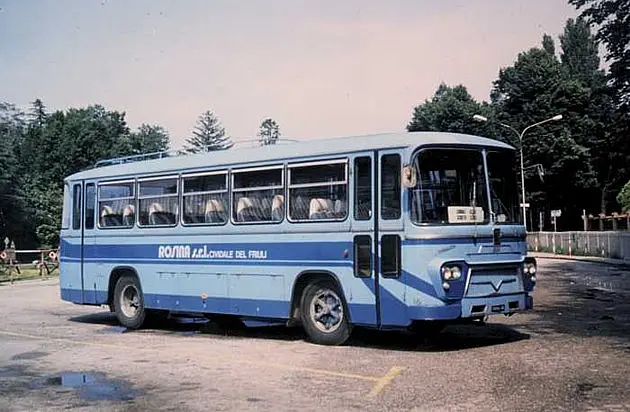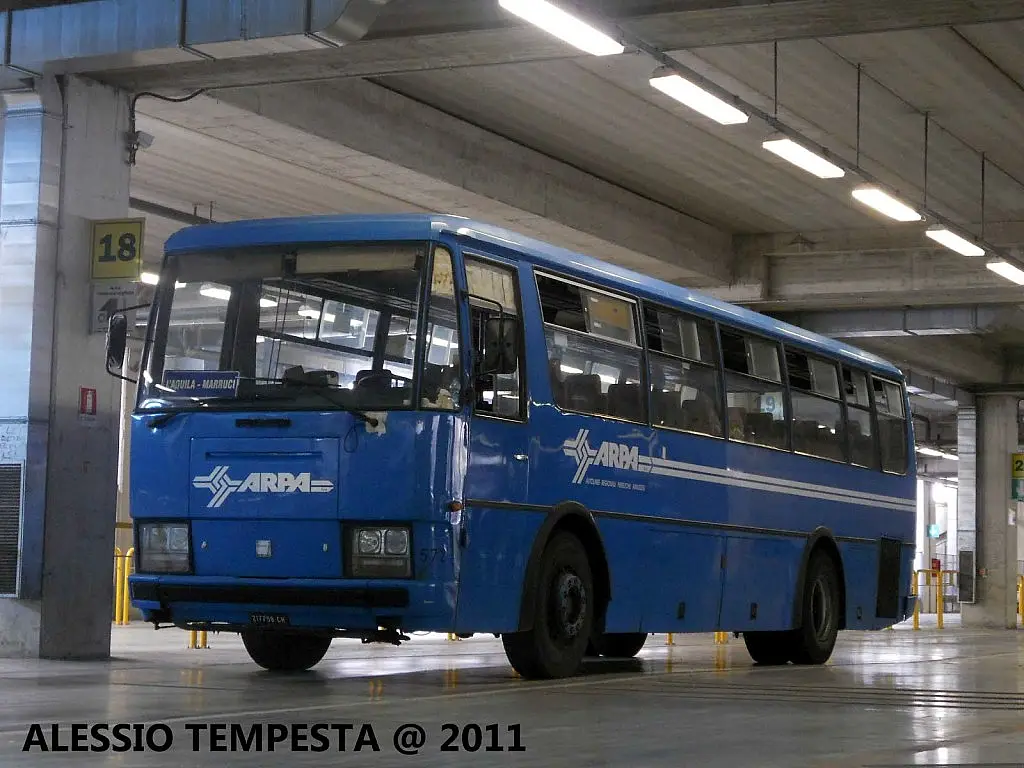
The Fiat 370 is an Italian bus that Fiat built from 1976 to 2001. It was presented in August 1976 to replace three earlier models and to unify Fiat’s bus range in a single type, adapted to the needs of individual transport companies. From 1979 it was also sold as an Iveco.
Fiat 370 at a glance
| Production | 1976–2001 |
|---|---|
| Predecessors | Fiat 343, Fiat 308, Fiat 306 |
| Engines | Fiat 8210, 8220, 8260, 8280 and 8460 diesels |
| Power | 200 to 352 CV |
| First engine | 13,798 cc inline six, 260 CV |
| Lengths | 9, 10, 11 and 12 metres |
| Badges | Fiat until 1983, Iveco from 1979 |
| Plants | Cameri, then Flumeri (Valle Ufita); Fourchambault for Unic |
| Replaced by | Iveco EuroClass, 1994 |
Based on one source, the Italian Wikipedia article. No free photographs of the bus were available, so the article has no photographs.
History of the Fiat 370
The Fiat 370 was presented in August 1976 to replace the Fiat 343, the Fiat 308 and the Fiat 306. The aim was to modernise the bus range of Fiat Veicoli Industriali by uniting every type, from intercity service to long-distance touring, in a single model that transport companies could specify to their own requirements. At launch it was offered in two equipment variants, a service version and a GT version, both with the 13,798 cc Fiat 8210.02 inline six producing 260 CV.
From 1979 the 370 carried the new Iveco badge alongside that of Fiat, and in 1983 Iveco took over completely. Also in 1983 Italian production left the historic Cameri plant near Novara for the new works at Flumeri in the province of Avellino, known as Valle Ufita. Outside Italy the bus was built in France under the Unic brand at the Lorraine works in Fourchambault.
The range grew steadily in capacity and power. In 1978 a 10-metre version appeared with the UNIC/Fiat 8220.02 six of 200 CV, already widely used in city buses. From 1980 an 11-metre version joined the 12-metre model with the new Fiat 8260.02 V6 of 12,880 cc and 260 CV, which replaced all earlier engines. From 1981 the large Fiat 8280.02 V8 of 17,174 cc and 352 hp became available.
A restyling in 1983 brought black plastic bumpers. In 1984 the 12-metre versions received the turbocharged Fiat 8210.22 of 13,798 cc and 304 CV, alongside an aspirated unit of 260 CV, while the 10-metre cars took the Fiat 8220.22 of 9,572 cc and 240 CV, all of them with the cylinders back in line rather than in a V. The new 370S of 1987 kept the existing engines, and the last series, the 370SE of 1994, used the 9,498 cc engine of the Iveco EuroClass. In the same year Iveco acquired the Sicca chassis maker of Vittorio Veneto, which produced a 9-metre version on the Siccar 9103 chassis as the 370SE.9.27.
The 370 was also sold as a bare chassis, and over the years many coachbuilders built bodies for it: Orlandi, Menarini, Portesi, Padane and Dalla Via, as well as the lesser-known Barbi, Bianchi, Garbarini and Autodromo. Portesi made a 9.70-metre version by shortening the 10-metre chassis. Buses with the original body were colloquially named after the plant that built them, Cameri or Valle Ufita.
Production of the rationalised range continued until the summer of 2001. Bodies built in-house had been dropped in the mid-1990s, and the model survived as an economical choice for coachbuilders and operators, in the 9-metre form especially as a bus for mountain routes. The 370 was produced in thousands of examples, helped by its adaptability and the availability of spare parts, and served with the armed forces, including the well-known Pullman Azzurro, and with operators such as SITA, COTRAL, SAIA, ATVO and AST Sicilia. The Storicbus association has preserved examples of the various bodies.
Design and features
- One range, many lengths: 9, 10, 11 and 12-metre versions from a single design.
- Bare chassis: supplied to coachbuilders including Orlandi, Menarini, Portesi, Padane and Dalla Via.
- Engine choice: inline sixes, a V6 and a 17,174 cc V8 of 352 hp.
- Long life: produced from 1976 to 2001 and widely used by Italian operators.
- Two identities: sold as a Fiat and, from 1979, as an Iveco.
Fiat 370 versions
- 370.26: 1976–1980, 13,798 cc inline six with 260 CV.
- 370.20: 1977–1980, 9,572 cc six with 200 CV.
- 370.25: 1980–1984, 12,880 cc V6 with 260 CV.
- 370.35: 1981–1990, 17,173 cc V8 with 352 CV.
- 370.24 and 370.30: turbocharged nine- and fourteen-litre sixes of 240 and 304 CV.
- 370SE: 1994–2001, 9,498 cc engine from the Iveco EuroClass.
The 370 replaced the Fiat 306 and the Fiat 343 and was itself replaced by the Iveco EuroClass. More vehicles are in the Fiat collection.
Sources
- Fiat 370, Italian Wikipedia: production dates, engines, versions, plants, operators