The Fiat Punto is a supermini car produced by Fiat from 1993 to 2018 over three generations. The third generation was marketed as the Grande Punto between 2005 and 2009 and as the Punto Evo between 2009 and 2012, before the single-word name returned. By May 2013 nearly nine million units had been sold worldwide.
Fiat Punto at a glance
| Production | 1993–2018 |
|---|---|
| Generations | three: Type 176, Type 188 and the 2005 car |
| Also called | Grande Punto (2005–2009), Punto Evo (2009–2012) |
| Designer | Giorgetto Giugiaro, first generation |
| Award | European Car of the Year 1995 |
| Bodies | three- and five-door hatchback, two-door cabriolet, panel van |
| Engines | 1.1 to 1.6 petrol, 1.7 and 1.9 diesel |
| Top first-generation model | 1.4 GT turbo, 136 PS |
| Suspension | all independent, MacPherson struts front and trailing arms rear |
| First generation built | 3.43 million |
| Second generation built | 2.96 million |
History of the Fiat Punto
Internally codenamed Project 176, the Punto was announced in September 1993 as a replacement for the ageing Fiat Uno and went on sale at the end of 1993 or the beginning of 1994 depending on the market. It was voted European Car of the Year for 1995, beating the Volkswagen Polo by 370 points to 292. The United Kingdom launch took place in October 1993 at the London Motorfair, and a very mild restyling in 1997 brought new hubcaps, exterior colours and interior trim.
The car was designed by Giorgetto Giugiaro and began as a 1990 design proposal for Renault’s project X57, which became the Renault Clio. When Giugiaro’s proposal was not chosen, he took the design to Fiat, which accepted it, and he received the Compasso d’Oro industrial design award in 1994. The Punto was available as a three-door or five-door hatchback, a two-door cabriolet and a three-door panel van, and, like most new Fiat group models of the period, it had all-independent suspension, with MacPherson struts at the front and trailing arms at the rear.
Entry-level engines were 1.1 and 1.2-litre petrol units and a 1.7-litre diesel. The 1.2 displaced 1,242 cc and came in three versions: one of 75 PS at 6,000 rpm in the Punto ELX 75, one of 86 PS in the ELX 85, and one of 60 PS that eventually replaced the 1.1-litre unit of 54 PS. A Sporting model used an updated 1.6-litre eight-valve 128 SOHC engine of 90 PS, replaced in 1997 by the 1.2 16-valve FIRE engine of the 85 ELX with a drop to 86 PS.
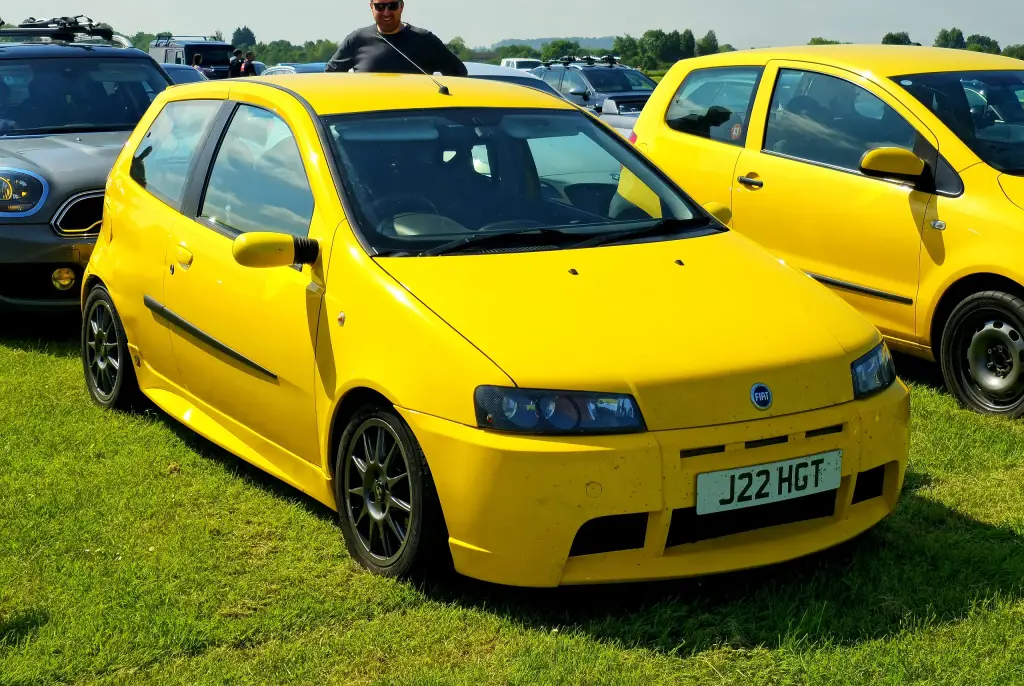
The top of the range was the 136 PS 1.4 GT, which used an evolution of the turbocharged 128 SOHC engine first fitted to the Fiat Uno Turbo Mk II. It could exceed 200 km/h, reached 100 km/h in 7.9 seconds and had a five-speed manual gearbox. The GT was made in three series, with 136 PS from 1993 to 1995, 133 PS from 1995 to 1997 and 130 PS from 1997 to 1999.
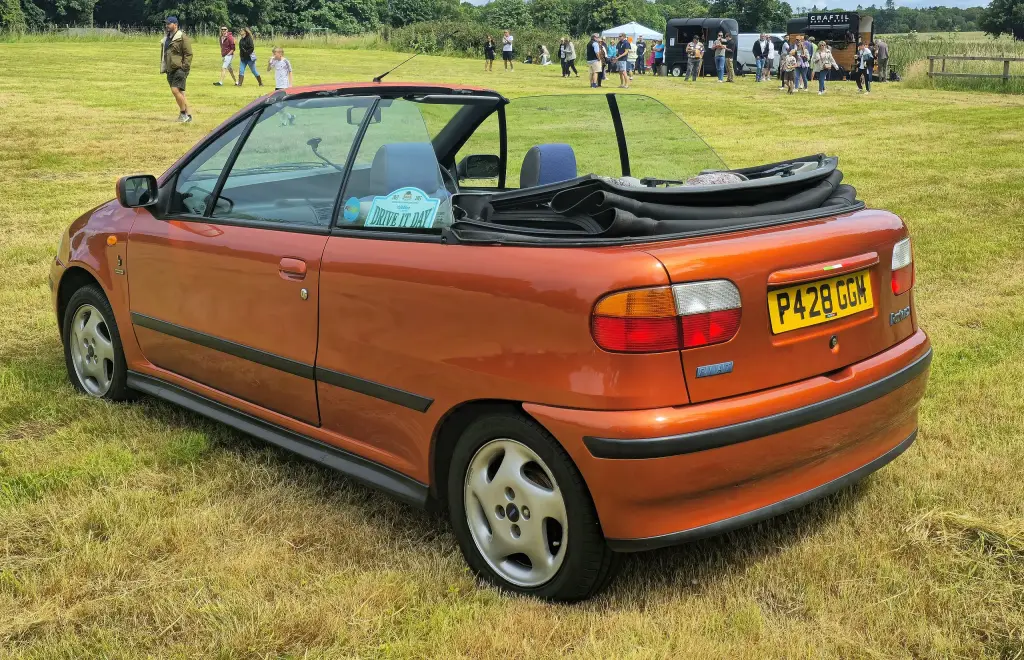
A cabriolet was also offered, designed by Giugiaro but built by Bertone rather than in a Fiat factory. Its horizontal rear light clusters were completely different from the vertical ones of the hatchback. It came in SX trim with the 1.2 60 PS FIRE engine and in ELX trim, at first with the 90 PS 1.6 MPI engine and from 1995 with the 86 PS 1.2 16-valve FIRE. The roof was manually operated on the SX and electrically powered on the ELX, and the car was one of the cheapest open-top models in the world at the time; about 55,000 were built between April 1994 and June 1999, although the last were registered in 2000.
Particular versions of the first generation included the Punto 6Speed, a 1.1 FIRE Punto 55 with a six-speed gearbox, the Punto Selecta with a CVT automatic, and the Punto ED, a 1.1 whose five-speed gearbox was designed for high fuel efficiency. The Punto Sporting Abarth added Abarth styling, suspension improvements and handling changes to the Sporting, with a 1.8-litre 16-valve engine of about 130 hp, side skirts, alloy wheels and sports seats. Carrozzeria Maggiora built a one-off performance version called the Punto Grama 2 on the underpinnings of a 1986 Lancia Delta Integrale 8V.
The second generation, Project 188, was launched in September 1999 at the Frankfurt Motor Show with all-new styling that retained the shape of the original, a completely overhauled chassis and interior and a new torsion beam rear suspension. It was the first Fiat in decades to carry the original round badge, adopted to celebrate the company’s centenary, and the launch event also presented the Fiat Wish concept, a hardtop convertible version of the Punto conceived by Pininfarina for the same anniversary. The 1.1 and 1.4 engines were dropped for emissions reasons, leaving a 1.2 petrol unit with eight or 16 valves and 60 or 80 hp, and a 1.9 diesel with common-rail injection and a turbocharger or with mechanical injection and no turbo. The third generation followed in 2005 as the Grande Punto, was renamed Punto Evo in 2009 and returned to the plain Punto name in 2012; production ended in 2018.
Design and features
- Giugiaro design: a proposal originally made for Renault, awarded the Compasso d’Oro in 1994.
- Independent suspension: MacPherson struts in front and trailing arms at the rear.
- Punto GT: a 1.4 turbo of up to 136 PS, over 200 km/h and 0–100 km/h in 7.9 seconds.
- Bertone cabriolet: a cheap open-top Punto built by Bertone from 1994 to 1999.
- Second generation: a new chassis with torsion beam rear suspension and the round Fiat badge.
Fiat Punto versions
- Punto 55, 60, 75 and 85: first-generation petrol models from 1.1 to 1.2 litres.
- Punto Sporting: 1.6 eight-valve of 90 PS, later the 1.2 16-valve of 86 PS.
- Punto GT: 1.4 turbo with 136, 133 or 130 PS depending on the series.
- Punto Cabriolet: Bertone-built two-door with a manual or electric roof.
- Punto Selecta, 6Speed and ED: CVT, six-speed and economy versions.
- Punto Sporting Abarth: 1.8 16-valve of about 130 hp with Abarth trim.
The Punto replaced the Fiat Uno and was later joined in the range by the smaller Fiat Seicento. More cars are in the Fiat collection.
Sources
- Fiat Punto, English Wikipedia: generations, first-generation design, engines, versions, production totals