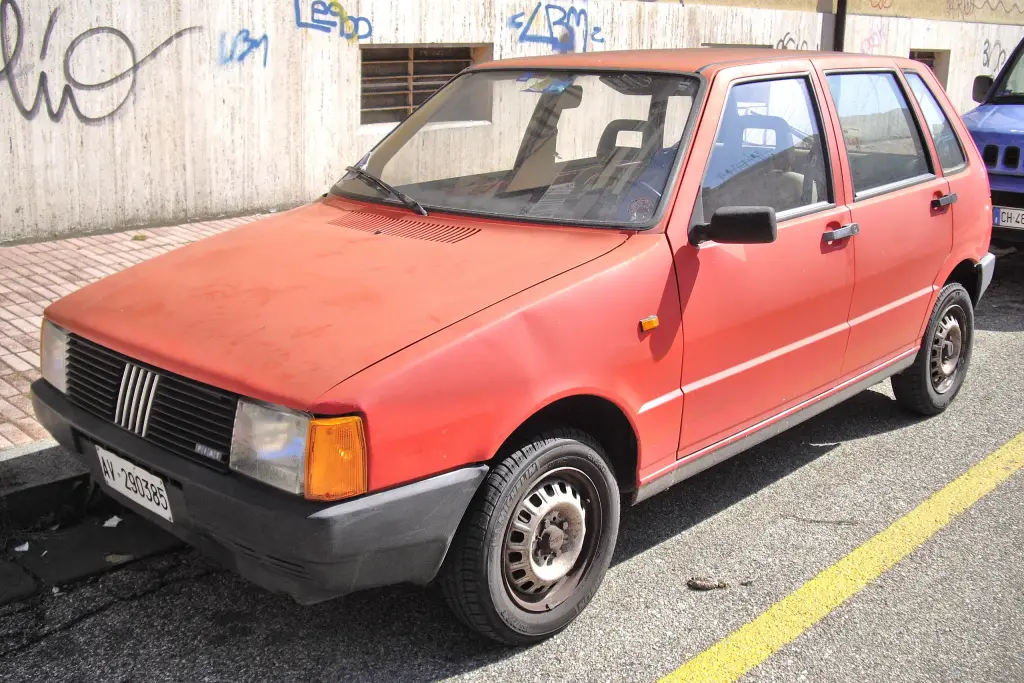
The Fiat Uno is a supermini launched by Fiat in 1983. It was produced over a single generation, with an intermediate facelift in 1989, in three- and five-door hatchback form until 1995 in Europe and until 1 January 2014 in Brazil. Designed by Giorgetto Giugiaro of Italdesign, the Uno strongly recalled the high-roof, upright packaging of his 1978 Lancia Megagamma concept in a smaller configuration.
Fiat Uno at a glance
| Production | 1983–1995 (Europe), to 2014 (Brazil) |
|---|---|
| Designer | Giorgetto Giugiaro, Italdesign |
| Replaced | Fiat 127 |
| Body | three- and five-door hatchback |
| Drag coefficient | 0.34 |
| Engines | 903 cc OHV; 1,116 and 1,301 cc SOHC; 999 cc FIRE from 1985 |
| Badging | by power output: 45, 55, 60, 70 or 75 |
| Suspension | MacPherson struts front, twist beam rear |
| Award | European Car of the Year 1984 |
| Total built | over 8,800,000 |
| UK sales peak | more than 40,000 in 1988 |
History of the Fiat Uno
First generation, 1983
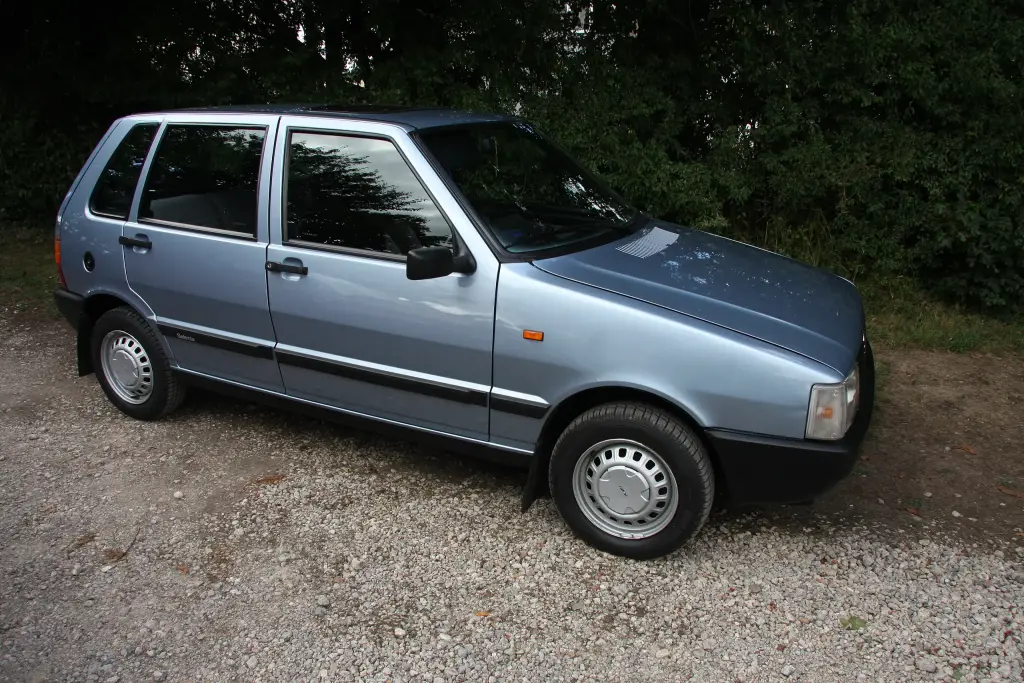
The Fiat Uno, type 146, was launched in January 1983 to replace the Fiat 127. Its tall, square body used a Kamm tail, achieved a drag coefficient of 0.34 and was noted for interior space, fuel economy, ride and handling. The project was called Tipo Uno, or Type 1, because it followed the Tipo Zero, the Panda. Following the Ritmo, production depended on the Robogate robotic body assembly system from Fiat’s automation supplier Comau. The Uno went on sale a month before the Peugeot 205 and just after General Motors launched the Opel Corsa, and in the United Kingdom sales began in June 1983, passing 20,000 in the first full year and peaking above 40,000 in 1988. In December 1983 it was voted European Car of the Year for 1984, narrowly ahead of the 205.
Initially the Uno was offered with the 0.9-litre 903 cc 100-series overhead-valve engine carried over from the 127, and with 1.1-litre 1,116 cc and 1.3-litre 1,301 cc SOHC 128-series petrol engines and transmissions. As was typical of Fiats of the era, the badging showed the metric horsepower rounded to the nearest five — 45, 55, 60, 70 or 75 — rather than the engine size. The car came as a three- or five-door hatchback, and had ergonomic switch clusters on each side of the instrument binnacle, usable with the hands on the wheel, with a single column stalk for the indicators and horn instead of Fiat’s traditional three-stalk layout. Suspension was by MacPherson struts at the front and a twist beam at the rear with telescopic dampers and coil springs.
From 1985 the 999 cc SOHC Fully Integrated Robotised Engine, or FIRE, replaced the 0.9-litre unit. It was lighter and built from fewer parts, with better performance and economy. The most luxurious version, the single-point injected 75 SX i.e., had remote door locks, integrated front foglamps and the oval exhaust tip used on the Turbo.
Uno Turbo i.e.
In April 1985 Fiat launched the hot hatch version of the first series, the Uno Turbo i.e., as a three-door only. It used a 1.3-litre 128-series engine derived from the Ritmo with Bosch multi-point fuel injection, Magneti Marelli electronic ignition and a water-cooled IHI turbocharger with an intercooler. Capacity was first quoted as 1,299 cc but revised early in production to 1,301 cc, because Italy’s motorway rules allowed a higher limit for cars over 1,300 cc; both gave 105 PS. Cars built from 1985 to late 1987 had a Ritmo-derived five-speed gearbox, later replaced by a new C510 five-speed with a stronger differential, and the Turbo reached 205 km/h, making it one of the fastest hot hatches of the 1980s. Outside there were black plastic sill trims, arch extensions, a fibreglass tailgate with spoiler, tinted glass, side decals and a revised bumper with foglamps and air inlets for the oil cooler and intercooler; the suspension was lowered and uprated, with 13-inch alloys on Pirelli P6 tyres and vented front and solid rear discs. Inside were sports seats, red carpet, an extended console and, on later cars, red seatbelts. Options included polished Cromodora wheels, electric windows, a manual sunroof and a digital instrument panel with bar graphs and a speed display switchable between km/h and mph, and later cars could have a simple ABS acting on the front wheels only.
Diesel and Selecta
In mid-1983 the 1.3-litre diesel already used in the Fiorino and the 147 was fitted to the Uno, at first only for Italy; the Brazilian-built engine was derived from 124-series units and was never sold in the United Kingdom. It reached other European markets from early 1984, and daily production in mid-1983 was 280 cars out of a total of 2,000. It was sold as the Uno D with three doors or the Uno DS, for Super, with five; the badges were the only external difference, an oil pressure gauge was added inside, and there was extra sound insulation under the bonnet and along the firewall. The engine produced 45 PS. A Selecta version with a CVT automatic was also offered.
Design and features
- Packaging: a high-roof shape inspired by the Lancia Megagamma concept.
- Aerodynamics: a Kamm tail and a drag coefficient of 0.34.
- Power badging: 45, 55, 60, 70 or 75 instead of engine size.
- FIRE engine: the 999 cc robotised-built unit from 1985.
- Turbo i.e.: 105 PS, 205 km/h and front vented discs.
Fiat Uno versions
- Uno 45 and 55: entry models on the 903 cc and 1,116 cc engines.
- Uno 70 and 75 SX i.e.: larger engines, the 75 with single-point injection.
- Uno Turbo i.e.: 105 PS three-door hot hatch from April 1985.
- Uno D and DS: 1.3-litre diesel in three- and five-door form.
- Uno Selecta: version with a CVT automatic transmission.
The Uno replaced the Fiat 127 and was itself followed by the Fiat Punto. Its van relative was the Fiat Fiorino, and more cars are in the Fiat collection.
Sources
- Fiat Uno, English Wikipedia: launch, engines, badging, Turbo i.e., diesel and Selecta