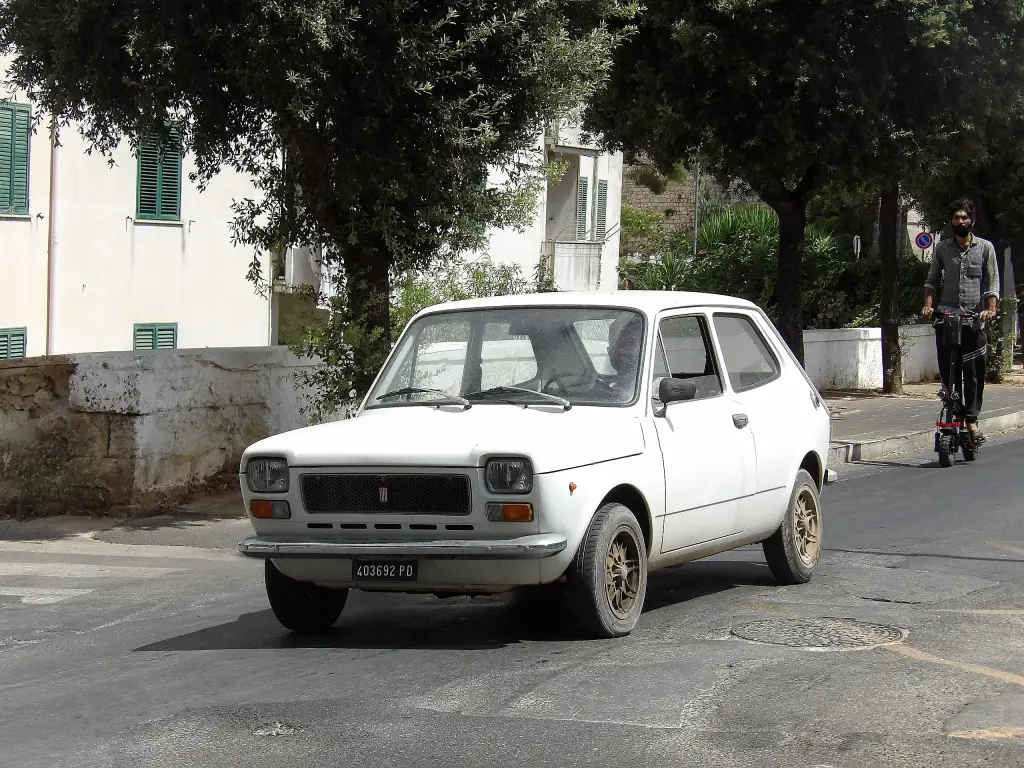
The Fiat 127 was a supermini built by Fiat from 1971 to 1983 as the replacement for the 850. Designed by Pio Manzù, it is generally regarded as one of the most influential small cars ever made, because its layout — transverse engine, end-on transmission, front-wheel drive and a hatchback — was followed by almost every B-segment car that came after it.
Fiat 127 at a glance
| Production | 1971–1983 (Italy) |
|---|---|
| Designer | Pio Manzù |
| Replaced | Fiat 850 |
| Replaced by | Fiat Uno |
| Body | two-door saloon, three-door hatchback |
| Layout | transverse engine, front-wheel drive |
| Engine | 903 cc OHV; 1,049 cc OHC from 1977 |
| Power | 50 PS in the 1,049 cc car, 70 PS in the Sport |
| Rear suspension | transverse leaf spring |
| Award | European Car of the Year 1972 |
| Millionth car | June 1974, Mirafiori |
| UK sales peak | over 20,000 in 1978 |
History of the Fiat 127
Series 1: 1971–1977
Developed towards the end of the 1960s, the 127 was launched as a two-door saloon in April 1971. A three-door hatchback with the same body profile but a full-depth rear door and a folding rear seat arrived in March 1972 and became the most popular version; it was Fiat’s first supermini-sized hatchback. The car used a state-of-the-art transverse-engine, front-wheel-drive layout with the transmission mounted on the end of the engine, both ideas already proven by Fiat on Autobianchi models — the 1964 Primula, the 1969 A112 and the A111 — precisely because those cars were not intended for large-scale production. The larger Fiat 128 of 1969 had been the first Fiat-badged car with the same transverse powertrain. The 127 used a shrunken version of the 128 platform and the rugged 903 cc OHV Fiat 100-series engine.
The 127 also had a unique transverse leaf spring rear suspension, an articulated steering column and crumple zones for progressive deformation. It was praised for its use of space, with 80 percent of the floor area available for passengers and luggage, and for its roadholding. It was the first car fitted with an all-polypropylene bumper on a steel support, won the European Car of the Year award for 1972 and became one of the best-selling cars in Europe. In June 1974, just over three years after launch, the millionth 127 left the Mirafiori plant; the Fiat 600 had needed seven years for the same total.
The Series 1 changed little. Saloons became available in standard and, in the UK, deluxe form in May 1973. The 127 Special of autumn 1974 brought a restyled grille, extra chrome, a new dashboard, carpet instead of rubber mats, reclining seats, hinged rear side windows and more standard equipment. In early 1976 the engine was revised for new emissions rules: a new carburettor and altered valve timing cost two horsepower but improved fuel economy by about ten percent.
Series 2: from 1977
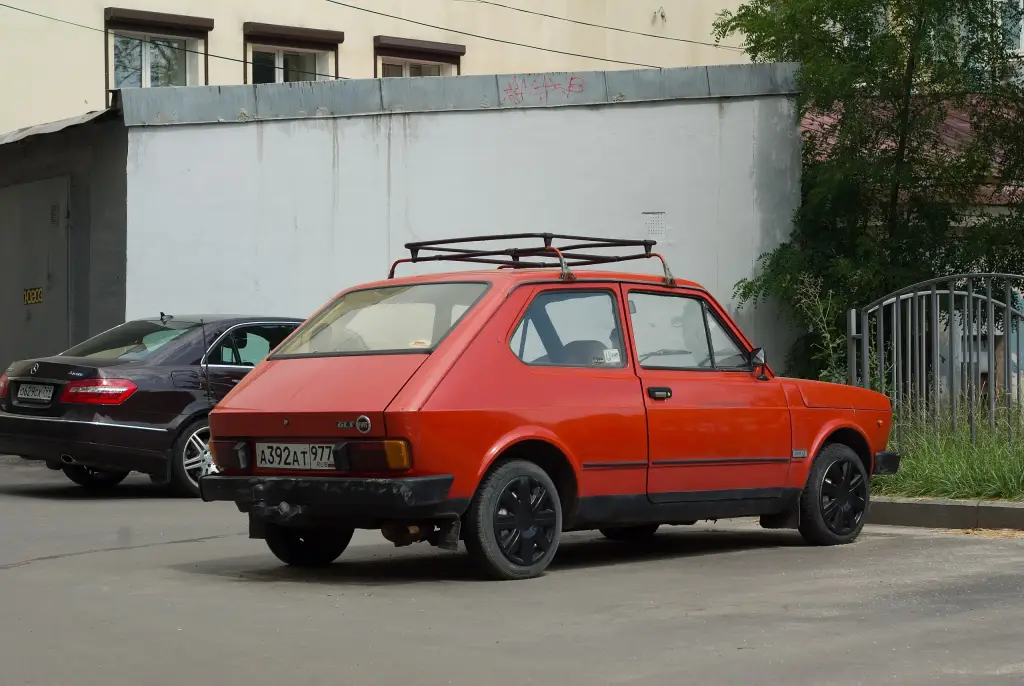
The Series 2 arrived in May 1977. The bodyshell stayed fundamentally the same, but the styling pointed towards the more angular Ritmo that would follow, with a restyled front and rear, larger rear side windows, the loss of the upswept belt line and a Hofmeister kink on the C-pillar. The new rear quarter pressings came from the Brazilian Fiat 147, without its extraction vent. A larger 1,049 cc engine of 50 PS was added — unusually for the 127, the five-bearing overhead-camshaft “Brazil” unit from the 147 rather than the 128 engine. The tailgate now reached almost to the rear bumper, answering complaints about the high loading lip, and the interior gained a plainer dashboard with cover panels beneath it. Three equipment levels were offered: L, C and CL.
A Sport model joined the range in June 1978 with a 70 PS version of the 1,049 cc engine, obtained through Abarth revisions to the cylinder head with larger valves, an Abarth exhaust and a twin-choke Weber carburettor, plus a revised final drive ratio. It had high-backed cloth seats with blue or orange piping, racing-style mirrors, a rev counter and sports wheels. Production in Italy ended in 1983 with the arrival of the Uno, although the name continued on cars imported from Brazil.
Design and features
- Supermini template: transverse engine, end-on gearbox, front-wheel drive and a hatchback.
- Space efficiency: 80 percent of the floor area was given to passengers and luggage.
- Safety work: articulated steering column and crumple zones.
- Polypropylene bumper: the first car with an all-plastic bumper on a steel support.
- Unusual rear suspension: a transverse leaf spring instead of coils.
Fiat 127 versions
- 127 two-door saloon: the original body of 1971.
- 127 hatchback: three-door with a full-depth tailgate, from 1972.
- 127 Special: better trim and equipment, autumn 1974.
- Series 2 L, C and CL: facelifted range from 1977 with the 1,049 cc engine.
- 127 Sport: 70 PS Abarth-assisted engine, from June 1978.
The 127 replaced the Fiat 850 and was itself replaced by the Fiat Uno. Its larger stablemate was the Fiat 128, and more cars are in the Fiat collection.
Sources
- Fiat 127, English Wikipedia: design, layout, series changes, engines, awards and production