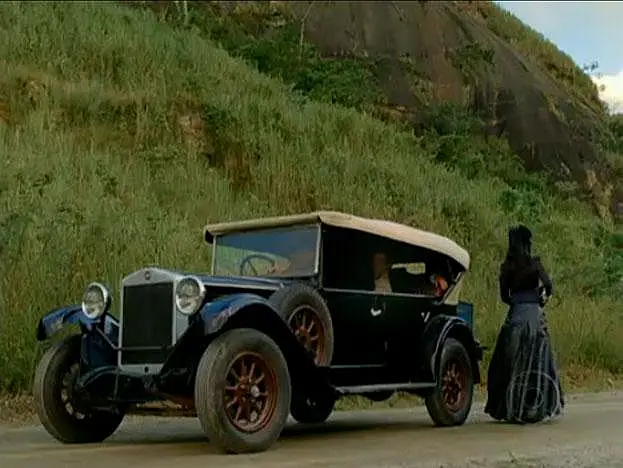
The Fiat 518, also called Fiat Ardita, was produced by Fiat between 1933 and 1938. It came with a choice of two chassis and two engines, and was also licence-built in France by Simca and in Poland by PZInż. In total 8,794 examples were built by Fiat in Italy.
Fiat 518 Ardita at a glance
| Production | 1933–1938 |
|---|---|
| Also called | Fiat Ardita |
| Bodies | four-door saloon, four-door torpedo |
| Chassis | 518 C, 2,700 mm wheelbase; 518 L, 3,000 mm |
| Engine | 1,758 cc sidevalve four, 40 PS |
| Ardita 2000 | 1,944 cc sidevalve four, 45 PS |
| Top speed | 98–100 km/h; 105 km/h in the 2000 |
| Suspension | solid axles front and rear, hydraulic dampers |
| Brakes | hydraulic drums on all four wheels |
| Units built in Italy | 8,794 |
| Licence production | Simca-Fiat 11 CV in France, Polski Fiat 518 Mazur in Poland |
Based on one source, the English Wikipedia article. No free photographs of the model were available, so the article has no photographs.
History of the Fiat 518 Ardita
The Fiat 518 was offered with two chassis of different wheelbase. The short 2,700 mm chassis was coded 518 C, for corta, and the long 3,000 mm chassis 518 L, for lunga. Two engines were available: the standard 1.8-litre unit, also known as the Ardita 1750, and a 2.0-litre version sold as the Ardita 2000. Suspension and brakes were fairly conventional, with solid axles at both ends, hydraulic dampers, hydraulic drum brakes on all four wheels and a band handbrake acting on the transmission.
The 518 L chassis was fitted with wider tyres, 5.50 by 17 inches instead of 5.25 by 17 inches, and used a different final drive ratio from the short-chassis 518 C. Both chassis were offered from the factory with four-door saloon and four-door torpedo bodies. The saloons had seven seats on the long chassis and five on the short one, six side windows, no centre pillar and rear doors hinged at the back, in the suicide style of the period.
The Ardita’s type 118 inline-four sidevalve engine had a bore and stroke of 78 by 92 mm and displaced 1,758 cc. With a compression ratio of 6.2:1 and a single Zenith 36 VIF carburettor it produced 40 PS. The saloons reached 100 km/h in 518 C form and 98 km/h as the 518 L. The Ardita 2000 used the type 118 A engine, obtained by enlarging the bore to 82 mm for 1,944 cc; with the same compression ratio and carburettor it produced 45 PS at 3,600 rpm and gave a top speed of about 105 km/h.
The Ardita Coloniale was a variant of the Ardita 2000 intended for the Italian colonies or for military use. It had larger wheels and tyres and a shorter final drive to cope with rougher ground, which reduced its top speed to 85 km/h. It was built on both wheelbases and with both saloon and torpedo bodies. The Fiat Ardita Sport was a more powerful version of the Ardita 2000 on the short 2.7-metre chassis, offered only as a four-door, four-window pillarless sports saloon with four seats and an external luggage compartment integrated into the body. It had wire wheels as standard, carried the spare wheel at the rear, and its type 118 AS engine of 1,944 cc produced 54 PS at 3,800 rpm for a top speed of 115 km/h.
Outside Italy, about 2,200 cars were built in France as the Simca-Fiat 11 CV, all with the 1,944 cc engine of 45 PS; it was Simca’s last executive car until the Vedette of 1954. In Poland the Polski Fiat 518 Mazur was produced between 1937 and 1939 by PZInż in Warsaw under Fiat licence, with four doors and five or seven seats, the two-litre Fiat 118 engine built as the PZInż 157, a four-speed gearbox, a weight of 1,070 kg and a top speed of 100 to 110 km/h. The 518-derived PZInż 302 was used as an artillery tractor by the Polish military.
Design and features
- Two wheelbases: the short 518 C and the long 518 L, with different tyres and final drive ratios.
- Two engines: a 1,758 cc four of 40 PS and a 1,944 cc four of 45 PS.
- Coachwork details: six side windows, no centre pillar and rear-hinged doors on the saloons.
- Hydraulic brakes: drums on all four wheels, with a transmission handbrake.
- Ardita Sport: a pillarless four-seat saloon with wire wheels and 54 PS.
Fiat 518 Ardita versions
- Ardita 1750: the standard 1,758 cc car on either chassis.
- Ardita 2000: 1,944 cc version with 45 PS.
- Ardita Coloniale: larger wheels, shorter final drive and 85 km/h for colonial and military use.
- Ardita Sport: short-chassis sports saloon with 54 PS and 115 km/h.
- Simca-Fiat 11 CV: French-built version with the two-litre engine.
- Polski Fiat 518 Mazur: Polish licence version of 1937–1939.
The 518 succeeded the Fiat 508 Balilla in the larger part of the range and was followed by cars such as the Fiat 521. More cars are in the Fiat collection.
Sources
- Fiat 518, English Wikipedia: chassis, engines, bodies, variants, licence production